

Prediction markets serve as instruments of collective intelligence, converting dispersed knowledge into precise probabilities on elections, economic indicators, and scientific outcomes. Today, a different force dominates their growth: sports contracts. Trading volumes now reach tens of billions of dollars monthly, and sports activity accounts for the clear majority of trades on leading platforms. This commercial success delivers liquidity and attention, not to mention company revenue, yet it simultaneously invites gambling scrutiny and regulatory pressure capable of tainting the category’s truth-seeking brand and potentially restricting the non-sports markets that still deliver genuine social value.
The transformation is already visible. Platforms have redesigned interfaces, marketing, and product features around short-dated sports events that resolve in hours. When you visit Kalshi, you are greeted with sports event markets. While the strategy produces impressive numbers, it risks redefining the sector as sports betting dressed in investment assets language.
The Scale of Sports Dominance in Current Trading Volumes
Sports event trading now comprises 80% of total volume on Kalshi and 39% on Polymarket since July 2024. Combined monthly global volume on these platforms rose from less than $5 billion in September 2025 to about $24 billion by April 2026. Sports, politics, and cryptocurrency together explain roughly 90% of activity, with sports leading on the largest regulated venue.
The 2026 FIFA World Cup intensified the pattern. Kalshi recorded $1 billion to $1.25 billion in daily sports volume during peak windows, according to the Sports Business Journal. Combined monthly volume across major venues approached $45 billion in June, a 75% jump driven largely by soccer contracts. Jefferies research placed sports at 67% to 89% of average daily volume in recent months.
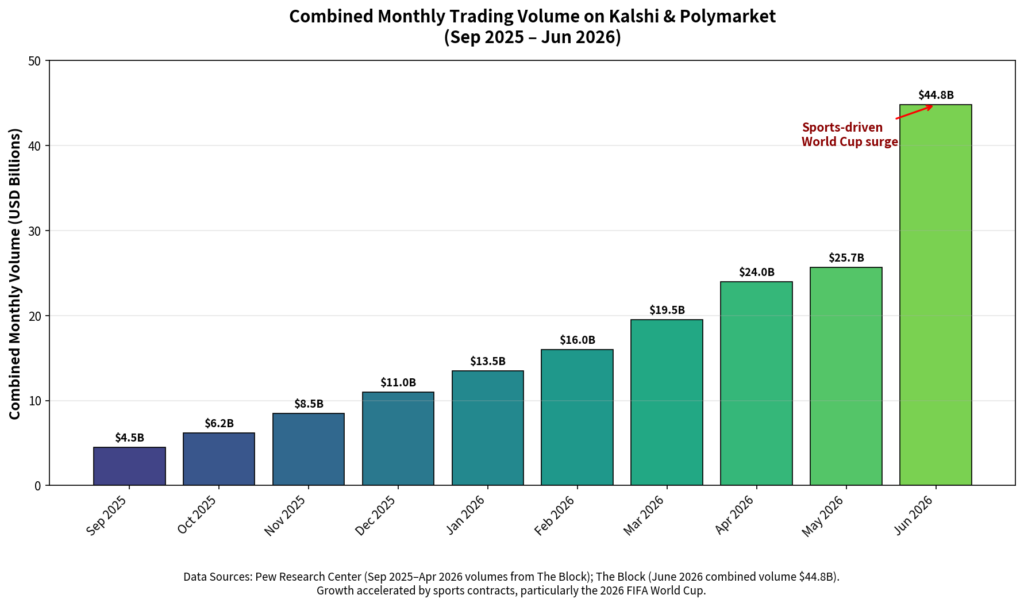
These numbers create both opportunity and risk. Sports contracts generate continuous, high-frequency trading that attracts casual users and market makers. At the same time, they pull the industry’s center of gravity toward entertainment rather than forecasting, leaving non-sports markets thinner and more exposed when legal scrutiny intensifies.
How Sports Contracts Reshaped the Product Experience
Early prediction markets emphasized binary outcomes on consequential events, largely political and macroeconomic outcomes. Sports expanded the model into near-continuous action covering game winners, point totals, player props, and now, multi-leg combinations. Interfaces now display prices in familiar sportsbook formats, and apps send live notifications timed to play.
This redesign prioritizes engagement and the excitement of the process itself. Short resolution windows reduce capital lock-up and encourage rapid turnover and churning. Emotional intensity of fandom and quick-wins drives volume far beyond what policy or scientific prediction questions can generate. Consequently, the typical user experience increasingly resembles that of a sportsbook customer rather than a forecaster seeking to add their nuanced research and expertise to consensus probabilities.
Traders at specialized forecasting gatherings have expressed discomfort. At the Manifest conference, some asked what truth-seeking value remains when athletic contests dominate activity, noting that platforms once active in those circles have stepped back as sports volume surged.
Public Perception Tilts Toward Gambling Risks
As sports contracts proliferate, public understanding has shifted. A national survey by The Harris Poll for the National Council on Problem Gambling found 45% of Americans view prediction markets as comparable to gambling, while only 27% liken them to investing. Fully 84% believe the platforms should receive consumer protections equivalent to gambling, and 82% support tools such as deposit limits and cooling-off periods. An even larger share—85%—agree that unhealthy or addictive behavior can develop around these markets.
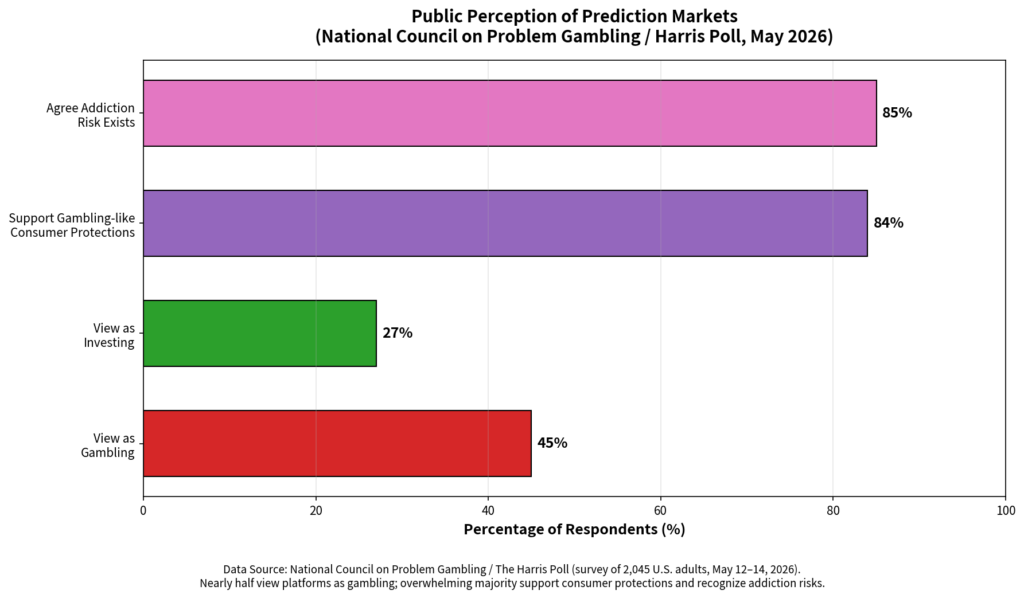
The continuous, high-stakes nature of sports trading creates variable-reward loops familiar from problem gambling. Authors of a policy forum in Science warned that commercial prediction markets now feature a “gambling-like design” raising public-health concerns. When users primarily encounter the platforms through sports props, the information-aggregation narrative loses force, and policymakers begin treating the entire category as an extension of sports betting. We’re seeing the culmination of this phenomena now in the legislative and judicial arenas.
Regulatory Pressure Centered on Sports Contracts
The sports-heavy profile has sharpened legal conflict. Multiple jurisdictions have issued cease-and-desist orders or filed suits arguing that sports event contracts constitute gambling subject to local authority rather than federal derivatives rules. Courts remain split on the preemption question, creating uncertainty that affects every product line.
Lobbying expenditures reflect the stakes. Both prediction-market operators and traditional gaming interests have increased spending as they contest the boundaries of federal versus local power. The Commodity Futures Trading Commission continues to assert exclusive jurisdiction over designated contract markets, yet coalitions keep pressing the opposite view.
If sports contracts are ultimately classified as gambling, collateral rules such as age limits, advertising restrictions, taxation regimes, or outright prohibition risk applying across all event contracts. Non-sports markets on economic data, corporate milestones, or scientific results would inherit constraints designed for an entirely different activity.
Brand Damage to the Truth-Seeking Mission
Beyond legal exposure lies reputational injury. Prediction markets built intellectual credibility by outperforming polls through skin-in-the-game incentives. Sports volume undermines that claim by flooding platforms with recreational activity whose societal value remains purely recreational compared with forecasts of policy or technological outcomes.
Marketing has adapted accordingly, emphasizing the thrill of live contests rather than probabilistic discipline. New users arrive seeking entertainment first. Over time, this composition can reduce the relative influence of informed traders who calibrate prices on harder questions. Once the category becomes synonymous with sports wagering in the popular mind, restoring the original brand grows steadily harder.
Practical Steps That Could Protect Core Value
Several measures could limit the Trojan-horse effect. Platforms might segregate sports contracts under distinct branding or interfaces, clarifying the difference between recreational and informational products. Fee revenue from high-turnover sports activity could subsidize liquidity in longer-dated, higher-value markets. Responsible-trading tools—deposit limits, session timers, and self-exclusion—could apply across the board without conceding that every contract is gambling.
Clearer federal distinctions among contract types would also help. Categories suited mainly to entertainment might face tighter limits, if not regulatory licensing state-by-state as sports betting currently operates. Meanwhile, contracts serving genuine hedging or information needs could receive lighter treatment. Transparent reporting of volume and open interest by category would allow external assessment of whether non-sports markets continue to function effectively.
The industry must decide whether sports volume is a temporary bridge to get to a higher utility forecast market or a permanent identity designed around commercial success. Treating it as a bridge requires deliberate investment in the markets that originally justified the category’s existence. Ignoring the risk invites legal rules designed for sportsbooks to reshape every event contract.
Prediction markets hold unique potential to surface accurate probabilities on questions that matter for governance, science, and commerce. That potential survives only if the sector prevents its most commercially successful product line from redefining and overwhelming its underlying utility. The sports surge has delivered capital and attention; the next decisions will determine whether those resources strengthen or extinguish the accurate forecasting core.
- Pew Research Center analysis of trading volumes and sports share
- National Council on Problem Gambling / Harris Poll survey findings
- Science policy forum on prediction markets as a public health threat
- Sports Business Journal reporting on World Cup volumes
- The Block data on June 2026 combined volumes
- Jefferies research on sports share of daily volume
- Coverage of Manifest conference reactions to sports volume
- CNBC report on lobbying expenditures
- CBS Sports overview of legal status by jurisdiction
- Pew Research Center social media summary of sports volume findings
- Bloomberg Television discussion of regulatory authority
- Odd Lots interview with CFTC leadership on regulation

The PolyPunter staff works tirelessly to bring you the latest and most insightful news, information, and tips on the fast-growing economic, financial, and social phenomenon that is prediction markets.