

AI versus Prediction Markets isn’t a fantasy digital tool sparring match, but it’s interesting to note how these two tech innovations may conflict or complement one another on their current utility and adoption trajectories.
Artificial intelligence processes vast datasets at remarkable speed while prediction markets convert real-money bets into dynamic probability signals. These two forecasting approaches stand ready to reshape how societies anticipate events from elections to technological breakthroughs. Their potential to combine creates both opportunity and important questions about dominance versus collaboration when mixing tools.
Businesses, policymakers, and individuals increasingly need accurate foresight amid rapid change. Pure AI delivers scale and pattern recognition but omits human common sense and intuition from the equation. Prediction markets supply incentive-driven updates that respond to new evidence based upon patterns of past human understanding. Both forecast through different patterns. Identifying where each excels and perhaps melding them together would yield optimized forecasting.
Where Artificial Intelligence Delivers Clear Forecasting Advantages
AI systems identify subtle patterns across news, economic data, and historical records far faster than manual methods allow. Developers train models on enormous datasets to produce calibrated probability estimates that update continuously as data inputs change or expand. This capability proves especially valuable when information arrives in high volume and requires rapid synthesis and greater precision.
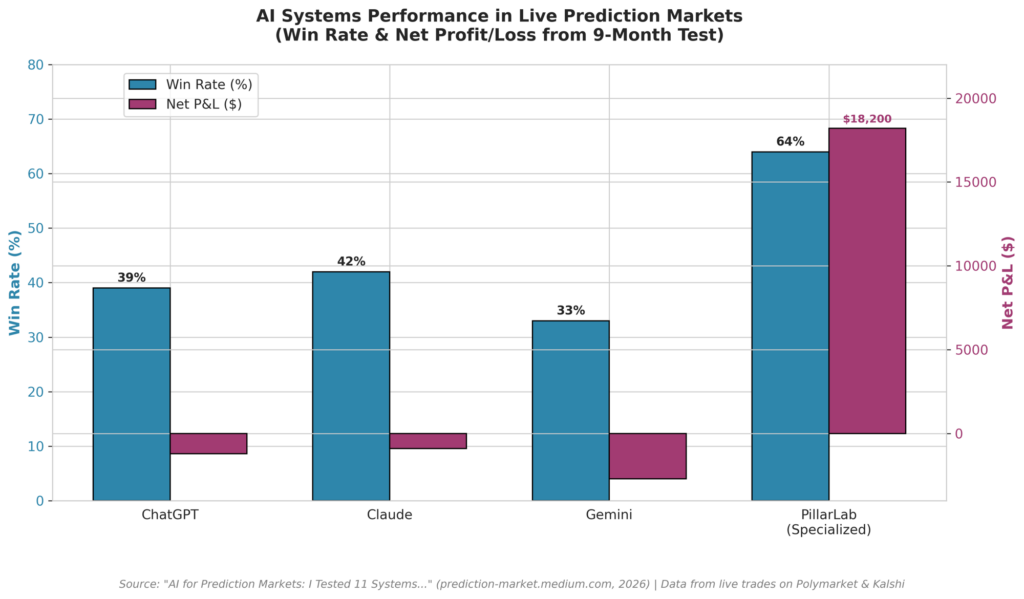
Real-world tests currently underway measure differences in performance using AI tools in prediction modeling. One nine-month experiment compared consumer models against dedicated prediction-market systems on live platforms. Generic versions achieved win rates near 39 percent and posted net losses exceeding $4,800 across dozens of trades. A specialized multi-model AI system reached a 64 percent win rate and generated substantial returns of $18,200 over 64 trades through better calibration and real-time data integration.
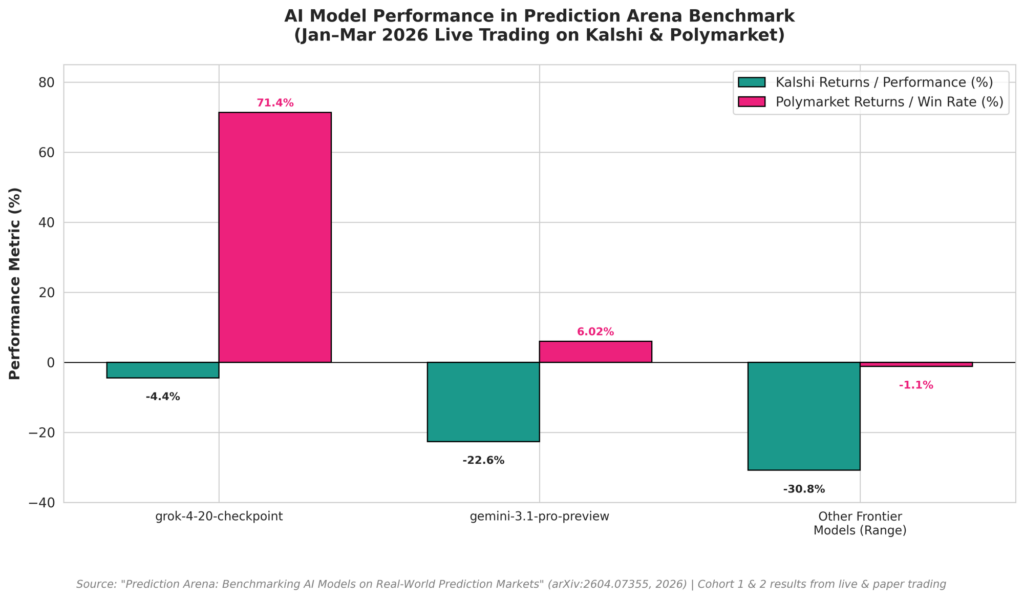
Autonomous AI agents now undergo direct evaluation in live environments. Researchers introduced the Prediction Arena benchmark to deploy frontier AI models as independent traders starting with $10,000 in capital on active platforms. Models operated under standardized prompts with research tools and position limits during a 57-day period in early 2026. Results varied, with some showing negative returns near 30 percent while others posted positive short-term performance, particularly on weather-related contracts that dominated many settlements.
Core Strengths That Sustain Prediction Markets
Prediction markets aggregate dispersed information into continuously updated prices through independent trader opinion backed by financial stakes. This structure encourages accurate revelation of knowledge because incorrect forecasts carry real costs. Markets penalize overconfidence and reward timely incorporation of new evidence more effectively than periodic surveys or polling.
Incentive alignment creates input accountability that pure algorithmic systems sometimes lack. When forecasts prove wrong, financial losses reinforce learning and calibration over repeated cycles. This feedback mechanism surfaces contrarian perspectives that might otherwise stay hidden in more traditional consensus environments. Prediction markets also enable direct hedging against specific risks, converting abstract probabilities into strategic portfolio positions.
Historical comparisons show prediction markets frequently outperforming polls and expert aggregates on major events. Their design prioritizes accuracy over volume of “expert” commentary or institutional authority, maintaining relevance even as platforms expand into corporate and scientific domains.
How AI and Prediction Markets Create Powerful Synergies
Artificial intelligence amplifies prediction markets by handling computational scale while markets supply the incentive structures that keep forecasts motivated by human ambition and reviewed by intuitive guardrails AI tools inherently lack. AI tools cluster related contracts, flag mispricings, and uncover correlated outcomes across fragmented event sets through agentic analysis of text and metadata. This discovery layer helps surface relationships that improve trading decisions and platform efficiency.
Ensemble methods combine machine outputs with market signals for stronger overall performance. AI weights historical accuracy, extracts insights from supporting rationales, and generates continuous probability distributions. Prediction markets then provide the real-money validation loop that refines the model for continuous calibration. Organizations gain continuous, hedgeable forecasts on supply chains, regulatory shifts, or competitive developments at lower cost and greater accuracy than current methods.
Structural similarities further support integration. Prediction markets function like online learning systems that update beliefs with each price movement. AI agents can therefore propose trades or supply analysis for human review while benefiting from the same dynamic learning feedback. Specialized platforms already demonstrate how calibrated AI estimates improve expected-value calculations in live conditions. The evidence isn’t overwhelming yet, but the trajectory is pointing in this direction.
Important Risks That Integration Must Address
Combining AI and prediction markets does introduce new vulnerabilities alongside benefits. Model correlation can produce herding effects when multiple systems reach similar conclusions from shared training data. These patterns risk triggering rapid price swings similar to flash moves seen in algorithmic equity trading. As more capital flows through AI-driven strategies, such dynamics require careful monitoring to ensure price shifts aren’t driven purely by mechanics.
Automation bias presents another challenge. Users may place excessive trust in polished AI reports while overlooking data limitations or execution constraints. Live benchmark results showed performance heavily influenced by platform features such as market discovery and liquidity rather than raw predictive power alone. The quality of decision-making therefore matters more than the volume of research or computational resources, and AI currently excels in the latter alone.
Information asymmetry could increase if well-resourced entities deploy advanced AI tools while others rely on basic interfaces. Transparent evaluation standards and accessible tooling help mitigate concentration risks. Responsible platform design must balance innovation with safeguards that preserve broad information aggregation.
Prediction Markets as Tools for Tracking AI Development
Prediction markets provide financial incentives for forecasting AI progress itself. Traders are placing stakes on model performance benchmarks, regulatory milestones, and broader breakthroughs such as advanced general intelligence. These contracts aggregate diverse perspectives on uncertain technological paths while forcing quantification of beliefs through market prices.
Real-time price movements deliver early signals on emerging capabilities that traditional reports may miss, and certainly can’t update with anything close to the continuous changes of the prediction markets. Markets on AI outcomes create valuable inputs for researchers, investors, and policymakers seeking to anticipate development trajectories. Hybrid systems can enhance these markets further by using AI to cluster related bets or simulate scenario impacts.
Direct betting on AI capabilities also clarifies measurement debates. Contested definitions of progress become subject to market discipline rather than abstract discussion alone among academics and wonks. Continued expansion of such specialized contracts will likely identify which aspects of technological advancement prove most amenable to incentive-based forecasting.
Building Responsible Systems for Integrated Forecasting
Successful integration depends on targeted safeguards. Platform operators can require model disclosure and stress testing for automated trading activity. Benchmarks like Prediction Arena continue refining real-capital evaluation methods that distinguish genuine predictive strength from market microstructure effects. These efforts support deployment while addressing execution risks.
Technical and governance challenges remain before seamless collaboration becomes standard. Liquidity constraints still limit effectiveness in many, if not most, prediction markets. Data privacy rules apply when models process sensitive inputs. Regulatory approaches must evolve to handle automated strategies without creating unfair advantages or stifling useful innovation.
Ethical considerations deserve ongoing attention. Overreliance on correlated AI systems could amplify errors during periods of high uncertainty. Transparent standards make model strengths and weaknesses visible to all users who care to follow these disclosures (and they should). Active development of agentic tools for market clustering already points toward workable solutions.
Investment in supporting infrastructure accelerates progress. Improved APIs, standardized benchmarks, and open evaluation frameworks help connect the two fields. Collaboration among platform developers, AI researchers, and market designers reduces fragmentation while protecting the distinct advantages each side contributes. These steps move forecasting toward integrated systems that serve broader societal needs.
The most promising future combines the scale of artificial intelligence with the incentive discipline of prediction markets. Organizations that adopt hybrid systems position themselves for the best competitive positioning.
References
- Prediction Arena: Benchmarking AI Models on Real-World Prediction Markets. https://arxiv.org/abs/2604.07355
- AI for Prediction Markets: I Tested 11 Systems and One Crushes the Rest. https://prediction-market.medium.com/ai-for-prediction-markets-i-tested-11-systems-and-one-crushes-the-rest-22ac70bbe5fa
- Prediction Markets Are Evolving Into AI-Powered Foresight Systems. https://www.linkedin.com/pulse/prediction-markets-evolving-ai-powered-foresight-systems-falls-ehhxe
- Risk Managing Prediction Markets. https://www.galaxy.com/insights/perspectives/risk-managing-prediction-markets
- Can AI Superforecasters Make Millions… Or Crash The Market? https://www.youtube.com/watch?v=-322bwe4oNQ
- Artificial Intelligence in Prediction Markets: The Case of Polymarket. https://medium.com/demistify/artificial-intelligence-in-prediction-markets-the-case-of-polymarket-5f45aed6c8d5
- Noya.ai: Agents in Prediction Markets. https://medium.com/@0xjacobzhao/noya-ai-agents-in-prediction-markets-090104ab781f
- Agentic AI for Clustering and Relationship Discovery in Prediction Markets. https://arxiv.org/abs/2512.02436
- Prediction Markets: Regulation, risks, and areas of research. https://aibm.org/policy/prediction-markets-regulation-risks-and-areas-of-research/
- Advancements in machine learning for stock price forecasting. https://pmc.ncbi.nlm.nih.gov/articles/PMC12835427/