

If you haven’t been watching major news channels in the past year, you’ve missed major media outlets moving away from citing polling data to build into news stories and instead utilizing Kalshi or Polymarket prediction market data. Some of this is due to the growing popularity of prediction markets; some arises from new formal partnerships; and for independent outlets and podcasters, it often involves paid sponsorship deals.
Prediction market odds now flash across news screens and tickers with growing frequency. They are often the very center of major stories. These prediction market probabilities reflect traders wagering on future events. They are inherently speculation. Presenting them as definitive forecasts creates collateral risk for outlets that treat these figures as gospel.
The Rise of Prediction Market Data in News Coverage
Major news organizations have integrated live prediction market feeds into election coverage, economic updates, and geopolitical event reporting. CNN added widgets from one prediction market platform during key cycles. The Wall Street Journal distributes similar data through its parent company. Bloomberg incorporated pricing information into its terminals earlier, encouraging others to follow.
Newsrooms adopt these visuals because they update continuously and capture attention in fast digital environments. However, this adoption often occurs without full explanation of how the numbers arise or what biases they may contain. Laypeople’s understanding of polling data is fairly high, given the long history and the fact that most people have participated in one poll or another. But the mechanics of prediction remain largely unknown in 2026. A review of any posted news item based on prediction market data reveals that the knowledge required to put these market probability figures into context is quite low.
Why These Prices Draw Journalists Seeking Quick Insights
Beyond their true informational value, prediction markets draw interest from the media sector because they are both “in the now” in terms of popularity and present easy-to-share, easy-to-consume numbers. Presenting: “This candidate has a 67% probability of winning the election” is an incredibly direct way to boil down a complex interaction of large amounts of data into a single, visible number. In contrast to detailed polls or cautious commentary, it fits neatly into graphics, alerts, and short segments. It’s perfect for modern soundbite media.
Journalists, and often their producers or editors, value the real-time nature of market numbers during breaking developments. Still, the underlying process by which forecast markets reach consensus probabilities is a bit like making sausage. And perhaps most people don’t care to know those details, but in the details lies a far more educated understanding of the net product.
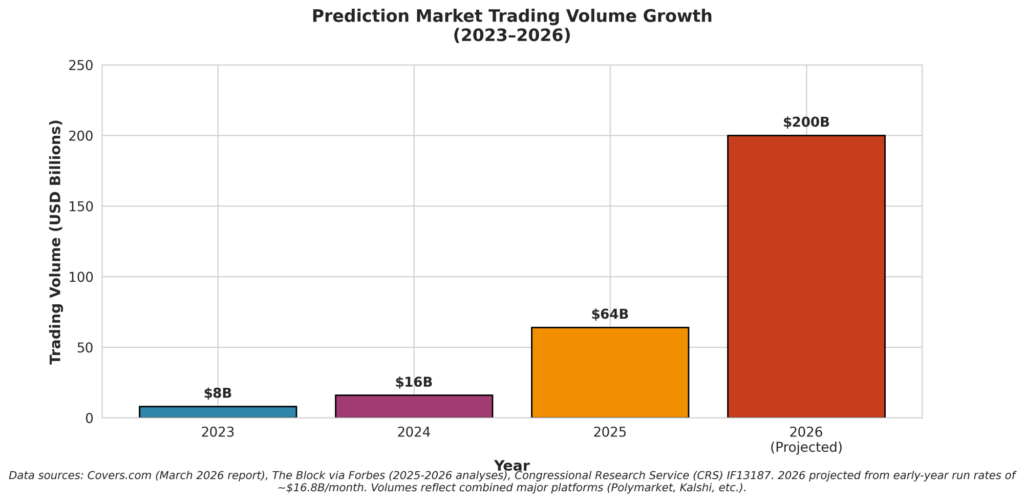
Prediction market probabilities are framed as market-going prices, formed by supply and demand among unknown traders who place informed wagers, rather than by controlled sampling. Large trades or concentrated activity can shift values sharply even when other evidence contradicts the move. This is especially true in thinner markets, where a single trade can dramatically shift probabilities, even when no new information has arisen to justify such a change. Media that displays shifts without context risks elevating trading activity to the level of established fact.
The media can create self-reinforcing loops that later prove wrong. Outlets report prediction market prices as reliable momentum indicators, leading to actual results surprising their very same audience. These patterns have appeared in recent election cycles, in which live probabilities received prominent placement. Sudden price changes sometimes framed stories as voter shifts when trading concentration or liquidity actually played larger roles. ProPublica revised its ethics guidelines to avoid treating such figures as neutral equivalents to verified reporting. The organization emphasized protecting reader trust by not equating betting-derived data with traditional sourcing.
This potential to mislead the public would hold even if we understand that prediction market forecasting in areas such as elections has proven more accurate than traditional polling.
Risks of Manipulation That Media Can Amplify
Prediction markets with high liquidity and volume are relatively safe from simple manipulation. As with any large market, individual trades, even large ones, tend to have minimal impact on the whole. But prediction markets are prone to distortion when large positions can temporarily move prices, which is the underlying case in the majority of open prediction markets at any given time. News tickers that broadcast these movements without noting trading patterns can spread trading-rooted signals, including intentionally manipulative strategies, rather than broad information. Insider activity adds concern, as cases involving non-public details have led to successful wagers on geopolitical contracts.
Platforms listing contracts on disasters or conflicts raise further issues. Heavy trading during unfolding events may create incentives misaligned with accuracy or safety. When outlets embed prices in real-time updates without strong disclaimers or deeper education on the numbers, they risk lending credibility to these dynamics. Consequently, audiences receive visuals that appear authoritative while resting on potentially fragile foundations. While there’s a general assumption among the public that media pundits present their personal opinions, the presentation of data is often seen as far more objectively factual.
You can’t argue with the data.
How Overreliance Undermines Standards and Trust
Audiences begin to view prediction market prices as near certainties when outlets display them prominently alongside other data. This framing blurs the line between aggregated trader views and verified evidence. Repeated use normalizes probabilistic visuals as superior to slower verification processes. What does Polymarket say?
Partnerships between platforms and newsrooms introduce conflicts when payment or data access ties to prominent placement. Readers would benefit from clear disclosure of these sponsored or partnership arrangements, though such disclosure is rarely provided. Without it, coverage can resemble promotional material more than independent analysis. Over time, this pattern reduces appetite for nuanced reporting that highlights uncertainty. This move toward highly summarized news hardly began in modern journalism with the rise of prediction markets.
Journalists should present market data as one supplementary signal rather than a standalone source. Pairing any cited price with polling, on-the-ground details, and historical context adds much-needed context, especially in the absence of any tutorials on how prediction markets work. Precise phrasing, such as “the market-implied probability from one trading platform,” would help audiences understand the inherent limits of the data presented.
Newsrooms, like ProPublica, will benefit from internal guidelines that require evaluating whether a prediction market price adds value or merely provides a convenient visual cue. Training on market mechanics, liquidity effects, and past manipulation attempts would prepare news staff to question figures before publication.
Why Careful Handling Matters for Public Information
Citizens rely on truth-seeking journalism to separate reliable signals from noise. Prediction markets surface traders’ convictions backed by capital and have proven to be more reliable forecasting methods than many previously used methods, yet they cannot replace verification and context. When the media elevates prices without context and disclaimer, it contributes to environments in which spectacle overshadows substantive journalism.
The pressure intensifies as volumes grow and integrations expand. Platforms will continue to seek media exposure because coverage of prediction markets attracts new users. Outlets that maintain restraint protect both professional standards and the audiences they inform. This is the ideal, though not necessarily expected in modern journalism, with reduced budgets and increased pressure for clicks and viewers.
References
- Santa Clara University Markkula Center for Applied Ethics: Prediction Markets, News Reporting and Ethical Stakes
- ProPublica Ethics Code Update on Prediction Markets
- Wikipedia: Prediction market
- Stanford News: Prediction markets are surging – here’s what you need to know
- Forbes: How Prediction Markets Actually Grew In 2025
- The Fix: Prediction markets are muscling into journalism in America
- Congressional Research Service: Prediction Markets: Policy Issues for Congress
- FinancialContent: How Prediction Markets Are Redefining Mainstream Media
- Covers: Prediction Market Volume Quadrupled in Past 2 Years
- Trade the Outcome: Prediction Markets in 2025 Data Stats & Key Trends