

At PolyPunter, we are passionate about prediction markets. Not the platforms, but the tool itself and how prediction market mechanics can benefit the greater world at large. We attempt to bring you news and stories that cover how. This once-academic theory is applicable to all manner of real-world solutions. Not always perfect solutions, but improvements over existing methods.
Business leaders are constantly searching for sharper tools to forecast business outcomes and guide strategic decisions. Prediction markets stand out because they convert dispersed employee knowledge into tradable probabilities backed by stakes, whether financial or other tangible incentives and rewards. Companies that experiment with these types of systems, whether internally or through external platforms, often uncover more reliable signals for resource allocation and strategy.
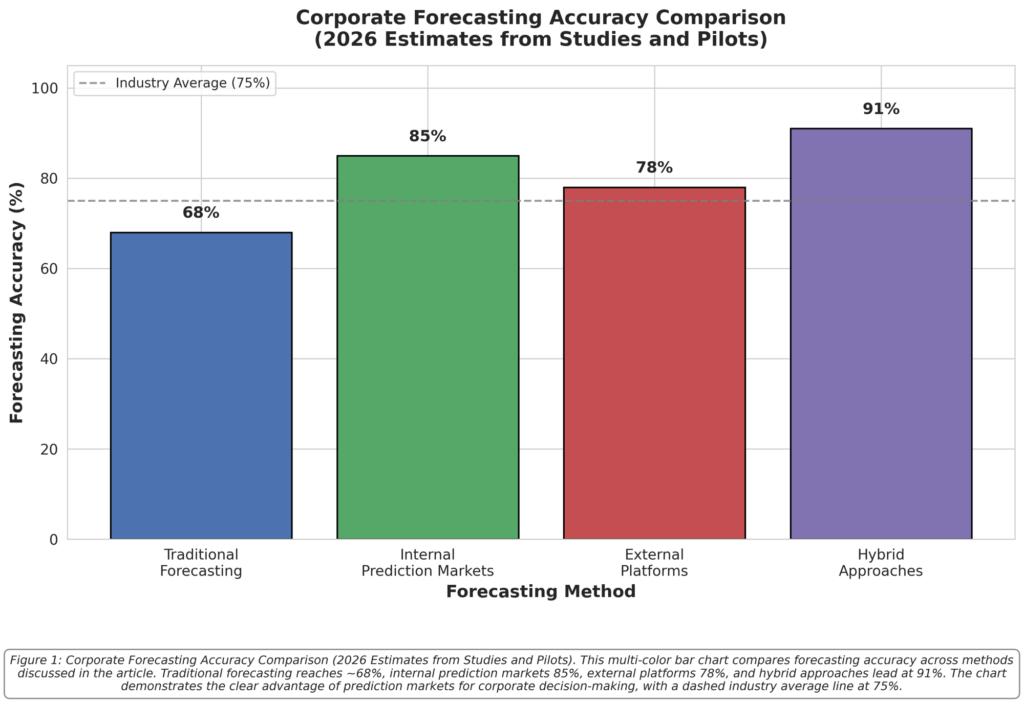
Enhancing Corporate Forecasting Accuracy with Prediction Markets
Traditional company forecasting methods frequently rely on surveys or top-down input, which can be greatly affected by organizational biases and suppress dissenting information. Prediction markets shift the process by allowing eligible employees or other related parties to trade “shares” on specific outcomes such as sales targets or product success. Resulting prices aggregate beliefs across the organization and create a live probability gauge. Consequently, many firms find that these employee market forecasts outperform conventional estimates.
Employees closest to operations contribute unique insights; financial or reward incentives encourage honest answers rather than safe ones. Sales teams understand demand patterns while technical product staff assess feasibility. When these insights enter the market, prices adjust dynamically, providing timely guidance for budgeting or investment decisions. The prediction market system reduces overconfidence or “flattery” because losses directly punish inaccurate views.
Companies can reduce costly misallocations by incorporating these signals early in the planning process. Clear eligibility rules and specific event definitions remain essential to sustain credibility.
Unlike polls, surveys, or direct managerial input at planning meetings, markets support continuous updates as new data emerge, rather than static annual projections. This ongoing quality proves valuable in industries where conditions evolve rapidly and updating key decisions has to be on a dynamic timeline. Decision-makers who monitor price shifts can pivot strategies before problems escalate, as documented in formal reports. Overall, the approach builds a democratized corporate culture that values evidence over hierarchy.
Have you ever been a part of a company that profusely claims to value your input, but then never seems to ask for it? This is a solution to that most often ignored promise of broad employee participation in decision-making.
Lessons from Past Corporate Experiments with Internal Markets
Early corporate trials demonstrated the practical strengths of internal prediction markets. Hewlett-Packard conducted one of the pioneering efforts focused on printer sales forecasts in the early 2000s. Market prices closely aligned with actual results and sometimes exceeded official company projections. Those outcomes prompted other organizations to test similar approaches for demand planning and project timelines.
Technology firms later explored markets around feature adoption or merger completion probabilities. Employees nearest the relevant data revealed patterns with their expected probabilities that standard meetings often missed. Leadership teams therefore received earlier warnings about potential shortfalls. Scale proved critical because thinly traded markets quickly lose reliability.
Unlike these early test trials, contemporary platforms simplify replication through automated settlement and compliance features. Firms can now launch restricted internal versions or blend signals from regulated external exchanges. Older manual systems required heavy oversight, which limited their frequency. Modern tools enable ongoing forecasting instead of occasional exercises.
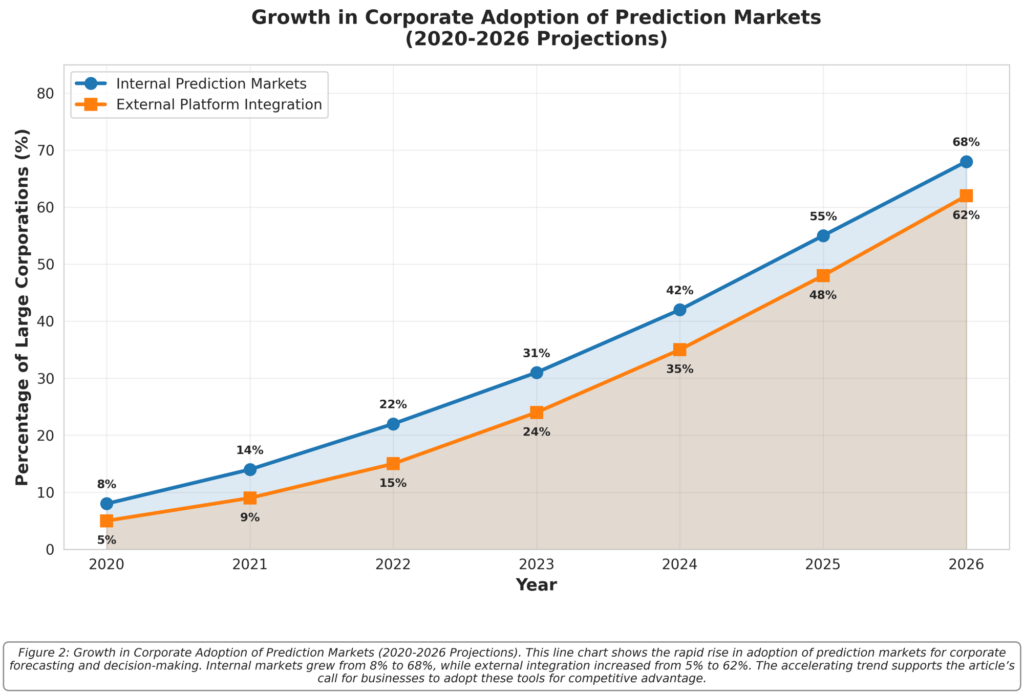
Best Practices for Companies Adopting These Tools
Effective programs could start with small pilots for low-risk events to refine mechanics and gather feedback. As wth any prediction market, precise outcome definitions prevent later disputes during settlement. Independent oversight committees that include legal and compliance perspectives build early credibility. These foundations help employees view the system and its tangible incentives as legitimate and fair.
Some organizations combine external price data with internal markets under controlled conditions. This hybrid model captures broader liquidity while keeping core company events tightly managed. Decision-makers receive richer inputs without unnecessary exposure.
Successful implementations treat prediction markets as one valuable input alongside other methods rather than a standalone solution. Company executives can continue applying judgment and context when interpreting prices. This layered strategy captures benefits while limiting overreliance on any single source. Firms that codify these practices can scale these prediction markets more easily.
Combining Prediction Markets with Emerging Technologies for Superior Decisions
Artificial intelligence can scan trading activity in real time to flag anomalies or emerging shifts in consensus. Models trained on historical market data help refine resolution accuracy.
Blockchain platforms increase transparency in settlement and reduce arguments over outcome verification. Smart contracts trigger automatic payouts once trusted data confirms results. Administrative costs drop, and feedback loops accelerate for strategy teams. Immutable blockchain records further strengthen compliance documentation. Every transaction is preserved.
Visual dashboards can convert price movements into clear, actionable insights for executives who cannot constantly track markets. Threshold alerts would notify teams when probabilities cross strategic benchmarks. The combined system creates living forecasts rather than the periodic snapshots traditionally used by most company managers.
Why Businesses Must Act Now to Embrace This Forecasting Revolution
Legacy forecasting methods often lag behind events in this modern digital age. Prediction markets provide a tested way to distill scattered knowledge into actionable probabilities. Organizations that begin experimenting now develop internal capabilities ahead of their competitors.
Employee engagement will rise when firms demonstrate respect for on-the-ground insights through tangible incentives. This cultural change aids retention of talent who now feel directly involved in company decision-making. Their voices are being heard. Retention of talent in this age is a massive problem for most companies.
Prediction markets represent more than a technical upgrade. They reflect a commitment to transparency and accountability that strengthens organizations internally. Businesses prepared to manage the associated challenges position themselves for stronger performance amid natural volatility.
References
- CNBC report on insider trading concerns and corporate policy responses regarding prediction markets.
- Congressional Research Service overview of prediction markets policy issues.
- Atlantic Council analysis of manipulation risks in prediction markets.
- Polymarket platform for examples of event contract trading.
- Kalshi regulated prediction market exchange.
- Industry discussion on the future of prediction markets, including potential business applications.