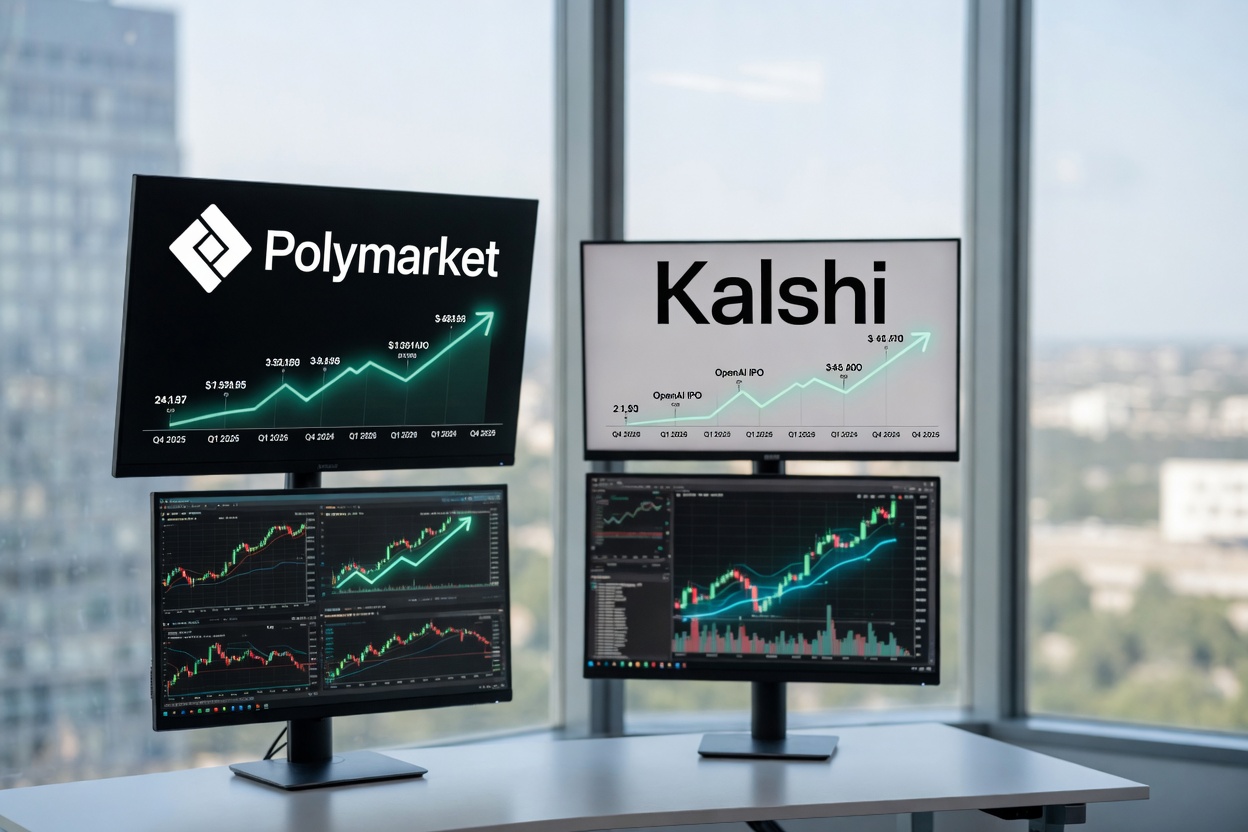
One question we get asked often at PolyPunter is about arbitrage. It sounds French and complicated, but it’s really not.
In simplest terms, arbitrage means the price of a specific good at one store differs from the price at the store next door, so you can buy it at the cheaper place and walk next door to sell it at the higher-priced store. Now, if you have to walk many miles to do this, probably not worth it. But what if it’s instantaneous and the push of a button on your laptop? You could pay $1,000 on the cheaper market, push a button, and sell it for $1,050 on the more expensive market. That’s arbitrage.
Arbitrage fun fact: The word “arbitrage” was first defined in its modern financial sense by the French mathematician Mathieu de la Porte in 1704. He used it to describe the evaluation of different exchange rates to determine the most profitable location for issuing or settling a bill of exchange.
Sharp prediction market traders spot and capitalize on persistent price gaps between Polymarket and Kalshi event contracts. These cross-platform discrepancies have intensified around high-profile tech events, such as OpenAI’s IPO timelines. Differing crowd assessments across platforms create actionable spreads that savvy market participants can exploit. That’s arbitrage.
Understanding Cross-Platform Price Discrepancies Driving Current Trades
Traders frequently encounter contracts on identical or near-identical event outcomes priced differently across the two leading venues. When one platform values a Yes share at 70¢ while the other values the corresponding No share at 55¢, combining positions can guarantee a profitable outcome. This is, of course, before fees and slippage, which are going to eat at least somewhat into your profit margin. Therefore, the price differences must be large enough to generate a profit that justifies the purchase.
Especially so on event outcomes that may have longer time horizons. How long would you lock up your money for a 3% guaranteed return? At some point, a guaranteed interest payment on a bank CD might be the same.
This arbitrage dynamic has played out vividly in recent weeks, with OpenAI-related markets offering some of the widest gaps.
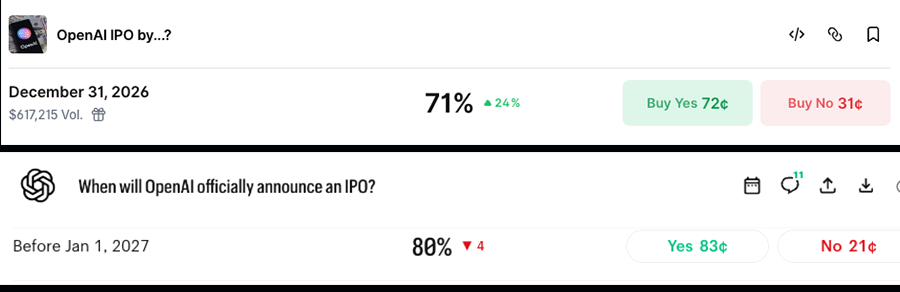
Polymarket draws global interest, pushing probabilities that often differ from Kalshi, which reflects more regulated domestic flows that sometimes diverge from the global trading market. Traders who monitor both similar markets on each platform simultaneously position themselves to buy low on one side and hedge high on the other, effectively neutralizing directional risk while capturing the difference.
Recent OpenAI IPO Market Spread Examples
| Event | Polymarket Price | Kalshi Price | Potential Combined Edge (Pre-Fees) |
|---|---|---|---|
| OpenAI IPO by Dec 31, 2026 (Yes) | 67¢ | 79¢ (equivalent timing) | Up to 12¢ spread on paired positions |
| OpenAI Announces IPO Before Nov 2026 | ~60-70¢ range | 81¢ | 8-15% locked return potential |
| OpenAI vs Anthropic IPO First | OpenAI favored ~76¢ | Similar but 4-6¢ variance | Arbitrage via opposing legs |
These figures, drawn from live market snapshots on May 31, 2026, demonstrate how traders actively scan for misalignments that deliver positive expected value with minimal net exposure. Because the contracts resolve to the same real-world event outcome, the price difference represents pure market inefficiency waiting to be exploited.
Fully legal. Fully legit. Fully arbitrage.
How Traders Execute Polymarket Kalshi Arbitrage in Practice
Like a superior athlete, successful arbitrage requires speed and coordination. To that end, many traders now employ custom scripts or bots that scan thousands of overlapping markets, alerting them when spreads exceed transaction costs. Once identified, they open the cheaper leg on one platform and the offsetting position on the other, aiming to execute within seconds to minimize slippage (the price differential between listed prices and the price when the trade actually completes).
Consider a typical flow: a trader buys Yes shares on the lower-priced venue for an OpenAI IPO milestone while simultaneously taking the No side, where the No side trades at a richer price. Even after modest platform fees, often under 1% on Polymarket for tech categories and built into Kalshi pricing, the net position yields a guaranteed profit percentage if held to resolution. Volume data show sophisticated accounts repeatedly executing these paired trades across platforms.
Broader Implications for OpenAI IPO and Tech Event Trading
OpenAI IPO contracts have emerged as arbitrage hotspots due to intense public interest and frequent news coverage of valuation and timing. Polymarket assigns roughly 67-70% probability to an IPO by year-end, while Kalshi traders push higher figures in certain windows. The resulting gaps invite capital to flow toward equilibrium.
Arbitrage serves a real purpose beyond just guaranteeing profits for some large investors. It helps to balance pricing between markets. These gaps get smaller and smaller as more and more traders exploit them. Hence the need for speed.
This video breaks down live examples of how to spot and execute cross-platform trades.
Challenges and Risks Traders Face in Arbitrage
Execution remains the primary hurdle for successful arbitrage on prediction markets. Liquidity varies by time of day and event popularity, sometimes causing partial order fills that erode the projected edge. Because the profit margins from this process are often small, you need to buy a fairly large position to really earn any sizable amount of profit. And that isn’t always available in the markets where you’re noting these gaps.
Fees, withdrawal limits, and platform-specific capital requirements also factor into net profitability. Sudden news events can shift prices dramatically before both legs complete. So there is always some risk. Automated trading bots help with this. Don’t get coffee in between the paired trades.
Regulatory considerations add another layer, particularly for traders balancing accounts on differently structured venues. Yet those who manage these variables report consistent monthly returns that outperform directional bets in volatile sectors.
Future Outlook for Polymarket Kalshi Price Convergence Strategies
As more capital flows into event contracts, cross-market spreads may narrow overall, yet new events and breaking developments will continually create fresh openings. Traders who build robust monitoring systems and maintain constant presence on both platforms stand to benefit most. The OpenAI IPO saga, with its multi-month timeline, promises ongoing opportunities for arbitrageurs. More French.
References
- Polymarket vs Kalshi Arbitrage Guide 2026
- Polymarket Kalshi Arbitrage Trading Bot Guide
- OpenAI or Anthropic IPO First Odds
- Polymarket OpenAI IPO by the end of 2026 Market
- Kalshi OpenAI IPO Announcement Market
- Kalshi vs Polymarket Comparison