
Prediction markets’ oil price bets have surged dramatically as participants respond to heightened geopolitical volatility affecting global energy flows. Traders commit substantial capital to contracts forecasting crude benchmarks and shipping recoveries through critical routes on platforms like Polymarket and Kalshi.
These event-driven markets deliver real-time pricing on supply disruptions with remarkable precision. Activity levels now rival peak periods, as fresh developments trigger rapid shifts in positions. Bettors leverage every headline to adjust probabilities on oil thresholds and transit timelines.
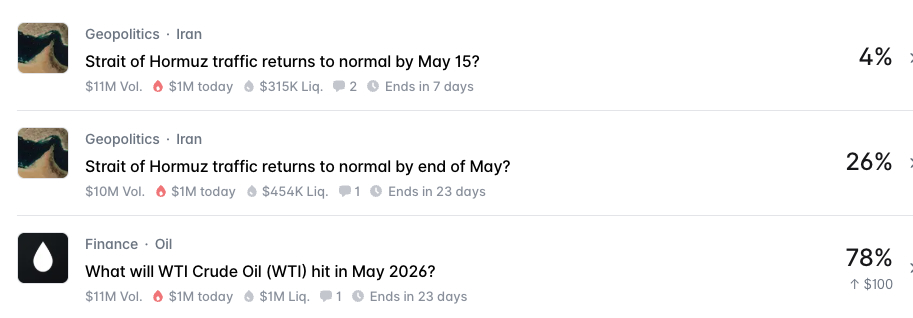
High-volume contracts tied to crude reaching specific targets dominate daily turnover. Participants’ prices elevated the chances of WTI hitting $100 in May, alongside longer-term bets on $120 or higher. This intensity demonstrates how prediction markets oil price bets transform uncertainty into tradable opportunities. Volumes continue to climb as risk premiums are deeply embedded in contract pricing across categories.
Oil Price Prediction Markets Capture Billions in Trading Volume During Volatility
Contracts linked to crude benchmarks that have climbed key levels have generated hundreds of millions in activity. Bettors assign a 79 percent probability to WTI crude reaching $100 during May, while separate markets evaluate the odds of Brent exceeding $120 by year-end.
Participants continuously monitor supply chain signals to refine positions ahead of shifts. The resulting data provides clear snapshots of collective expectations on energy prices. Prediction markets, oil price bets, therefore, serve as dynamic tools for navigating persistent uncertainty.
Consequently, volumes on related contracts spike whenever diplomatic or supply updates emerge. One venue recorded more than $950 million in wagers on oil direction in a compressed timeframe, according to Reuters. Traders shift capital swiftly between outcomes as information flows. The process creates tightly calibrated forecasts that reflect real-time developments.
Top Oil Price Contracts and Implied Probabilities in Prediction Markets
| Contract Description | Current Implied Probability | Recent Trading Volume |
|---|---|---|
| WTI Crude Hits $100 in May | 79% | $88 million+ |
| Brent Crude Exceeds $120 by Year-End | 63% | $425 million+ in cluster |
| Crude Surpasses Previous Wartime Highs | Over 50% | Multi-platform aggregate |
| All-Time Crude High by Specific Date | Variable daily | Part of $21B monthly totals |
Geopolitical Volatility Drives Record Activity in Shipping Recovery Prediction Markets
Contracts focused on vessel traffic returning to normal levels have attracted more than $36 million in single-resolution timelines, according to Polymarket data. Traders price only 22 percent odds of full recovery by late April, with longer-dated options hovering near 50 percent by July. Participants analyze satellite feeds and port statistics to sharpen their edges. The conservative probabilities reveal widespread caution regarding quick resolutions amid ongoing tensions. Prediction markets shipping contracts, therefore, highlight deep skepticism about rapid normalization.
Monthly transit volume markets on leading platforms have surpassed $7 million as bettors debate weekly averages above key vessel counts. Activity accelerates with each new incident or signal from involved parties. The interconnected contracts allow sophisticated layering of exposure across timelines. Volumes remain robust because participants treat these tools as precise trackers of energy supply chain health on Kalshi.
Broader analysis from TRM Labs confirms that shipping-related prediction markets now rank among the top categories during elevated-risk periods. Capital flows freely between oil price bets and route recovery contracts as events unfold. The combined activity produces comprehensive views on global commodity impacts.
Watch: How Prediction Markets Track Oil and Geopolitical Volatility
Ceasefire Contracts Fuel Rapid Adjustments in Prediction Markets Oil Price Bets
Participants have placed hundreds of millions on timing and the likelihood of agreements that could ease energy pressures. One high-profile contract on ceasefire outcomes before specific oil thresholds generated $283,000 shortly after listing. Bettors assign strong short-term probabilities while displaying caution on extended horizons. The swift volume reflects how diplomatic signals immediately influence positioning. Prediction markets ceasefire contracts therefore move in tight correlation with oil benchmarks.
Platforms record intraday swings that mirror real-world developments in energy corridors. Traders recalibrate probabilities with every official statement or report. This feedback loop enhances the overall information quality embedded in prices. Activity stays elevated because resolutions carry direct portfolio consequences according to recent multi-billion-dollar trade analyses.
Clusters of related contracts amplify engagement as bettors seek comprehensive exposure. The interplay between ceasefire timing, oil levels, and shipping flows creates layered trading opportunities. Prediction markets’ tools for geopolitical volatility reward those who process information fastest.
Broader Energy Contracts Amplify Momentum in Prediction Markets During Uncertainty
Contracts on downstream commodities and secondary effects have joined the surge as participants build diversified positions. Bettors evaluate probabilities around fertilizer costs, tanker rates, and related impacts from disrupted passages. The tightly linked outcomes drive capital rotation across categories in rapid succession. Activity, therefore, stays consistently high across energy security prediction markets.
Recent aggregates show geopolitical clusters pushing single-day volumes to new records. Participants combine satellite data with futures correlations to identify edges. The approach yields forecasts that many view as more responsive than conventional sources. New capital continues to enter these prediction markets, with oil price bets driven by compelling action.
Watch: Oil Price Shocks and Prediction Market Trading Strategies
Private-sector expectations often lag public-market pricing, with many insiders citing later timelines for stabilization. This divergence generates additional trading opportunities as participants arbitrage differing viewpoints. The ecosystem thrives on persistent uncertainty that keeps volumes elevated.
Volume Patterns Show How Prediction Markets Price Supply Risks Effectively
Industry reports document a 2,800 percent increase in activity in early 2026, driven primarily by energy- and route-related contracts. Geopolitical developments now lead daily turnover across platforms, according to TRM Labs research. Participants reallocate swiftly across linked outcomes with each new signal. The repeating pattern underscores the responsiveness of prediction markets’ oil price bets.
Consequently, open interest rarely falls from record levels when algorithms capture small-probability edges. The growing sophistication improves aggregate forecast quality. Markets function as powerful aggregators of dispersed knowledge on global energy dynamics. Additional contracts on record highs and weekly metrics draw continuous fresh capital.
Participants layer these bets alongside traditional instruments to maximize exposure. The strategy heightens the impact of each resolution on overall performance. Activity shows no signs of slowing while underlying tensions persist.
Prediction Markets Deliver Real-Time Insights Into Energy Security Amid Volatility
Collective wagers now exceed many traditional indicators in both speed and precision. Contracts price 63 percent odds of Brent reaching $120 versus more moderate targets. Direct financial incentives compel participants to forecast accurately. The resulting prices provide valuable reference points for assessing broader risks. Prediction markets’ coverage of geopolitical volatility compresses complex signals into clear probabilities.
Weekly shipping window contracts have accumulated substantial volume on shorter timeframes via Kalshi weekly transit markets. Bettors scrutinize live data feeds to inform rapid decisions. The mechanism turns raw statistics into actionable market insights within hours. Overall, these tools create living forecasts that evolve continuously as events unfold.
The sustained surge illustrates how participants convert abstract risks into concrete trading positions. Each development triggers immediate repricing across dozens of interconnected contracts. The ecosystem rewards speed and accuracy while punishing delays. Passion for these dynamic markets runs strong among active users tracking commodity flows.
References
- Oil-price bets ahead of Iran war news totalled $7 billion
- Strait of Hormuz traffic returns to normal by the end of April on Polymarket
- TRM Labs Report on $21B Monthly Volume
- Kalshi Strait of Hormuz Normalization Markets
- Polymarket Oil Predictions
- 22% Chance of Strait Recovery by End of April
- Polymarket Strait of Hormuz by the end of May
- Prediction Markets Expect Prolonged Strait of Hormuz Disruption