Traders continue to flood nuclear deal prediction markets with substantial capital as probabilities shift on key timelines for a US-Iran agreement. These geopolitical betting contracts reflect evolving diplomatic signals and persistent uncertainties in high-stakes negotiations. Market participants adjust positions rapidly whenever fresh reports surface from ongoing talks.
Consequently, odds swing dramatically within short periods. Volumes on select nuclear pact contracts now exceed multiple millions as participants seek precise forecasts. The intensity highlights how these events drive passionate engagement among those tracking real-time developments in prediction market platforms.
US-Iran Nuclear Agreement Odds Climb on Kalshi and Polymarket Amid Diplomatic Signals
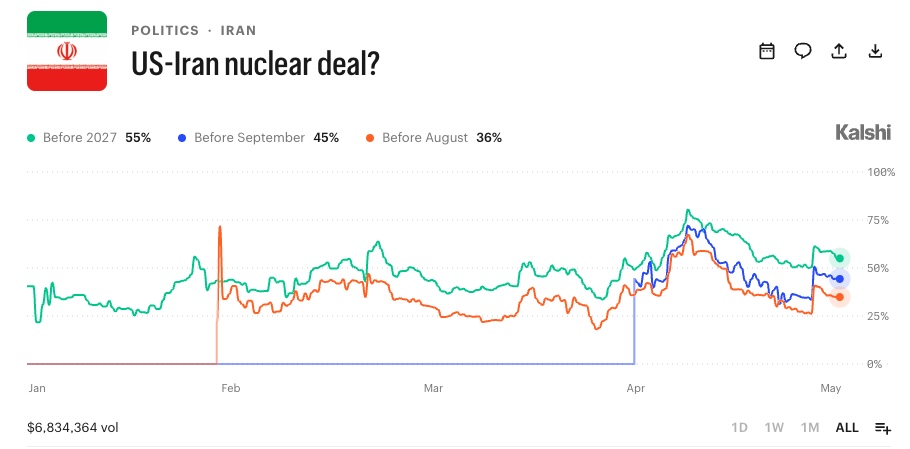
Nuclear deal prediction markets show rising optimism for longer-term resolutions. Kalshi participants assign a 58 percent chance to an agreement by the end of 2027, up notably after recent memorandum proposals emerged. They price a 47 percent likelihood for completion by September in active trading.
Meanwhile, shorter-term contracts reveal caution. Polymarket traders peg the odds of a deal by May 31 at around 21 percent. The June 30 horizon carries a 33 percent probability, while broader 2027 contracts hover near 63 percent on some platforms. These figures evolve constantly as indirect negotiations advance through mediators.
Participants are examining details of the proposed one-page memorandum covering uranium stockpile reductions and sanctions relief. Such specifics fuel intense activity across US-Iran nuclear agreement odds markets. The combination of hope and skepticism sustains strong capital flows into these contracts.
Current Nuclear Pact Contract Probabilities and Trading Volumes
| Contract Description | Yes Probability | Reported Volume |
|---|---|---|
| Nuclear deal by September 2026 | 47% | $6.8M+ |
| Iran ends uranium enrichment by June 30, 2026 | 58% | Multiple millions |
| Nuclear deal by June 30 2026 | 33% | $1.7M+ |
| Iran ends uranium enrichment by June 30 2026 | 28% | $849K+ |
Strait of Hormuz Prediction Market Contracts Draw Heavy Activity on Maritime Disruptions
Maritime route contracts tied to shipping lane resolutions attract equally robust participation in geopolitical prediction markets. Traders assign only a 24 percent chance that traffic through the vital chokepoint returns to normal by the end of May. Longer horizons perform better, with June 30 odds reaching 52 percent in active markets.
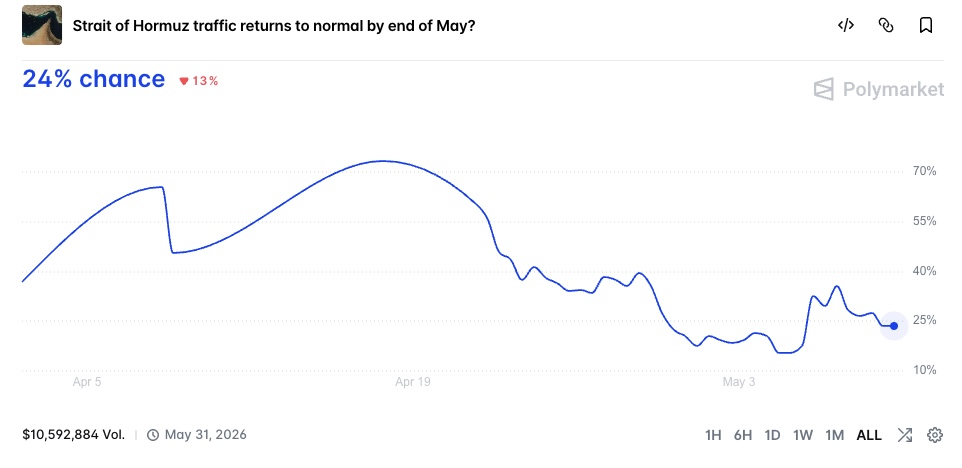
Earlier deadlines command minimal confidence. Popular contracts price a mere 1 percent probability for normalization by May 15. These figures hold despite ceasefire declarations and reopening claims. Traders therefore monitor naval movements and official statements for any informational edge in Strait of Hormuz prediction markets.
Volumes on these disruption contracts frequently surpass 11 million dollars each. The sustained interest demonstrates how participants view such events as critical drivers of global energy flows and related outcomes. Shifting probabilities create ongoing opportunities for informed positioning.
Key Maritime Disruption Contract Snapshot in Prediction Markets
| Contract Description | Yes Probability | Reported Volume |
|---|---|---|
| Traffic returns to normal by the end of June | 24% | $11M+ |
| Traffic returns to normal by end of June | 52% | $4M+ |
| Full closure for seven or more days before 2027 | 40% | $7.2M+ |
Geopolitical Betting Contracts See Participants Chase Timely Peace Deal Resolutions
Activity around permanent peace deals remains strong across prediction market platforms. One leading contract prices a 74 percent chance of such an accord by December 31. Shorter windows carry lower odds, yet participants commit substantial sums, anticipating breakthroughs in US-Iran nuclear agreement timelines.
Diplomatic meeting contracts trade at 74 percent for occurrence by June 30. These wagers enable participants to monetize insights into negotiation schedules. The fast-paced environment rewards those who blend public signals with pattern recognition in geopolitical betting contracts.
Overall trading in these flashpoint developments exceeds $2 billion across major platforms. Such a scale illustrates the extent to which participants pursue edges in volatile scenarios. Every new headline, therefore, prompts immediate repricing and fresh inflows into nuclear deal prediction markets.
Insider Activity Concerns Mount in High-Volume Geopolitical Prediction Markets
Regulators examine unusually timed bets that preceded major announcements in recent weeks. Multiple accounts placed large wagers on the timing of the ceasefire shortly before official statements, yielding significant profits. CFTC officials review these patterns for signs of improper information advantages.
Lawmakers call for stricter oversight of these contracts. Public Citizen representatives filed complaints highlighting precise bets on strike timing and peace announcements. Platforms tighten verification processes, but questions persist about information flow in prediction markets.
One trader reportedly secured nearly $1 million by accurately forecasting military actions. These instances intensify debates over whether markets inadvertently reward privileged details. Congressional probes continue to examine the boundaries of acceptable participation.
This DW News segment examines how certain accounts achieved remarkable timing on conflict-related contracts in prediction markets.
Prediction Market Volumes Rise as Traders Assess Ceasefire Durability and Economic Impacts
Broader peace deal contracts remain in focus as participants weigh optimism against past setbacks. The December 31 permanent peace contract holds near 74-75 percent, reflecting collective expectations for eventual resolution. Interim volatility nevertheless keeps traders engaged across linked outcomes.
Related contracts on regime stability and uranium surrender also trade in millions. Participants deploy strategies incorporating real-time diplomatic updates. This environment turns abstract negotiations into dynamic trading opportunities in nuclear deal prediction markets.
Oil price direction contracts tied to these events show participants pricing prolonged uncertainty. Forecasts remain elevated, underscoring interconnections among these wagers. Traders calibrate positions across multiple outcomes simultaneously for maximum exposure.
Longer-Term Nuclear Deal Prediction Markets Offer Extended Horizons for Traders
Participants now focus on contracts extending into 2027, covering regime change possibilities and enrichment curbs. These markets exhibit lower daily volatility while maintaining notable open interest. Extended timelines support more deliberate positioning based on phased diplomatic progress.
Any sudden escalation or concession triggers cascading adjustments across interconnected contracts. Traders watch mediator statements closely for signals. The price discovery process stays fluid and highly competitive in these geopolitical prediction markets.
References
- CNBC: Kalshi traders see odds rising that a U.S.-Iran nuclear deal will be reached by 2027
- Kalshi: US-Iran Nuclear Deal Odds and Predictions 2026
- Polymarket: Iran Prediction Markets and Live Odds
- Polymarket: US-Iran Nuclear Deal by June 30 Odds
- Yahoo Finance: Traders See One-in-Three Chance of US-Iran Peace Deal
- The Guardian: Traders Placed Over $1bn in Perfectly Timed Bets on Iran War
- NBC News: Prediction Market Bets on Iran War Top $2 Billion
- Bitcoin.com: Kalshi and Polymarket Iran Predictions
- YouTube: Suspicions of Insider Trading as Online Betting Markets Reap Windfalls in Iran War
- Polymarket: Strait of Hormuz Predictions and Real-Time Odds
- YouTube: Prediction Market Accounts Bet Millions on Iran War Developments
- Kalshi: Strait of Hormuz Closure Markets
- PBS: Iran War Puts Prediction Markets Back in Spotlight