
Iranian Foreign Minister Abbas Araghchi declared the Strait of Hormuz completely open to all commercial vessels for the remaining period of the ceasefire. This announcement triggered immediate and dramatic swings across oil prediction markets. Traders repositioned aggressively, sending volumes soaring while probabilities shifted rapidly toward faster normalization of shipping traffic.
Strait of Hormuz Open Declaration Sends Oil Prediction Markets into Turmoil
The foreign minister’s statement, reported widely, including by Al Jazeera, reached traders within minutes on Friday. Contracts focused on Strait of Hormuz traffic returning to normal experienced sharp repricing. High-volume trading reflected collective bets on restored oil supply flows and reduced geopolitical risk premiums.
Prediction markets captured the evolving sentiment in real time. Probabilities on near-term normalization climbed as participants digested the news against the backdrop of the Lebanon ceasefire. Equity recovery contracts rose in parallel with falling bets on oil prices.
Live Prediction Market Odds on Strait of Hormuz Traffic Normalization After Declaration
| Market Description | Current Yes Probability | Total Volume | Recent Volume Spike |
|---|---|---|---|
| Strait of Hormuz traffic returns to normal by end of April | 52% | $13.9 million | $3 million+ |
| Strait of Hormuz traffic returns to normal by the end of April | 80% | $1.1 million | $241K |
| Strait of Hormuz traffic returns to normal by the end of May | 92% | $2 million | $787K |
| Iran agrees to unrestricted shipping through Hormuz in April | 40% | $131K | $87K+ |
Volumes and probabilities continue moving as fresh details emerge from diplomatic channels. The data underscores how prediction markets aggregate trader views on the Strait of Hormuz open announcement almost instantly.
Oil Price Prediction Contracts Plunge Following Iran Strait of Hormuz Reopening
Contracts betting on sustained high crude oil prices lost substantial value right after the news broke. Participants who anticipated prolonged supply disruptions sold positions quickly. Brent crude futures dropped more than 10% in early trading, mirroring the sentiment shift on prediction platforms, as covered by Yahoo Finance.
Traders rotated capital toward scenarios assuming restored commercial shipping through the vital waterway. Equity-linked recovery bets attracted fresh buying as lower energy costs supported broader risk appetite. The action sparked one of the most volatile sessions in the recent history of the oil prediction market.
One contract tracking normalization by the end of June reached an eighty-seven percent probability. Participants cited the clear language on commercial routes as a strong positive signal for de-escalation.
Trump Comments on US Blockade Add Layers of Uncertainty to Hormuz Prediction Markets
President Donald Trump acknowledged the Strait of Hormuz opening while emphasizing that the US naval blockade on Iranian ports would continue until a complete deal materializes. His clarification, noted in BBC News reports, introduced measured caution into the market reaction. Contracts on blockade lift timing were adjusted toward May resolutions as traders weighed the statements.
The interplay between the Iranian declaration and presidential response fueled intense back-and-forth trading. One market now prices in a 92% chance that the blockade announcement will be resolved by May 31. Participants monitor every update for clues on implementation details.
Shipping interests await practical verification of safe passage protocols along the coordinated routes announced by authorities.
This report from Global News details the sharp oil price reaction and the interconnected developments following the announcement of the reopening of the Strait of Hormuz.
Prediction Market Volumes Surge on Iran Hormuz Open News and Ceasefire Hopes
Overall trading activity in Hormuz-related contracts surpassed fourteen million dollars in recent sessions. The end-of-April normalization market alone drew over three million dollars today. Diverse participants converged to express views on the durability of restored shipping access.
Peripheral contracts for daily ship transits and for specific national involvement also saw elevated turnover. These bets reflect the broad interest generated by the core diplomatic development tied to the Lebanon ceasefire.
Oil prediction markets aligned with the broader repricing. Bets on monthly crude benchmarks moved lower while capital flowed into recovery scenarios. The fast-paced sessions demonstrate how geopolitical breakthroughs translate directly into platform activity.
Strait of Hormuz Traffic Return to Normal Prediction Markets React to Ceasefire Breakthrough
The declaration arrived as part of the fragile truce framework in Lebanon. Iranian authorities explicitly linked the opening to that agreement, while emphasizing commercial vessels and predetermined routes. Prediction contracts on permanent peace deals edged higher amid the positive momentum.
Traders who tracked developments in Lebanon anticipated spillover benefits for the critical waterway. The foreign minister’s social media post served as the immediate catalyst for synchronized probability shifts. One contract on Iranian asset unfreezing in April assigned strong odds to reciprocal steps.
This ANI News segment captures the breaking announcement and immediate implications surrounding the Strait of Hormuz’s complete opening declaration.
Equity Recovery Prediction Markets Climb as Hormuz Open News Eases Supply Concerns
Contracts tied to stock market performance recorded upward revisions after the announcement. Reduced risk around global energy flows improved the outlook for corporate margins and consumer spending. The Dow’s intraday surge validated early positioning on recovery timelines.
Participants argued that restored flows through the Strait of Hormuz would support lower energy costs and broader economic stability. These views translated into higher probabilities across equity-linked markets. The environment shifted decisively toward risk-on sentiment.
Longer-dated contracts extending into June trade at robust levels. Traders assign strong chances to sustained normalization once initial transit data confirms the opening.
Diplomatic Nuances Keep Strait of Hormuz Prediction Markets Highly Active
Confusion lingers around the precise status of the US blockade despite the positive declaration. President Trump’s insistence on full terms before any changes for Iranian ports keeps probabilities fluid. Market participants weigh these nuances carefully while avoiding premature commitments.
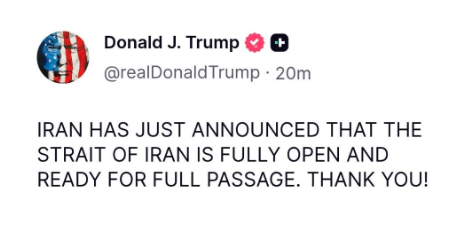
Shipping firms and energy interests watch for concrete implementation steps. The coordinated route requires real-world testing before full confidence returns. Weekly traffic contracts already reflect this cautious outlook on execution.
One current-period market shows a 72% probability of above-average flows. Granular bets allow precise expression of views on near-term developments.
Long-Term Implications for Oil Supply Chain Prediction Markets
Contracts beyond April display robust probabilities for full normalization. The end-of-May market sits near 80%, while June contracts approach 87%. These figures suggest traders expect the opening to hold if ceasefire conditions persist.
Energy sector participants reference these platforms alongside traditional futures for flow forecasting. Alignment between prediction prices and physical market moves reinforces their utility in capturing real-time sentiment. High-volume data confirms deep engagement from informed participants.
The Iranian declaration of the Strait of Hormuz as completely open marks a pivotal moment in recent ceasefire efforts. Oil prediction markets responded with characteristic speed and intensity. Traders continue to adjust positions while watching for confirmation of sustained access and further de-escalation steps, as detailed in reports from CNBC and Reuters.
References
- Al Jazeera: Iran’s foreign minister says Strait of Hormuz ‘completely open’
- BBC News: Iran says Strait of Hormuz is ‘open’ as Trump comments on blockade
- CNBC: Iran declares Strait of Hormuz open to shipping during Lebanon ceasefire
- Reuters: Iran’s foreign minister says passage of vessels via Hormuz Strait is open during ceasefire
- Polymarket: Strait of Hormuz traffic returns to normal by the end of April?
- X Post by Iranian Foreign Minister Abbas Araghchi announcing Strait of Hormuz declaration
- YouTube: Iran declares Strait of Hormuz open as oil prices plunge
- YouTube: BREAKING: Iran declares Strait of Hormuz “completely open” after Israel-Lebanon ceasefire