
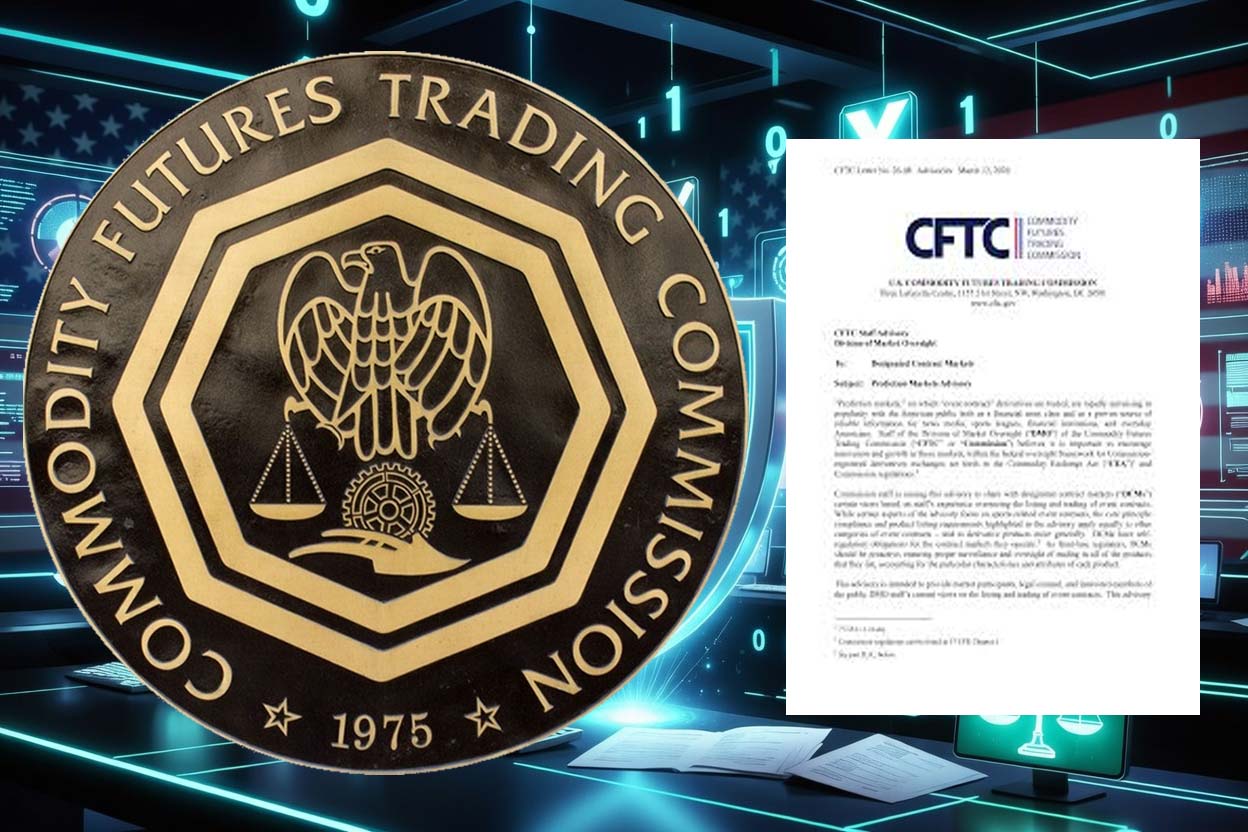
The Commodity Futures Trading Commission delivered transformative clarity to the derivatives industry on March 12, 2026. Staff issued CFTC Letter No. 26-08, a detailed advisory that equips designated contract markets with precise expectations for listing and overseeing event contracts. At the same moment, the agency published an Advance Notice of Proposed Rulemaking under RIN 3038-AF65, inviting stakeholders to shape the regulatory future of these dynamic instruments.
Industry experts hail the coordinated actions as a decisive step that balances explosive growth with unwavering market integrity. The measures reinforce the CFTC’s exclusive jurisdiction while addressing manipulation risks head-on. Designated contract markets now possess actionable guidance that strengthens their front-line regulatory role under the Commodity Exchange Act.
CFTC Staff Advisory 26-08 Delivers Targeted Compliance Expectations for Event Contracts
Division of Market Oversight staff crafted the advisory to encourage responsible innovation across all event contract categories. The document reminds designated contract markets of their obligations under Part 38 and the core principles embedded in the Commodity Exchange Act. Staff stresses proactive surveillance that accounts for each product’s unique attributes and settlement mechanics.
Event contracts qualify as swaps under the broad statutory definition, triggering full compliance requirements for listing, trading, and monitoring. The advisory underscores Core Principle 3, which requires contracts that are not readily susceptible to manipulation, and Core Principle 4, which mandates robust surveillance programs. Designated contract markets must submit new products or amendments for review while maintaining real-time monitoring systems, as outlined in the official CFTC Press Release 9193-26.
CFTC staff highlight the need for robust settlement-verification mechanisms and rules to prevent abusive trading practices. The guidance applies equally to sports-related and non-sports event contracts, yet it pays special attention to products tied to individual athlete performance or official decisions. Market participants gain practical recommendations that enhance compliance programs without stifling creativity.
Core Principles Highlighted in CFTC Staff Advisory 26-08
| Core Principle | Key Obligation | Application to Event Contracts |
|---|---|---|
| Core Principle 3 | Contracts not readily susceptible to manipulation | Requires detailed settlement methodology, reliable data sources, and assessment of permutation-specific risks |
| Core Principle 4 | Surveillance and prevention of manipulation | Demands real-time monitoring, engagement with governing bodies, and rules against abusive practices |
| Product Submission Rules | Self-certification or approval under Reg. 40.2 | Must include explanation of compliance, data source reliability, and manipulation resistance analysis |
Designated contract markets reviewing this table recognize the heightened expectations for sports-related products. Staff recommends proactive engagement with sports leagues and integrity units during contract design. The advisory positions exchange as vigilant guardians of market fairness.
Analysts note that the guidance builds directly on existing enforcement priorities. Designated contract markets now possess clearer guardrails that foster confidence among participants and regulators alike. The advisory serves as a living document that evolves alongside market developments.
Chairman Michael S. Selig discussed these regulatory priorities in a recent Bloomberg interview, underscoring the agency’s commitment to tailored oversight. The video captures his vision for balancing innovation with protection. Viewers gain direct insight into the thinking driving CFTC Staff Advisory 26-08.
Sports Event Contracts Face Intensified Manipulation Safeguards Under New CFTC Guidance
Sports-related event contracts dominate trading volume, prompting staff to outline specific risk-management strategies. Contracts resolving disputes over actions by individual athletes, officials, or for unsportsmanlike conduct carry an elevated risk of manipulation. Designated contract markets must implement enhanced verification processes and account for the concentrated control inherent in these products.
In short, they want to avoid more of the existing scandals in which individual players or coaches intentionally affect betting outcomes.
Staff encourages collaboration with professional leagues and governing bodies to strengthen settlement integrity. The advisory envisions information-sharing arrangements that bolster CFTC oversight capabilities. Exchanges gain flexibility to tailor surveillance programs to each contract’s distinct characteristics.
Market participants should appreciate the forward-looking tone that promotes innovation while demanding accountability. The guidance equips designated contract markets to prevent price distortion and maintain fair trading environments. Robust rules against insider trading and misuse of nonpublic information receive renewed emphasis across all event contract types.
CFTC Advance Notice of Proposed Rulemaking Invites Comprehensive Input on Event Contracts Framework
The Advance Notice of Proposed Rulemaking published in the Federal Register on March 16, 2026, launches a 45-day comment period ending April 30, 2026. The agency seeks detailed feedback on how to apply core principles and regulations to prediction markets. Stakeholders will address public interest determinations under CEA Section 5c(c)(5)(C) and potential prohibited categories, as detailed in CFTC Press Release 9194-26.
Questions span surveillance requirements, position limits, risk management, and data reporting obligations. The ANPRM probes the scope of contracts involving unlawful activity, terrorism, or gaming elements. Commenters will explore hedging utility, price discovery benefits, and the impacts on innovation.
Major Comment Areas in CFTC Event Contracts ANPRM RIN 3038-AF65
| Topic Category | Key Issues Raised | Potential Regulatory Impact |
|---|---|---|
| DCM/SEF/DCO Core Principles | Prohibited categories include war, assassination, unlawful activity | Possible new or amended rules tailored to event contract liquidity and volatility |
| Public Interest Determinations | Prohibited categories include war, assassination, and unlawful activity | Clearer procedural framework for CFTC review and prohibition decisions |
| Inside Information and Manipulation | Risks from small-group control events | Enhanced anti-fraud and insider trading safeguards |
| Cost-Benefit and Classification | Swaps vs. futures status, excluded commodities | Streamlined compliance while preserving exclusive CFTC jurisdiction |
The ANPRM draws on historical context, including past no-action letters and a withdrawn 2024 proposal. Staff invites analysis of antitrust implications and effects on small entities. Commenters possess a unique opportunity to influence a rational, coherent regulatory structure grounded in the Commodity Exchange Act.
Designated contract markets and market participants are actively preparing submissions that highlight practical compliance experiences. The process signals the CFTC’s dedication to evidence-based policymaking. Analysts anticipate robust dialogue that advances both market growth and systemic safeguards.
This video from industry coverage captures reactions to the March 12 releases and Chairman Selig’s statements. It illustrates how the guidance reassures participants while signaling vigilant oversight. The discussion reinforces the agency’s proactive stance on the integrity of event contracts.
Chairman Selig Positions CFTC as Champion of Responsible Innovation in Event Contracts
Chairman Michael S. Selig described the ANPRM as an essential step toward a coherent framework that protects market integrity. The agency reaffirms its exclusive jurisdiction over these derivatives. Selig emphasizes that clarity empowers participants while enabling active enforcement against misconduct.
The coordinated releases follow the withdrawal of the proposal for the 2024 event contracts and reflect the sector’s rapid expansion. Staff advisory complements a recent enforcement advisory on insider trading risks. Designated contract markets receive tools that simultaneously promote confidence and accountability.
The guidance equips exchanges to navigate complex manipulation scenarios with precision. Commenters now shape future rules that sustain liquidity and price discovery functions.
Designated contract markets implementing enhanced programs gain competitive advantages through demonstrated compliance excellence. The CFTC’s actions underscore its commitment to preventing disruptive trading while fostering fair and equitable markets. Industry momentum builds as participants align operations with the new expectations.
Stakeholders submit comments that refine surveillance techniques and public interest criteria. The process ensures regulations evolve alongside technological and market advancements. Designated contract markets stand ready to meet these elevated standards, safeguarding participants and maintaining systemic resilience.
Long-Term Implications of CFTC Prediction Market Guidance and ANPRM
Designated contract markets now operate under clearer expectations, reducing regulatory uncertainty. The advisory establishes benchmarks for product submissions and ongoing oversight programs. Exchanges refine settlement methodologies and data source validations to meet manipulation-resistance thresholds.
Commenters address cost-benefit considerations that influence future rulemaking scope. The ANPRM explores classification questions that affect capital and reporting requirements. Market participants contribute insights that balance innovation incentives with robust risk controls.
Enforcement priorities gain sharper focus through reinforced surveillance obligations. Designated contract markets integrate real-time monitoring tools that swiftly detect abusive patterns. The framework strengthens overall market integrity while supporting continued volume growth.
Analysts project sustained expansion as clarity on compliance attracts institutional interest. The guidance positions the United States as a leader in regulated event contract trading. Stakeholders anticipate rules that preserve the unique informational value of these products.
The ANPRM’s dozens of targeted questions invite granular feedback across multiple dimensions. Commenters dissect hedging applications and liquidity dynamics in detail. The resulting record informs amendments that enhance rather than constrain market functions.
Chairman Selig drives this balanced approach that prioritizes integrity without sacrificing progress. The March 12 actions mark a pivotal chapter in the evolution of derivatives oversight. Designated contract markets embrace the opportunity to demonstrate excellence in self-regulation.
References
- CFTC Staff Letter No. 26-08 (March 12, 2026)
- CFTC Press Release 9193-26: Staff Issues Prediction Markets Advisory
- Federal Register: Advance Notice of Proposed Rulemaking on Prediction Markets (March 16, 2026)
- CFTC Press Release 9194-26: Seeks Public Comment on ANPRM Relating to Prediction Markets
- Bloomberg Talks: CFTC Chairman Michael Selig Discusses Prediction Markets
- YouTube Coverage: Prediction Markets Receive Tailored CFTC Guidance