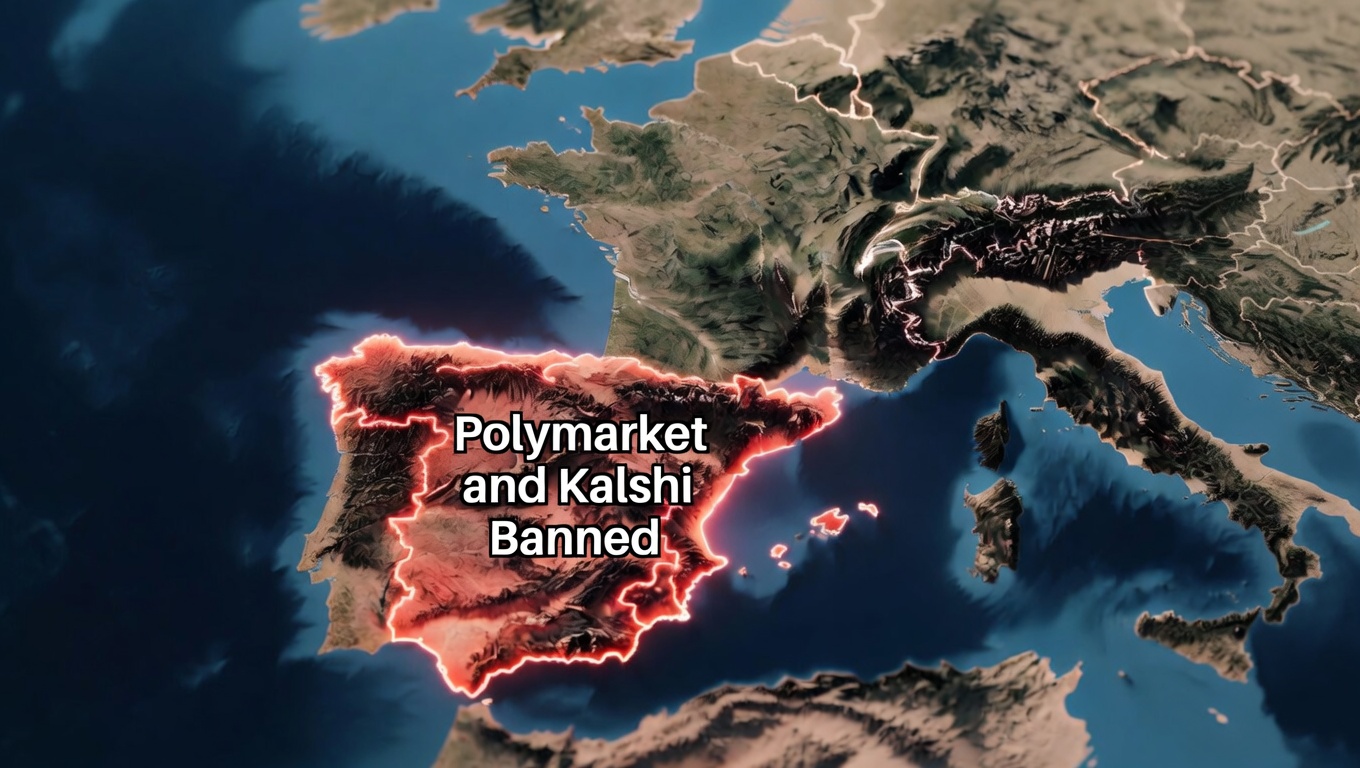
Spanish authorities have launched a decisive strike against the two major U.S.-based event-contract platforms, directing Internet service providers to block access to the Polymarket and Kalshi sites immediately. This follows a similar nationwide ban we covered a couple of weeks ago in India.
The Ministry of Consumer Affairs initiated disciplinary proceedings against both platforms, citing the complete absence of required gambling licenses under national law. This major enforcement action underscores the growing clash between innovative crowd-sourced forecasting tools and stringent consumer safeguards across jurisdictions.
Or, if you want to be more blunt, banning gaming platforms that operate outside Spain’s national tax and regulatory systems. Online gambling and sports betting have long been highly active in Spain.
Traders in Spain who have come to rely on Polymarket and Kalshi for dynamic pricing and trading in futures on future outcomes now face sudden, total restrictions on use. That can be disruptive to both continued trading and portfolio holdings.
Ministry Orders Immediate ISP Blocks While Launching Formal Probe
The Dirección General de Ordenación del Juego published official notices in Spain’s state gazette on May 26, mandating blocks within 7-10 days as a preliminary step. Officials highlighted missing identity verification, inadequate protections to prevent minors from engaging, and the absence of self-exclusion features that licensed operators must provide. Essentially, the same arguments were made by state gaming regulators in the United States when suing the prediction markets.
Proceedings will last three to four months, during which time the platforms can respond to allegations that they are operating without proper administrative authorization. Which, of course, they are. This move, detailed in the Reuters report, reflects regulators’ determination to enforce compliance.
Spanish enforcement teams emphasized that any entity that facilitates wagers on uncertain events must obtain full licensing under Law 13/2011. By bypassing these requirements, the platforms allegedly left users exposed to risks that regulated services actively mitigate. Consequently, the temporary blocks aim to shield domestic users while investigations unfold. Or, to put it briefly, you don’t pay, you don’t get to play.
Core Elements of the Spanish Enforcement Action Against Unlicensed Platforms
| Aspect | Details |
|---|---|
| Regulator | Dirección General de Ordenación del Juego (DGOJ), Ministry of Consumer Affairs |
| Primary Action | ISP-level website blocks plus disciplinary proceedings |
| Provisional Block Period | 3-4 months pending full investigation |
| Key Violations Alleged | No gambling license; insufficient minor safeguards and self-exclusion tools |
| Implementation Window | Blocks enforced within 7-10 days of May 26 order |
Legal Classification Driving the Crackdown on Event-Based Trading Sites
Spanish regulations classify contracts tied to future events as betting activities whenever financial stakes are involved, requiring compliance with the strict technical and protective standards in place for betting platforms. The DGOJ determined that both platforms failed to implement mandatory controls, prompting swift intervention.
This stance aligns with broader international patterns, in which governments such as India and Argentina have increasingly scrutinized unlicensed operations that offer betting-style services to their populations.
Immediate Effects on Active Traders Relying on Global Platforms
While virtual private networks offer temporary solutions for some, authorities caution that bypassing official blocks may trigger further legal consequences.
Polymarket and Kalshi are being blocked in Spain 🚨
— StarPlatinum (@StarPlatinum_) May 26, 2026
Spain’s Ministry of Consumer Affairs has officially opened sanction proceedings against Polymarket and Kalshi
For allegedly operating as unlicensed gambling platforms.
The Spanish government has now ordered internet… pic.twitter.com/ivHHLO26fG
Social community conversations reveal frustration mixed with a determination to adapt.
Consumer Protection Requirements Versus Reported Platform Shortfalls
| Standard Required | Spanish Regulatory Expectation | Status Cited in Orders |
|---|---|---|
| Identity Checks | Full verification for every user | Absent per DGOJ findings |
| Age Restrictions | Robust systems blocking minors | Insufficient mechanisms identified |
| Self-Exclusion | Simple, effective opt-out options | No dedicated tools implemented |
| Responsible Practices | Comprehensive harm prevention | Lacking, according to the official assessment |
Classification Debates Highlight Tension Between Innovation and Regulation
Legal commentators suggest treating these event contracts more akin to financial derivatives than conventional betting, potentially opening pathways for alternative oversight models. Enforcement bodies continue stressing standardized protections as non-negotiable. And then, of course, there are the financial splits and taxes that the government is quite used to taking from all gaming within its borders.
The ongoing proceedings between Spanish authorities and the operators of the Kalshi and Polymarket platforms may influence approaches taken by neighboring countries facing similar questions. At some point, a general framework for operating peacefully in foreign nations will be found that suits most countries. For now, expect a hodgepodge.
References
- Reuters: Spain blocks prediction markets Polymarket, Kalshi
- CoinDesk: Spain joins growing list shutting out platforms
- Crypto Briefing: Spain blocks access over licensing issues
- WSJ: Polymarket and Kalshi face Spanish ban
- The Guardian: Spain blocks access as it launches investigation
- X post detailing blocking timeline