
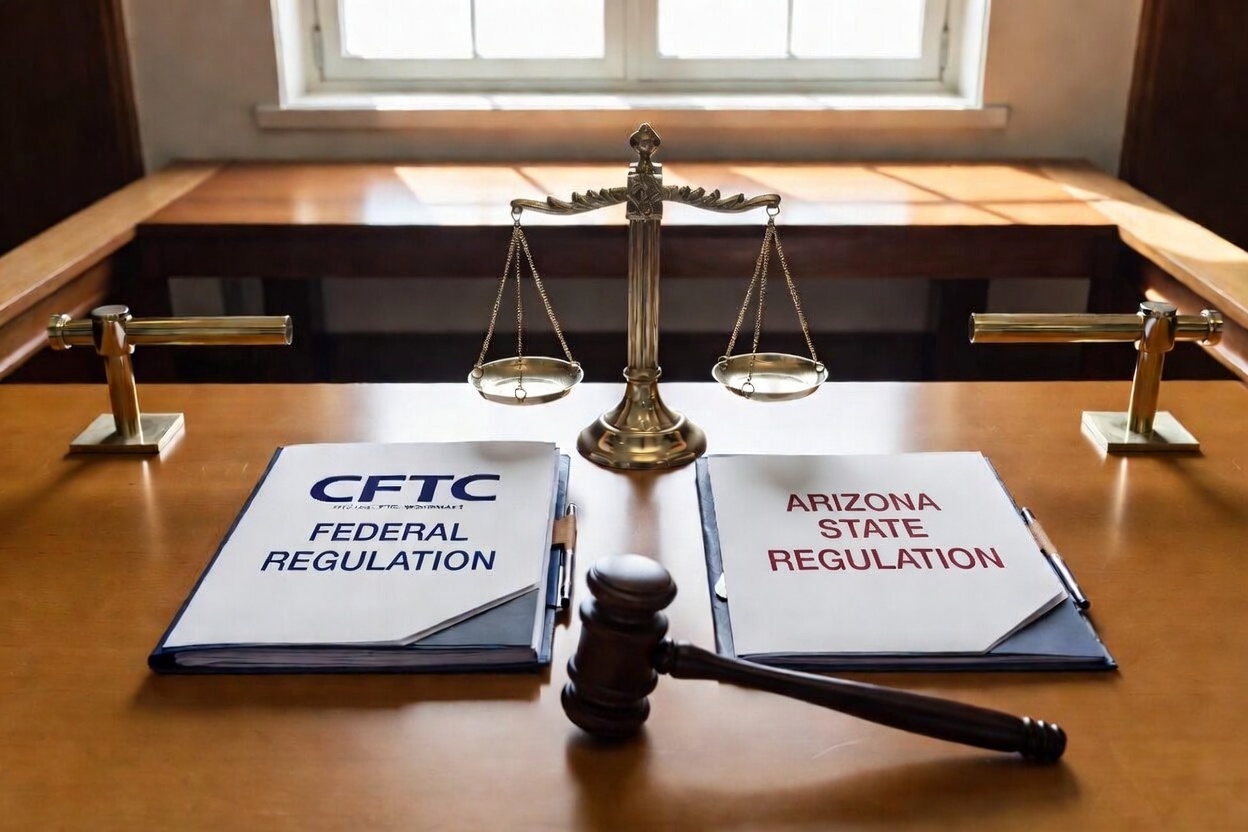
The Commodity Futures Trading Commission secured a significant victory on April 10, 2026, when U.S. District Judge Michael T. Liburdi granted a temporary restraining order halting Arizona’s criminal prosecution of CFTC-regulated platforms offering event contracts.
This CFTC Arizona temporary restraining order prevents the state from enforcing its gambling laws against designated contract markets like KalshiEX LLC. The ruling underscores the Commodity Exchange Act’s field preemption over state actions targeting event contracts.
Federal authorities acted swiftly after Arizona filed criminal charges, demonstrating the agency’s commitment to exclusive jurisdiction over swaps and derivatives. This development in the CFTC vs. Arizona event contracts dispute sends a strong signal to other states considering similar enforcement actions.
What Happened in the CFTC Arizona Legal Battle Over Event Contracts Jurisdiction?
KalshiEX LLC faced criminal charges from Arizona Attorney General Kris Mayes in March 2026 for allegedly operating an unlicensed gambling business through event contracts. The platform initially requested a preliminary injunction to stop the proceedings, but the court denied that motion under the Anti-Injunction Act. The CFTC and the Department of Justice then intervened directly, filing a complaint and a motion for a temporary restraining order and a preliminary injunction.
Judge Liburdi granted the CFTC’s request on April 10, blocking Arizona’s enforcement actions until at least April 24, 2026. This federal preemption victory highlights that the Commodity Exchange Act shields CFTC-regulated event contracts from conflicting state gambling statutes, as detailed in the CFTC’s motion.
Arizona prosecutors had targeted wagers on elections and other outcomes, claiming they violated state wagering prohibitions. The CFTC countered that these instruments qualify as swaps traded on designated contract markets and thus fall under exclusive federal oversight. The temporary restraining order paused the scheduled April 13 arraignment and prevents further criminal or civil enforcement by state officials. This sequence reveals the procedural advantage federal intervention provides in jurisdiction disputes involving event contracts.
Why the Commodity Exchange Act Grants CFTC Exclusive Jurisdiction in Event Contracts Cases
Judge Liburdi’s order states that the Commodity Exchange Act, at a minimum, field preempts Arizona law, thereby rendering state enforcement efforts a violation of the Supremacy Clause. Event contracts involve payments based on the occurrence or non-occurrence of specified events and meet the statutory definition of swaps. The CFTC has maintained longstanding exclusive authority over such contracts when executed on CFTC-regulated designated contract markets.
Arizona’s application of gambling laws directly conflicts with this federal framework, which is designed for uniform national regulation of derivatives. The ruling reinforces that states cannot intrude on interstate commodity derivatives markets through criminal prosecutions.
The CFTC filed parallel lawsuits against Connecticut and Illinois on April 2, 2026, seeking declaratory judgments and permanent injunctions affirming federal preemption. These multi-state actions address a pattern of states attempting to regulate or restrict CFTC-approved event contract trading, according to the official CFTC press release announcing the suits. The Arizona temporary restraining order builds momentum for broader federal clarity on jurisdictional disputes in event contracts nationwide.
Timeline of the CFTC Arizona Temporary Restraining Order and Event Contracts Dispute
| Date | CFTC files a motion for a temporary restraining order and a preliminary injunction after the initial Kalshi request was denied. |
|---|---|
| March 17, 2026 | Key Development in the CFTC Arizona Event Contracts Case |
| April 2, 2026 | CFTC and DOJ sue Arizona, Connecticut, and Illinois to reaffirm exclusive federal jurisdiction over event contracts under the Commodity Exchange Act. |
| April 8, 2026 | Judge Michael T. Liburdi grants CFTC Arizona a temporary restraining order blocking state enforcement until April 24, 2026. |
| April 10, 2026 | CFTC files a motion for a temporary restraining order and a preliminary injunction after the initial Kalshi request was denied. |
| Ongoing | Hearings on preliminary injunction pending; potential appeals expected in federal preemption battle over event contracts. |
Third Circuit Ruling Strengthens CFTC Position on Sports Event Contracts and Federal Preemption
A divided U.S. Court of Appeals for the Third Circuit recently affirmed that the Commodity Exchange Act preempts New Jersey’s gambling laws as applied to sports-related event contracts traded on designated contract markets. This precedent directly supports the CFTC’s arguments in the Arizona case and similar disputes. The appellate decision confirms that such contracts constitute swaps under federal law, granting the CFTC exclusive regulatory authority.
Federal regulators now leverage this holding to demonstrate consistent preemption principles across jurisdictions involving event contracts. The ruling limits states’ ability to impose conflicting requirements on federally overseen derivatives platforms, as analyzed in the Holland & Knight alert on the Third Circuit decision.
CFTC Chair Mike Selig and agency officials emphasize that event contracts promote price discovery and risk management consistent with congressional intent in the Commodity Exchange Act. Allowing fragmented state enforcement would undermine the national market framework Congress established. The agency’s Innovation Task Force continues developing guidelines while these cases advance through the courts.
Multi-State Implications of the CFTC Arizona Temporary Restraining Order on Event Contracts Regulation
Connecticut and Illinois face identical federal complaints challenging their attempts to restrict CFTC-regulated event contract activities. Each state had issued demands or enforcement threats based on local gambling statutes. The CFTC maintains that the Commodity Exchange Act occupies the field, preempting overlapping state actions against designated contract markets. The successful temporary restraining order in Arizona weakens similar strategies in other jurisdictions. Upcoming hearings will determine whether preliminary injunctions extend protection across these cases.
Industry participants view the decision as advancing much-needed regulatory certainty for event contracts trading.
Core Legal Arguments in the CFTC vs Arizona Event Contracts Jurisdiction Dispute
Federal briefs classify event contracts as swaps because counterparties exchange payments tied to event outcomes with economic consequences. The Commodity Exchange Act explicitly vests the CFTC with exclusive jurisdiction over swaps on designated contract markets. State gambling laws cannot apply without creating impermissible conflict or field preemption issues. Judge Liburdi found the CFTC demonstrated a strong likelihood of success on the merits and potential irreparable harm absent relief. The temporary restraining order preserves market operations while courts fully examine the preemption claims.
Arizona had focused on specific-event contracts, arguing that they required state licensing regardless of federal registration and oversight. The CFTC rebutted that its comprehensive framework already ensures integrity, transparency, and consumer protection in these markets. Congress enacted the Commodity Exchange Act to establish uniform national standards for derivatives, thereby avoiding the inefficiencies of patchwork state regulation.
Comparison of Federal Preemption and State Positions in Event Contracts Disputes
| Key Issue | CFTC Federal Position | State Position (Arizona Example) |
|---|---|---|
| Contract Classification | Event contracts qualify as swaps under the Commodity Exchange Act. | Contracts constitute unlicensed gambling activities under state wagering laws. |
| Jurisdiction Authority | Exclusive CFTC oversight of designated contract markets and swaps. | States retain traditional police powers to regulate gambling and protect residents. |
| Preemption Analysis | Field and conflict preemption apply through the Supremacy Clause. | No preemption; state laws operate independently of federal derivatives rules. |
| Enforcement Consequences | Criminal actions disrupt federally approved interstate trading markets. | Prosecutions and cease-and-desist orders address perceived illegal operations. |
Federal regulators prioritize nationwide uniformity to support efficient derivatives markets. States defend their role in addressing local concerns about consumer protection. The current temporary restraining order tilts toward federal authority, with potential for expanded injunctions or appellate review shaping the final outcome.
References
- Temporary Restraining Order Blocks Arizona Criminal Enforcement Proceedings on Prediction Markets | CFTC
- US judge blocks Arizona criminal case against Kalshi at CFTC’s request | Reuters
- CFTC Gets Judge to Block Arizona’s Prediction Market Prosecution | PYMNTS
- CFTC Sues Trio of States to Reaffirm its Exclusive Jurisdiction Over Prediction Markets | CFTC
- Federal Appeals Court: CFTC Jurisdiction Over Sports Event Contracts | Holland & Knight
- CFTC Motion for Preliminary Injunction and Temporary Restraining Order
- X post by Mike Selig on CFTC Arizona ruling

The PolyPunter staff works tirelessly to bring you the latest and most insightful news, information, and tips on the fast-growing economic, financial, and social phenomenon that is prediction markets.


