
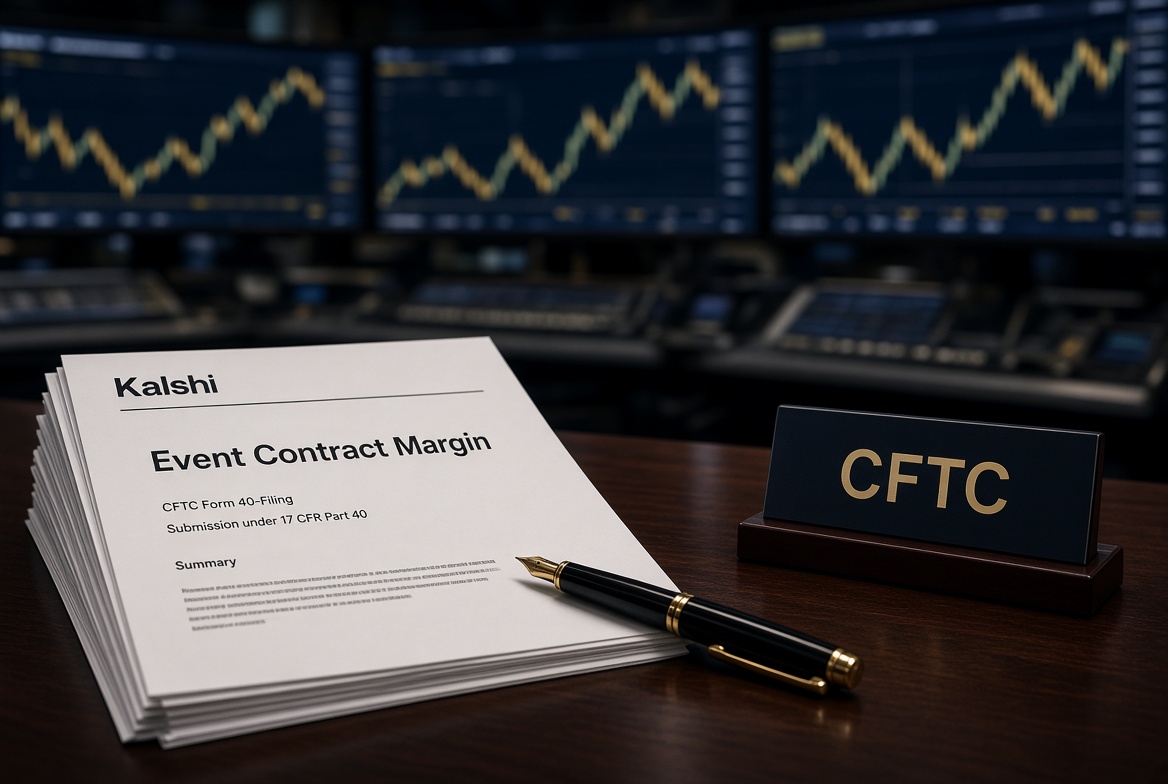
Kalshi’s proprietary, CFTC-regulated derivatives clearinghouse, Kalshi Klear, filed with the Commodity Futures Trading Commission on Tuesday, September 22, 2026, seeking permission for selected traders to buy event contracts with borrowed money. The request, submitted under Regulation 40.5(a), would end the current requirement that every regulated event contract be paid for in full. Desks that already run stocks and futures on leverage have been waiting for that feature. The notice is public and starts a review period, Kalshi Klear says, that will last at least 45 days.
The source text is the Kalshi Klear Regulation 40.5(a) event contract margin filing.
Today, a $10,000 long-dated contract still requires $10,000 in cash. That design is fairly simple for retail accounts, yet it freezes capital that funds would rather put to work, adding a time-value-of-money cost to any long-term Kalshi contracts. Kalshi already offers leverage on crypto and metal perpetual futures. It does not have the same clearance for binary-style event contracts. Tuesday’s filing tries to close that gap without opening sports, culture, or “mention” markets to borrowed funds.
Only self-clearing members with a direct tie to Kalshi Klear, plus traders routing through a futures commission merchant who meet capital tests, can get into contracts on margin.
Kalshi argues that contracts on economic data, financial outcomes, politics, and other verifiable events become more useful when cash is not locked dollar-for-dollar for months or even years. Capital requirements would rise as expiration nears, cutting borrowed capacity when binary risk is highest to avoid major trader collapses on borrowed funds, the risk that comes with margin trading.
What Does the Kalshi CFTC Margin Filing Request?
Kalshi Klear wants clearing rules amended so eligible event contracts can carry initial margin instead of 100% cash. Access would run through approved self-clearing members or an FCM. A standard app account would not receive the same terms on day one. Eligibility would depend on the product and on which side of the contract is held.
The proposed margin risk window is short. Kalshi is targeting a one-day liquidation horizon and a confidence standard above the 99% per-side level described in CFTC Rule 39.13. That is tighter than the five-day window used on some other cleared products. Event contracts can jump from 40¢ to 90¢ on one speech or data drop, so the clearinghouse has to show it can still cover losses after a market spike.
There are expected carve-outs. Sports contracts stay fully paid. Culture markets and mention markets, which pay on whether a named person says a word or phrase, also stay fully paid. Kalshi knows that institutions care more about multi-month inflation, rate, and election contracts than about weekend games or viral clips. Institutional accounts are where Kalshi is clearly headed for new growth paths beyond sports.
On a more pessimistic front, portfolio manager Eddy Elfenbein quoted the Kalshi Klear filing nd asked what could go wrong when event contracts meet borrowed funds. Leverage can deepen books. It can also force emergency sell-offs. This is true in every financial market currently.
Why Longer-Dated Event Contracts Matter to Institutional Traders
Locking up investor cash is expensive when a contract doesn’t pay out for six months. A fund that wants $5 million of notional exposure to a December policy outcome must park $5 million in cash today. That cash earns little inside a clearing account. Margin changes the ROI equation. Posting a fraction of notional, then topping up as time and event risk rise, looks closer to how the same desk already trades Treasury or equity-index futures.
(Some platforms, like Kashi, will credit interest on open positions to encourage purchases of longer-term contracts.)
Kalshi’s memo to reporters said leverage would make distant contracts more attractive to institutional traders. Retail flow, heavily in sports, drove Kashi’s volume surge last year. The next big volume step up is expected from institutional funds, which are far less likely to freeze cash for an entire campaign or rate cycle.
Rival venues have been circling the same idea. In July, Polymarket was seeking licenses that could, over time, support legal margin trading on event contracts. Tuesday’s filing puts Kalshi first on the regulated-margin clock, even if approval may take time or may not even come yet.
Perpetual futures already showed Kalshi can run leveraged products under CFTC oversight. Event contracts are different. They do not drift; they tend to lurch in price. A jobs number or a court ruling can reprice a book dramatically in minutes. Pairing borrowed money with rising capital requirements as market expiration approaches is Kalshi’s attempt to keep leverage away from the final hours of a binary settlement, what might be called the potential calamity phase when trading on margin.
How Membership Rules Would Limit Event Contract Leverage
Self-clearing membership would be a basic requirement for leverage positions. Firms that clear directly with Kalshi Klear already meet capital, operational, and surveillance tests that a standard account does not. Routing through an FCM adds another regulated intermediary. If approved, the change would take effect no earlier than the first business day after the review period, unless Kalshi Klear or the Commission stretches that timeline, which remains a possibility.
The carve-out of sports and lighthearted cultural and entertainment contracts should appease many lawmakers focused heavily on the validity of federally regulated contracts in those more traditional gambling arenas.
Cointelegraph’s X alert split replies between “this was inevitable” and “this is how you get a mess.” Both reactions clearly omit the strict membership requirements for margin trading status. Clearing risk still sits with Kalshi Klear if a leveraged book gaps through margin. That is why the company is talking about 99% per-side confidence and a compressed liquidation window.
What Happens After the Tuesday Kalshi CFTC Submission?
The Commission can ask questions, demand extra capital add-ons, refuse the one-day window, or allow the change as written. Until then, every event contract on the regulated contracts board remains fully funded. Nothing about Tuesday’s filing changes buying power this afternoon, or in the future, for a trader funding a standard account.
If staff allow the change, the first users will be firms that already operate in the futures market. They will likely look at December and 2027 contracts first, not short-dated books. Longer-dated event contract margin trading is the product Kalshi is selling to those desks. Shorter books stay cash-heavy by design. This is certainly a big potential move into institutional accounts for Kalshi, a direction they are clearly banking on for future growth in a world where they are beset by legal and political challenges over their sports event contract book of business.
References
1. Commodity Futures Trading Commission
2. Kalshi Klear Regulation 40.5(a) event contract margin filing (PDF)
3. CNBC: Kalshi asks CFTC to allow margin trading
4. crypto.news: Kalshi seeks CFTC approval for event contract margin trading
5. CryptoTimes: Kalshi seeks CFTC approval for institutional margin
6. CoinLaw: Kalshi eyes leverage for institutional traders
7. KuCoin: Kalshi applies for margin trading in event contracts
8. Odaily: Kalshi requests CFTC to allow margin trading
9. Crypto Economy: Kalshi seeks federal approval for leverage
10. UA.News: Kalshi asks CFTC to allow margin trading
11. Ground News aggregation of the Kalshi margin filing
12. Bloomberg: Polymarket seeks license related to margin trading
13. Eddy Elfenbein post on the Kalshi CFTC request
14. Cointelegraph post on the Kalshi CFTC request
15. CoinDesk Policy Protocol: Kalshi, SCOTUS, and market structure
16. House hearing: customer protections and sports event contracts