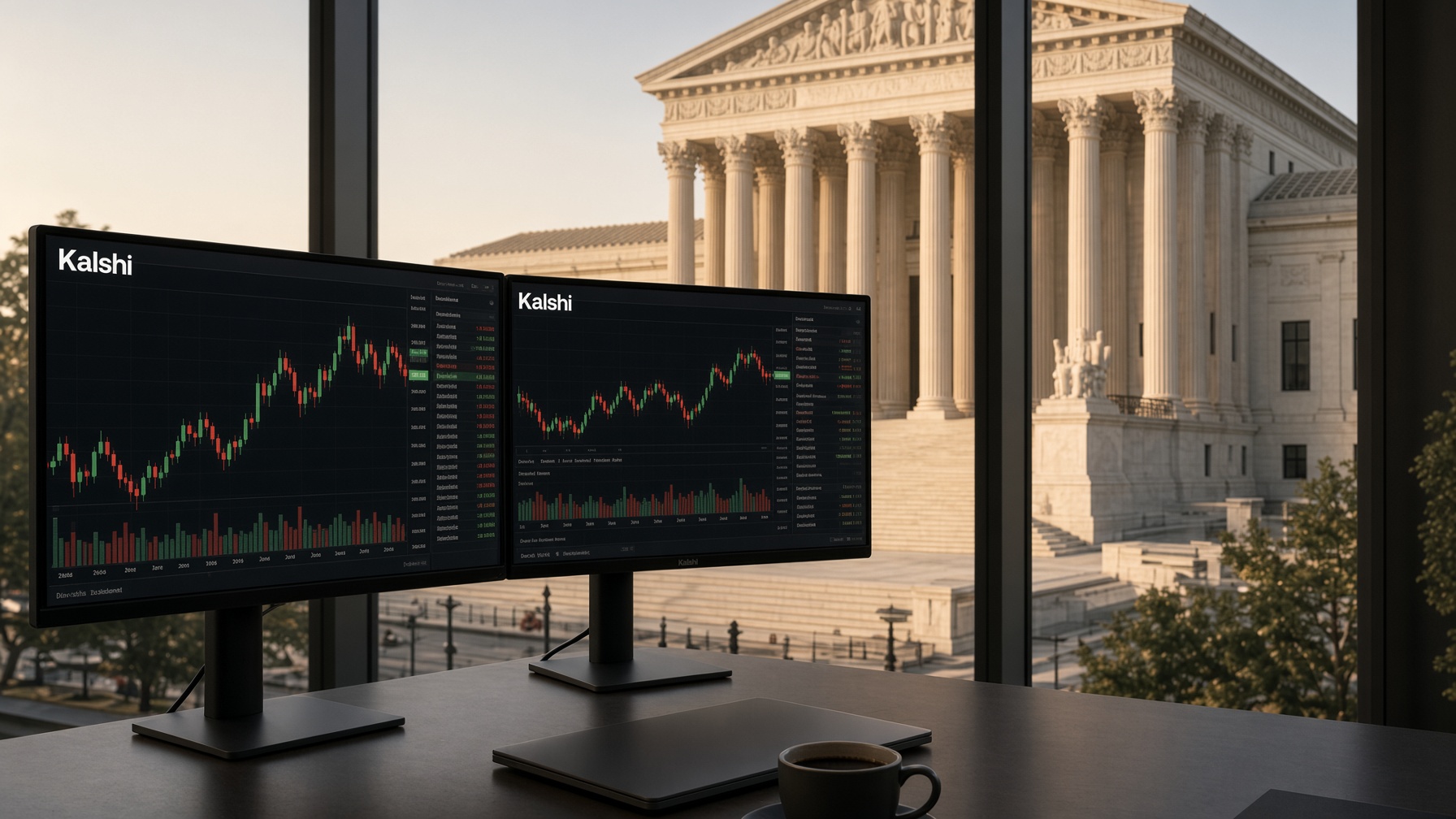
The popular sentiment that “everything is gambling now” may be mostly true, but it’s definitely not true on Kalshi. There’s one specific market they won’t touch. Kalshi will not let traders price the lawsuit that could remake its federally regulated sports event contracts into a state-by-state licensed sportsbook.
After New Jersey asked the U.S. Supreme Court to review KalshiEX, LLC v. Flaherty, the exchange told Barron’s it will list neither a contract on whether the justices grant review nor a contract on how they would rule. Kalshi is the respondent. Its own briefing could move those prices, creating a tremendous concern about privileged information, even if only in appearance.
Sports event contracts now generate most of Kalshi’s volume. A loss at the Court could push those products under state gambling licenses and subject them to state gambling regulations, limits and often heavy taxes. Even so, a company spokesperson said Kalshi could list the market, as it has listed similar SCOTUS markets, but is refusing to do so specifically because of Kalshi’s direct interest and involvement in the case. Though you should expect it to be trading as a forecast market on other platforms.
Rival Polymarket has carried an international contract dispute over whether the Court will accept a sports-event contract case. However, the U.S. Polymarket venue has not matched that listing. Traders who want a live certiorari price have to look offshore.
What New Jersey Asked the Justices to Decide
Attorney General Jennifer Davenport filed a petition for a writ of certiorari on September 2, 2026. The question is whether the 2010 Dodd-Frank Act preempted states from regulating sports wagers inside their borders when those wagers sit on a CFTC-registered market.
Davenport said that Kalshi, quite literally in its advertising, claims to offer legal sports betting nationwide while following no state’s gambling laws. Division of Gaming Enforcement Interim Director Mary Jo Flaherty added that college sports contracts tied to in-state teams conflict with the New Jersey Constitution.
The petition is the first of its kind on this model. Suits are open in about 20 states, and federal judges have already blocked several gambling statutes. The New Jersey filing landed days after a contrary Ninth Circuit opinion, and just ahead of an extended deadline Justice Samuel Alito granted in July.
Bloomberg Law docketed the matter as Flaherty v. KalshiEX LLC, with Milbank LLP for Kalshi. Next comes the brief in opposition and a Rule of Four conference vote. Filing for Supreme Court review is not a grant. They could easily say no thank you on various grounds.
Spokesperson Dani Lever separately rejected New Jersey’s filing. She called Kalshi “an open, nationwide financial exchange” that “cannot be regulated by 50 different regulators,” and said the Third Circuit and the district court already backed CFTC preemption.
A Split Between Appeals Courts Made the Petition Inevitable
On April 6, 2026, a 2-1 panel of the Third Circuit held that Kalshi’s sports-related event contracts are swaps on a designated contract market, thereby conferring exclusive jurisdiction on the CFTC.
On August 28, the Ninth Circuit, in a 3-0 decision, went the other way, holding that sports-event contracts constitute gambling outside the CFTC’s reach. Blank Rome’s case note labeled it a direct split with KalshiEx, LLC v. Flaherty, 172 F.4th 220 (3d Cir. 2026). When two circuits read the same statute two ways, the Supreme Court exists to pick one reading.
New Jersey’s petition for a writ of certiorari waited for an opposing appellate opinion so the justices would see a live split, not a one-circuit curiosity.
Polymarket Priced the Question Kalshi Left Blank
Polymarket’s international book has run a related contract since October 2025. The page “SCOTUS accepts sports event contract case by…” has drawn nearly $1 million in volume.
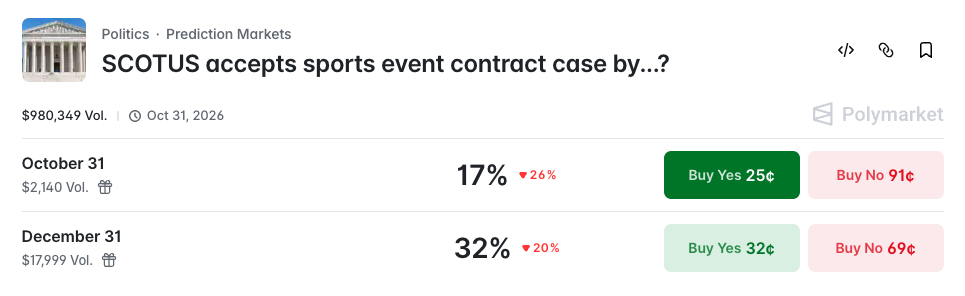
The Polymarket’s U.S. venue has not listed a match and did not say whether it would.
Kalshi still lists other Court markets such as court vacancies, tariff votes, and unrelated grants. It is only in this case, the one that could reclassify its sportsbook, that the company will not conduct a marketplace for outcome trades. In “When the Market Watches the Court,” authors at the University of Chicago showed how event-contract prices twitch during oral argument. Kalshi is choosing not to offer that live feed on a dispute it can still directly shape itself.
What Traders Should Watch on the Docket
Four justices must vote to grant review. Circuit splits have historically helped secure agreement to hear a case. Only 1% of the 7,000 to 8,000 requests for a writ of certiorari are approved by the Court each year. Or, to put it pessimistically, 99% are denied.
If it occurs, a hearing would likely fall in the October 2026 term or later, with an opinion possible in 2027. A denial of the hearing request would leave the Third Circuit win standing in that circuit and the Ninth Circuit loss standing in the West. Meaning, a conflicting federal court opinion, with separate rules for separate parts of the country.
Until the highest court in the land speaks, sportsbooks and state attorneys general will keep arguing that event contracts drain licensed handle. And Kalshi will continue to argue that a CFTC-supervised order book constitutes a national financial market.
References
- Barron’s via TradingView: Kalshi won’t take bets on Supreme Court case
- The Independent: Kalshi draws a line on cases deciding its future
- State Affairs: Dani Lever response to New Jersey filing
- YouTube: Kalshi founders on The Axios Show
- Petition for Writ of Certiorari, Flaherty v. KalshiEX, LLC
- POLITICO: New Jersey asks Supreme Court to take up fight
- CoinDesk: First state certiorari petition on prediction markets
- InGame: NJ files certiorari petition
- Bloomberg Law: New Jersey seeks high court review
- Reuters: Third Circuit ruling, April 6, 2026
- JD Supra / Blank Rome: Ninth Circuit rejects swaps claim
- YouTube: Did the Ninth Circuit just send Kalshi to the Supreme Court?
- Gaming America: Petition filed on schedule after circuit split
- Polymarket: SCOTUS accepts sports event contract case
- University of Chicago Law Review: When the Market Watches the Court
- CoinDesk State of Crypto: Case inches closer to the Court