The shift from sportsbook to sports prediction market is never more overt than when you watch DraftKings, a U.S. sportsbook app powerhouse, devote ever more resources to its event-contract marketplace.
DraftKings is finally sending real football flow onto the prediction market exchange it built for itself. After months of routing most DraftKings Predictions sports volume through external venues, the company began moving significant activity onto DKeX last week, including millions of dollars in combo trades that function like sportsbook parlays. Kickoff week is the deadline CEO Jason Robins set in August, when he said college football and the NFL would be the moment to move sports volume onto the exchange “as fast as is reasonably possible.”
That plan sat behind a simple split. DraftKings Predictions is a futures commission merchant that can place orders on several exchanges. DKeX is the matching engine DraftKings wants those Sunday tickets to hit. Crypto.com had been taking most of the sports flow from DraftKings Predictions. Last Thursday and Friday were the first clear break in that pattern.
The sportsbook and Predictions products already share the Sports & Casino app, so a trader can jump from a traditional line to an event contract without leaving the screen. The well-known app and its 4.8 million active users are the hook. The exchange is the margin story.
Why Football Volume Is Moving Onto DKeX This Week
DKeX launched June 26 after DraftKings absorbed the technology and CFTC designation from its October 2025 Railbird purchase. The company said at the time that owning the exchange would mean faster product changes and better operating economics. Until last week, that claim was mostly structural. The trading tickets still left the building.
Industry reporter Daniel O’Boyle wrote that DraftKings “for the first time sent serious volume to its in-house exchange,” including combo flow in the millions. That matches what CEO Jason Robins told investors on the second-quarter call: phase in the exchange, but do not starve it of liquidity. Spreads have to stay tight, or traders will bounce.
Every contract that matches elsewhere pays a partner. Every contract that matches on DKeX keeps more of the take-rate at home. Citizens JMP’s Jordan Bender has pointed to hundreds of millions of dollars in longer-term market-making revenue if DraftKings can run both the matching and the inventory. That only works if NFL football contracts actually clear in-house.
Robins also said Predictions is not simply draining the sportsbook. He estimated that 80% to 90% of prediction volume in legal sportsbook states comes from professional syndicates and institutional traders, flow that “mostly would not have been on sportsbooks to begin with.” If that holds, moving football tickets onto DKeX is new margin, not a reshuffle of the same handle.
Combo Contracts and the Football Board DKeX Can Now List
Combos are the Predictions version of a parlay, packing several event contracts into one position. DraftKings first offered them by sending the tickets to Crypto.com. In August, it self-certified combos for DKeX, then followed with nine football contract categories covering winners, spreads, totals, player stats, in-game achievements, matchup markets, awards, and futures.
Those listings matter because combos already do real work. Robins said more than half of Predictions customers have used combos and that they accounted for about 20% of consumer volume before football arrived. He also said he expects the NFL season to bring “millions and millions of customers” onto Predictions and called this year “by far our biggest.”
The volume ramp underneath that bet is steep. Around the June launch, DraftKings cited about $3.4 billion in annualized consumer volume and $11.3 billion in annualized total trading volume for the week ended June 21. Later Q2 commentary put annualized volume near $11 billion in July, up from $2.3 billion in April. Those figures still trail Kalshi’s biggest months. They are large enough that keeping football combos off a partner venue is a live earnings decision.
What In-House Matching Changes for Fees and Partners
DraftKings is not cutting every outside pipe. On the Q2 earnings call, Robins said the company can keep plugging into multiple exchanges and sourcing content from multiple places. The intent is still to put the “vast majority” of major sports content onto DKeX this fall. But there are contingency plans in the event that the timeline isn’t met.
That is a sharper stance than December 2025, when Predictions launched and needed partners to fill the board. The June company announcement framed DKeX as the next phase after those partnerships. Avoiding third-party matching fees is only part of the pitch. DraftKings also wants faster listings, tighter combo logic, and one wallet for the trader.
The spend behind that shift is already in guidance. DraftKings is holding 2026 revenue at $6.5 billion to $6.9 billion and adjusted EBITDA at $700 million to $900 million, including a $200 million to $300 million Predictions investment. Bank of America equity researcher Shaun Kelley has warned the outlay could climb if the acquisition stays hot. Robins has accepted that risk because Predictions’ customer cost came in about 25% cheaper per head in Q2, even after the company spent 10% more than planned and added about 600,000 customers.
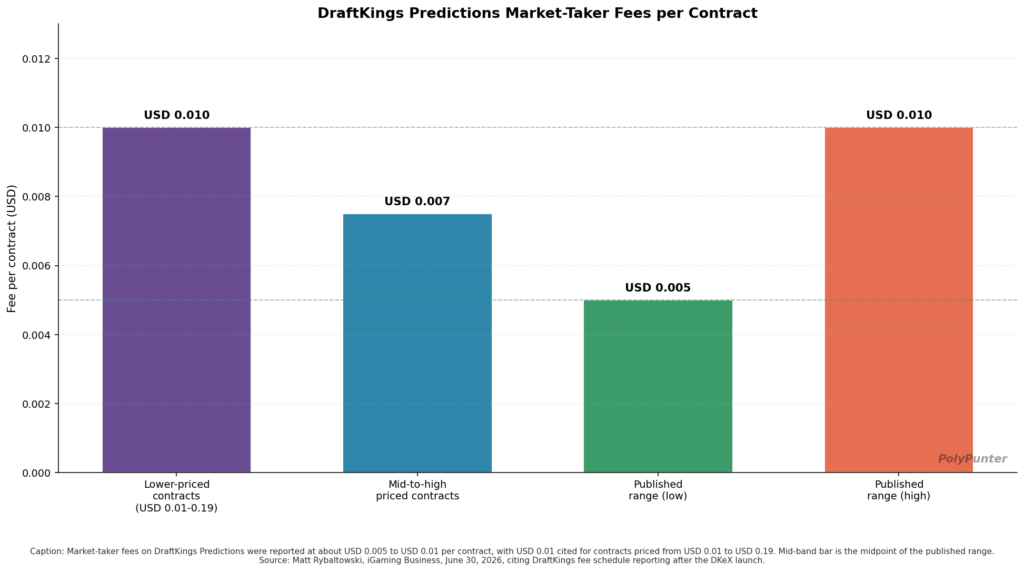
Trading fees sit within a familiar range, with market-makers paying roughly $0.005 to $0.01 per contract, depending on price. Those slices compound only if the tickets stay on DKeX. Send the same Sunday combo to Crypto.com, and a partner collects on the most valuable Predictions product DraftKings has.
Sunday Is the Liquidity Test DKeX Cannot Bluff Through
Robins already named the fail condition. DraftKings will move sports volume onto DKeX only if the exchange can keep trades “flowing smoothly and quickly.” A clean interface will not make up for a thin book. If a spread sits unmatched while a drive is live in a game, traders will route around it.
Last week’s first burst of in-house volume is therefore a signal, not a season win. It shows DraftKings is willing to steer combo flow onto its own engine this NFL season. Clean fills through Week 1 give the company cover to keep pulling tickets off partner venues.
The competitive clock does not pause for this DraftKings experiment. Other sportsbook brands are standing up event-contract products, and Kalshi still does more sports volume than DraftKings Predictions. Robins is betting that a shared app, a combo-heavy football menu, and an owned exchange can close the gap without denting the core DraftKings sportsbook, which he says remains on track to generate about $1 billion in adjusted EBITDA in 2026 before Predictions spend.
References
- CDC Gaming, “DraftKings readies in-house exchange DKeX for football season with volume surge, parlay launch,” Sept. 2, 2026
- Bill King, Sports Business Journal, “DraftKings’ Robins: ‘We are on offense,’” Aug. 7, 2026
- DraftKings Inc. (DKNG) Q2 2026 Earnings Call Transcript, Seeking Alpha, Aug. 7, 2026
- Corey Sharp, Legal Sports Report, “DraftKings Eyes In-House Combos As Predictions Volume Surges,” Aug. 13, 2026
- Gambling Insider, “DraftKings’ DKeX Self-Certifies Nine Football Contracts Ahead of NFL Season,” Aug. 11, 2026
- DraftKings / Business Wire via FT, “DraftKings Launches Proprietary Exchange to Bolster Differentiated Predictions Experience,” June 26, 2026
- DraftKings Network, “DraftKings Acquires Railbird to Enter Prediction Markets Business,” Oct. 21, 2025
- Matt Rybaltowski, iGaming Business, “DraftKings is bullish on new exchange, but questions remain on fee generation,” June 30, 2026