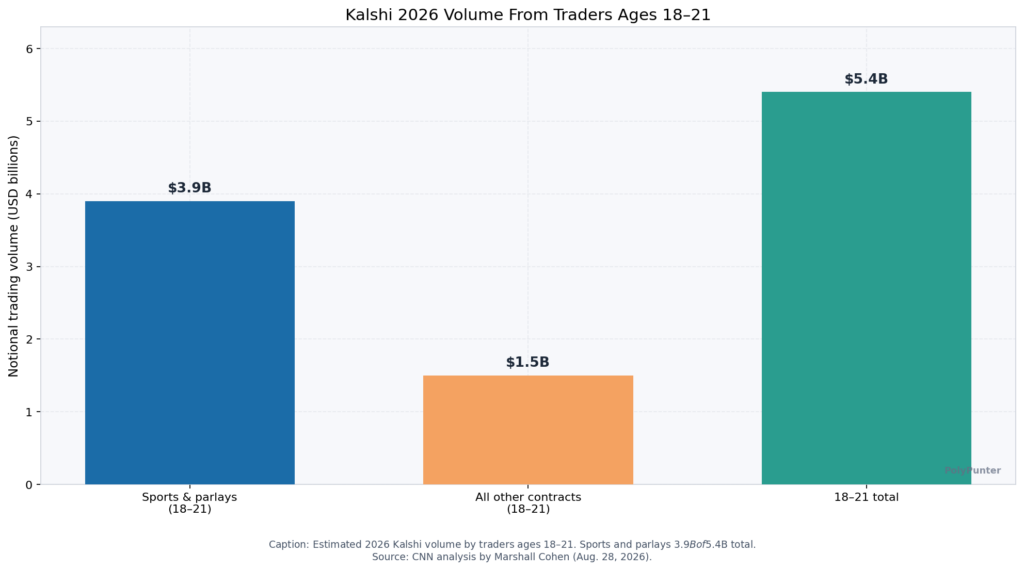
Young adults between 18 and 21 have traded an estimated $5.4 billion on Kalshi so far in 2026, according to a Friday CNN analysis by Marshall Cohen. Federal event-contract rules allow trading at 18, while state-licensed sportsbooks still require 21. Sports and parlays already account for about 80% of Kalshi’s flow, and the same college-age group has moved an estimated $3.9 billion in trades through those contracts this year.
Kalshi’s 2026 volume has topped $173 billion as of Friday. A company spokesperson told CNN that traders ages 18 to 21 currently make up 3.14% of that volume, then declined to disclose deposits or the exact amount spent, though there’s no specific reason to believe this figure isn’t accurately pulled. The share is small. The cash is obviously not.
Why the $5.4 Billion Print Matters
At 3.14% of more than $173 billion, the 18-to-21 cohort is a thin slice of the book. $5.4 billion in notional trading is still large enough to dominate the age debate, especially because $3.9 billion of it sits in sports and parlays that look like popular wagering products locked behind a 21+ door elsewhere.
Kalshi has not released the number of 18-to-21 accounts, so it is unclear whether a few heavy traders or a broad base of accounts drove the volume. We know the depth, not the extent. The company has described deposit-limit prompts and warnings for risky patterns, and it gave $2 million to the National Council on Problem Gambling for trader-health work. But that’s a pro forma type donation for a platform like Kalshi and unlikely to close the argument over whether 18 is the right starting age for sports-linked contracts.
Polymarket declined to comment and has not published comparable figures for ages 18 to 21. That leaves Kalshi’s disclosure as the clearest public window into college-age money in event contracts this year.
Leagues, Rivals, and the Push to Raise the Age to 21
American Gaming Association president Bill Miller told CNN that many families do not realize a freshman can open an event-contract account and trade football while remaining locked out of a licensed sportsbook. “This means their freshman son or daughter is prohibited from entering legal sportsbooks, but now they can just pull out their phone and use Kalshi to bet on football,” Miller said.
The NCAA, NFL, NBA, and PGA Tour have urged the Commodity Futures Trading Commission to lift the sports-contract minimum to 21. The agency has so far kept the 18+ line in proposed rules still under review after comments closed July 27. A separate Senate bill, the Prediction Markets Security and Integrity Act of 2026 (S. 4060), would also raise the federal floor to 21 if it becomes law.
Two business models now sit side by side. Kalshi accepts traders at 18. Fanatics launched a 21+ product last year, with a spokesman telling CNN that 21 is “the right age for any type of real-money activities.” Novig, which won CFTC approval in June, also set a voluntary 21+ policy and has recorded about $450 million in trading volume.
Novig CEO Jacob Fortinsky told CNN the company “listened to the concerns of the NCAA and other professional sports leagues” and does not want “irresponsible trading behavior” among college-age adults as a core part of its book. That choice leaves billions in 18-to-20 volume on the table. Forty-four state attorneys general, tribal gaming authorities, and casino groups are separately challenging the claim that event contracts sit beyond state gaming laws.
Safeguards Have Not Ended the Harm Stories
Kalshi spokeswoman Elisabeth Diana has said federal law already lets 18-year-olds trade financial products, including event contracts. In a May CNN case study, an 18-year-old identified only as Andrew used credit-card cash advances to trade live tennis, booked quick profits, then lost the stack after a failed overnight withdrawal that Kalshi attributed to a bank fraud hold. Andrew later described the session as “tunnel vision.”
Abdullah Mahmood, who runs the gaming intervention program at the Maryhaven rehab center, described a 21-year-old student who lost “over five figures” across Kalshi and Polymarket. Philip Sullivan, who runs the Florida Council on Compulsive Gambling helpline, said many under-21 callers had already relapsed from other wagering apps. Those accounts sit outside the $5.4 billion print, yet they explain why the number landed with force.
Worth noting, CNN, reporting on these age-gate issues with Kalshi, has a data partnership with Kalshi and bars editorial staff from trading. Cohen’s Friday story and an earlier May investigation remain the main primary sources for the age-band totals and named interviews. Bernstein research, cited by CNBC earlier this year, estimated that Kalshi held about 90% of U.S. prediction volume, and that 80% of Kalshi trading is sports-event contracts, which is why Kalshi’s 18-to-21 book now shapes the national argument.
Football calendars tend to draw college-age attention the way the World Cup did in June, when Kalshi posted stretch runs of $1 billion-plus in sports days. If that pattern repeats, the sports-and-parlay tally for 18-to-21 traders will keep climbing before any final CFTC rule or Senate bill can change the age line.
Regardless of position, everyone should agree that this is an issue worthy of broad public debate. And that debate should rely on both principle and facts. And these are the facts regarding college-age use of Kalshi sports-event contracts.
References
- Marshall Cohen, “Young adults under 21 traded $5 billion on Kalshi this year,” CNN, Aug. 28, 2026
- Marshall Cohen, “College-age adults are rushing to prediction market sites,” CNN, May 28, 2026
- Paradigm, Kalshi volume dashboard
- Tanya Chepkova, “Kalshi’s Youngest Traders Moved $5.4 Billion,” Finance Magnates, Aug. 28, 2026
- CNBC Television, “Where Is Young Money Going,” Aug. 27, 2026
- CNBC, Bernstein prediction-market growth estimate, April 14, 2026
- Kalshi, National Council on Problem Gambling partnership announcement
- Front Office Sports, Novig partnership coverage
- Bill King, Kalshi World Cup volume, Sports Business Journal, June 26, 2026