

Prediction markets promise crisp, continuous probability signals derived from the collective consensus of staked traders. Yet a quiet arithmetic force pulls those signals off course whenever contracts stretch far into the future. Capital sits locked until settlement, earning nothing while the clock ticks. As a result, long-dated prices systematically understate true probabilities, embedding a settlement discount that pure belief models ignore.
This capital lock-up effect remains one of the least examined distortions in modern event contracts. While favorite-longshot patterns draw repeated attention, the time-value penalty on distant outcomes receives far less scrutiny. Understanding it changes how anyone should read a price, size a position, or design a platform.
Why Locked Capital Creates Systematic Underpricing in Event Contracts
Every prediction market contract functions as a delayed contingent claim. These are futures contracts. The buyer posts collateral that stays immobilized until an oracle or official source confirms the outcome. During that interval, the capital generates zero yield on most platforms. The opportunity cost of that capital, therefore, compounds over time.
Consider a near-certain event trading near Yes $0.95 with one year remaining. A risk-free investment alternative might return 4 percent or more. Holding the contract forgoes that return on nearly the entire stake. Consequently, the rational bid falls below the subjective probability, creating an apparent underconfidence that is mechanical rather than cognitive.
Researchers formalizing this process describe the resulting prices as discounted probabilities rather than frictionless forecasts. The mapping from price to probability therefore becomes incomplete for any horizon long enough to matter. Short-dated contracts escape most of the penalty because the lock-up window is brief, while long-dated contracts absorb it fully and ought to shift capital toward nearer-term markets.
Settlement Discounting and the Annualized Settlement Wedge
Recent empirical work recovers the precise size of this friction by examining persistent near-certain contracts. Contracts that trade at or above $0.90 for seven consecutive days should, in a frictionless world, sit near par. Their observed shortfall relative to $1.00 reveals the market’s required compensation for lock-up.
Authors Jonas Gebele and Florian Matthes convert those shortfalls into an annualized settlement wedge, or ASW. The recovered wedges prove positive, maturity-dependent, and time-varying, with mean estimates ranging from roughly 3 percent to nearly 7 percent. Adjusting observed prices by these curves reduces the raw horizon gradient in near-certainty pricing by 48 to 88 percent.
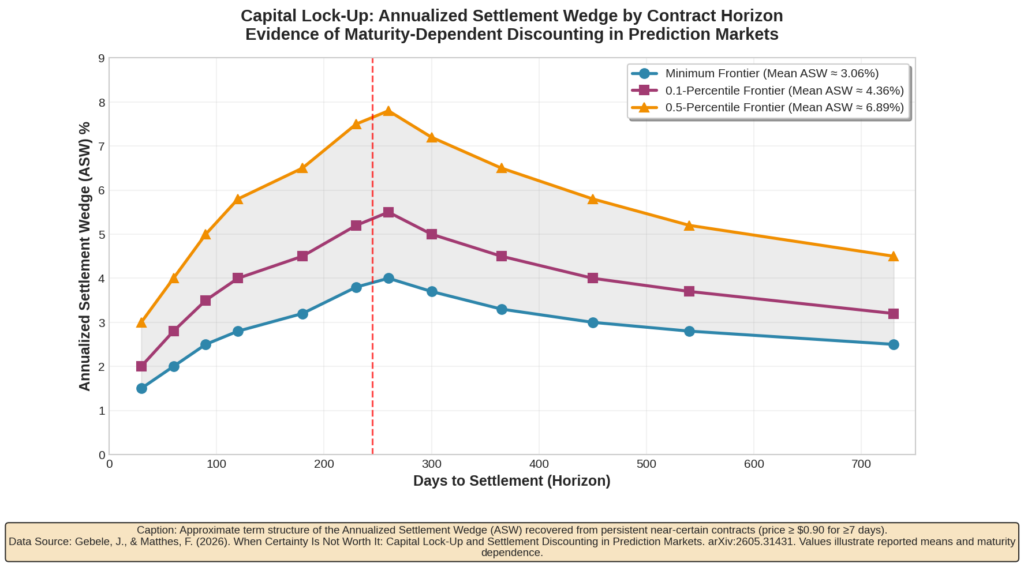
In other words, a large share of what appears as forecast error at long horizons is simply the market pricing in the cost of capital tied up in immobilized capital. The study draws primarily on Polymarket data, with cross-checks against Kalshi. Architecture differences matter: platforms offering yield on collateral display flatter term structures, while those recycling positions through negRisk conversion compress the effective lock-up period. Pricing quality is endogenous to settlement mechanics and collateral productivity.
Watching a clear explanation of the underlying time-value principle helps fix the intuition. Khan Academy’s short lesson on the time value of money explains why a dollar today is worth more than a dollar tomorrow at positive interest rates.
How Opportunity Cost Shapes Trader Behavior and Market Depth
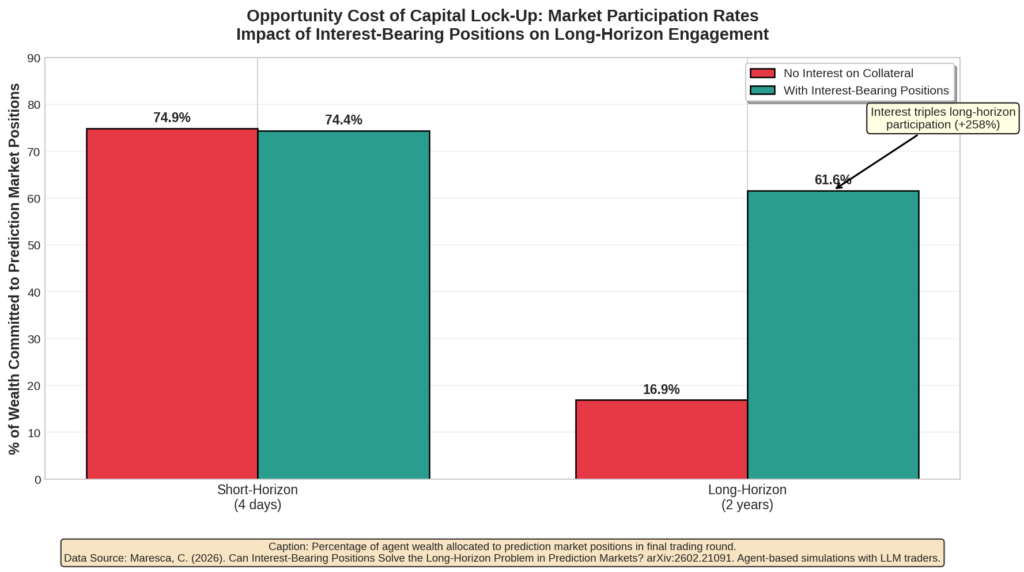
The same arithmetic that discounts prices also rations capital. Traders facing high opportunity costs simply allocate less wealth to long-horizon books. Agent-based simulations using large-language-model traders quantify the scale of this withdrawal.
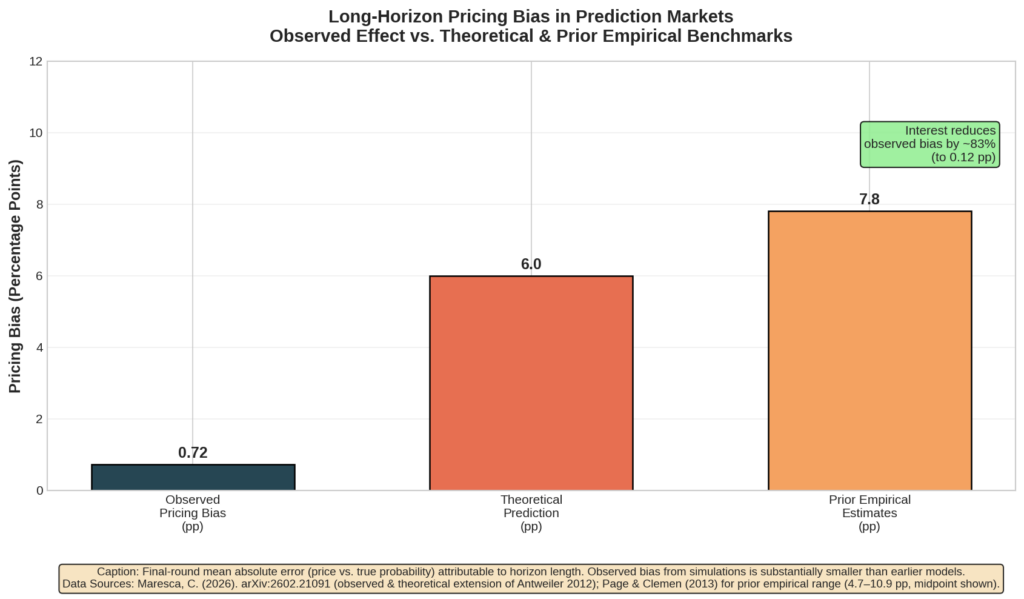
In a design varying horizon and the presence of interest, long-horizon markets without yield saw only about 17 percent of wealth committed. Introducing interest-bearing positions lifted that share above 60 percent and eliminated roughly 83 percent of the residual pricing bias attributable to horizon length.
Caleb Maresca of New York University reports these results in the February 2026 paper “Can Interest-Bearing Positions Solve the Long-Horizon Problem in Prediction Markets?” The observed bias of 0.72 percentage points proved smaller than earlier estimates, yet still material. Paying interest primarily restores participation rather than rewriting beliefs, so platforms that leave capital idle starve their most valuable markets of depth.
Contrasting Capital Lock-Up with the Favorite-Longshot Pattern
Most commentary on prediction-market distortions centers on the favorite-longshot bias: low-priced contracts win less often than their prices imply, while high-priced contracts win slightly more. That pattern is real and well documented. Capital lock-up operates on an orthogonal axis.
Favorite-longshot effects appear at every horizon and reflect behavioral over-weighting of small probabilities plus limited arbitrage capital. Capital lock-up effects intensify strictly with maturity and reflect pure arithmetic. A contract priced at $0.20 for resolution next week faces little opportunity-cost drag, yet the identical probability for resolution in eighteen months faces a substantial one.
A July 2026 examination of calibration identifies capital lock-up as the least discussed of the major distortions. Treating the raw price as an unadjusted forecast therefore systematically understates distant outcomes. Both biases can coexist, so separating them requires maturity-conditioned analysis that most casual traders never perform.
Practical Consequences for Reading and Trading Long-Dated Contracts
Anyone treating a long-dated price as a pure probability forecast is reading an incomplete number. The market is simultaneously expressing a belief and demanding compensation for forgone yield. Adjusting upward by the prevailing risk-free rate scaled to the remaining horizon restores a closer approximation of collective belief.
Traders hunting edge confront the opposite problem. An apparent mispricing on a distant contract may vanish once opportunity cost is subtracted. The expected profit must cover both the probability error and the yield sacrificed while capital remains locked. Many edges disappear under that dual hurdle.
Platform designers face a clearer mandate. Yield-bearing collateral, tokenized positions that can serve as collateral for lending, and mechanisms that recycle losing shares into synthetic collateral all reduce the effective lock-up. Expanding such features would deepen books on the very market questions society most needs answered.
Design Paths That Reduce Time-Value Distortions
Three architectural levers stand out. Paying interest on locked collateral directly offsets opportunity cost and has already shown large effects on participation in controlled simulations. NegRisk or complete-set conversion lets traders free capital by combining offsetting positions into synthetic collateral that can be withdrawn or redeployed. External lending protocols that accept prediction-market positions as collateral would transform idle balances into productive assets.
Each change alters the annualized settlement wedge. Yield flattens the term structure. Recycling shortens effective duration. Credit layers convert lock-up into leverage. Platforms that ignore these levers leave their long-horizon markets structurally disadvantaged relative to short-term flows.
Empirical support continues to accumulate. The Gebele-Matthes term-structure recovery and the Maresca participation results both point in the same direction: settlement frictions are design choices. Choosing better designs improves both price quality and the volume of capital willing to underwrite distant forecasts.
Why the Bias Matters Beyond Trading Screens
As we note on PolyPunter, when discussing all mechanical flaws in prediction markets, these markets increasingly inform media narratives, corporate scenario planning, and policy debates. When long-dated prices systematically understate probabilities, those downstream users inherit a distorted signal. Treating the raw number as gospel therefore misleads.
Moreover, the bias concentrates liquidity in short-horizon entertainment contracts and starves precisely the markets that could aggregate dispersed knowledge in science, economics, and global events about slow-moving risks. Society loses the information externality that justified prediction markets in the first place.
Recognizing capital lock-up as a first-order distortion rather than a footnote therefore carries stakes larger than any single trader’s P&L. Correcting it through yield, recycling, and credit would let the mechanism fulfill more of its original promise: turning private conviction into public probability estimates that improve with horizon rather than degrade.
The arithmetic is simple, the evidence is mounting, and the design solutions already exist. The remaining question is whether platforms and traders will continue to treat long-dated prices as pure probabilities or begin to adjust for the silent cost of locked capital.
References
- Gebele, J., & Matthes, F. (2026). When Certainty Is Not Worth It: Capital Lock-Up and Settlement Discounting in Prediction Markets. arXiv:2605.31431
- Gebele, J., & Matthes, F. (2026). Full HTML version of capital lock-up study
- Maresca, C. (2026). Can Interest-Bearing Positions Solve the Long-Horizon Problem in Prediction Markets? arXiv:2602.21091
- Maresca, C. (2026). Full HTML version of interest-bearing positions study
- Crypto.news (2026, July 27). Do prediction market odds equal probability? Not quite
- Khan Academy. Time value of money | Interest and debt | Finance & Capital Markets
- Investopedia. Time Value Of Money Explained
- Theta Edge — Binary Time-Value Calculator for Prediction Markets
- The cost of capital in a prediction market. International Journal of Forecasting (2018)
- Market Math. Prediction Market Bankroll Management: How to Size Positions and Survive
- DWF Labs (2026). A Second Identity: Prediction Markets as Financial Derivatives
- Laika Labs. Do Prediction Markets Pay Interest on Open Bets? 2026
- Medium / Coinmonks (2026). The Hidden Liquidity Trap in Long-Dated Polymarket Bets
- Lattica Finance (2026). Unlocking Liquidity on Prediction Markets
- Works in Progress. Why prediction markets aren’t popular