

Prediction markets once promised pure aggregation of collective foresight, converting scattered beliefs into precise probabilities. A deeper structural weakness is now exposing itself. When the underlying event becomes contested, the rules governing settlement collapse into open fights over interpretation. Markets stop reflecting practical results and turn into arenas where competing narratives battle for control of the payout. This rules-based disorder is not a rare glitch. It is an existential design flaw.
The problem surfaces most clearly on decentralized venues relying on optimistic oracles and token-weighted voting. Ambiguous wording, flexible standards such as “consensus of credible reporting,” and concentrated voting power combine to transform market settlement itself into a secondary contest. Traders must forecast both the event and how a small group of tokenholders will interpret its proper resolution. Consequently, prices begin tracking governance dynamics as much or even more than underlying event truth, eroding the informational value that justified the markets’ existence.
High-profile disputes have already locked hundreds of millions of dollars in limbo. These cases follow a consistent pattern: the more subjective the resolution criteria, the greater the opportunity for narrative capture. The system rewards rule-lawyering and influence over accurate research and foresight. Unless platforms confront this flaw, prediction markets risk losing the credibility that fueled their expansion.
How Optimistic Oracles Turn Settlement into a Second Market
Most decentralized prediction markets resolve through an optimistic oracle. A proposer posts an outcome with a bond, typically $750. A short challenge window follows. If no one disputes the proposal, the market settles quickly. When a challenge appears, the dispute escalates to a vote among holders of the oracle’s native token. The design assumes economic incentives will drive honest reporting because voters who side with the majority earn rewards while dissenters lose stake.
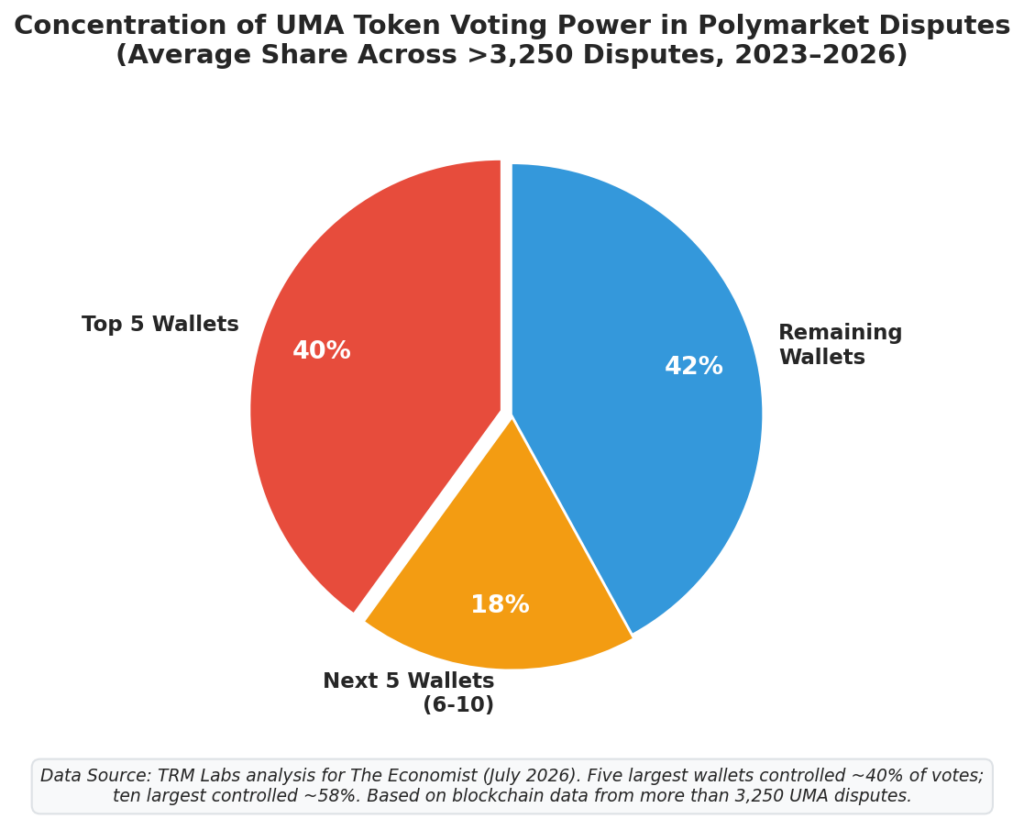
In practice, the mechanism creates powerful secondary incentives. Tokenholders who also hold positions in the disputed market face clear conflicts. Voting power is strictly proportional to token holdings. Blockchain investigations examining more than 3,250 disputes over three years found that the five largest wallets controlled an average of 40 percent of the vote while the ten largest approached 58 percent. These concentrations turn settlement into a contest of capital commitment rather than a search for clarity.
The debate period preceding the formal vote adds further complexity. Evidence is submitted in public channels, yet the final ballot remains secret. Prices swing as influential tokenholders signal their leanings. Traders who correctly anticipate the eventual vote can profit even when the real-world event stays ambiguous. As a result, the market’s primary function shifts from forecasting external reality to forecasting internal governance outcomes. Platform documentation acknowledges the difficulty, noting that resolution rules are supposed to specify precise sources and criteria in advance, yet the pressure to list novel markets often produces deliberately flexible language.
Polymarket currently has 10,000 open markets.
Signature Cases That Exposed the Fracture Lines
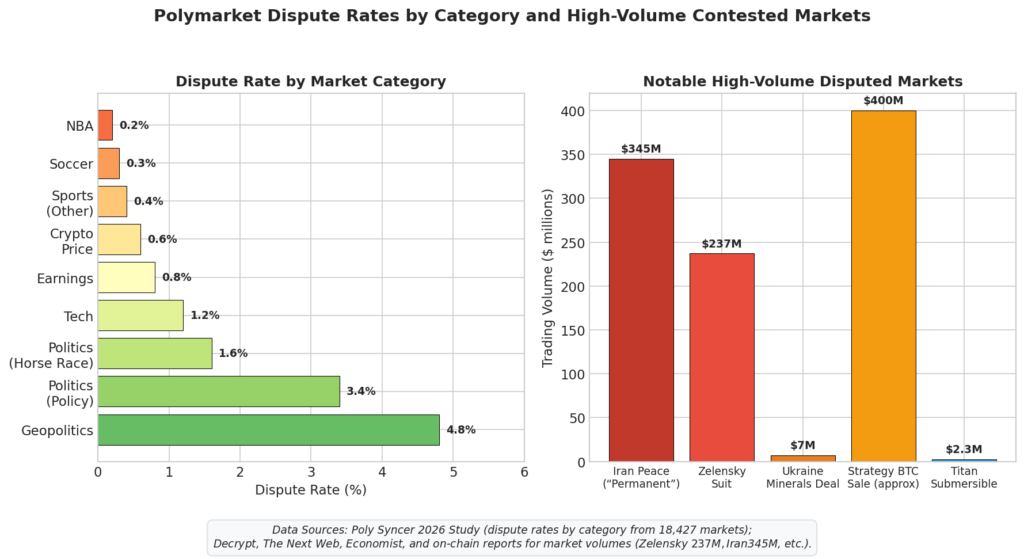
One clear illustration arrived with a market asking whether a national leader (Zelenskyy) would be photographed or videotaped wearing a suit within a defined window. Trading volume exceeded $237 million. Multiple major outlets described the appearance as a suit and images circulated widely. An initial proposal favored the affirmative. After successive challenges, the final token-weighted vote resolved to the negative, citing insufficient consensus of credible reporting. The reversal sparked intense backlash among those who had positioned according to the plain visual evidence and contemporaneous media language.
A similar pattern appeared with a market on whether a missing submersible would be found by a specific date. The criteria contained an explicit caveat: locating pieces alone would not suffice unless the cabin containing the passengers was recovered. Debris was located, and officials announced a catastrophic implosion. The market nevertheless resolved in the affirmative after an oracle dispute, prompting complaints that the letter of the rule had been subordinated to a broader interpretive preference.
More recent examples continue the trend. A market requiring a “permanent” end to U.S.-Iran hostilities left $345 million in trading volume frozen when an interim agreement appeared. Temporary ceasefires explicitly failed the stated standard, yet the semantic debate over permanence proved intractable. Another high-volume contract on whether a corporate entity would sell any Bitcoin by a cutoff date resolved contrary to subsequent official filings because confirmation timing, rather than the event itself, became the decisive battleground for final resolution. In each instance, the market ceased to be a pure reflection of the real-world event outcome and became a referendum on how the governing rules should be read.
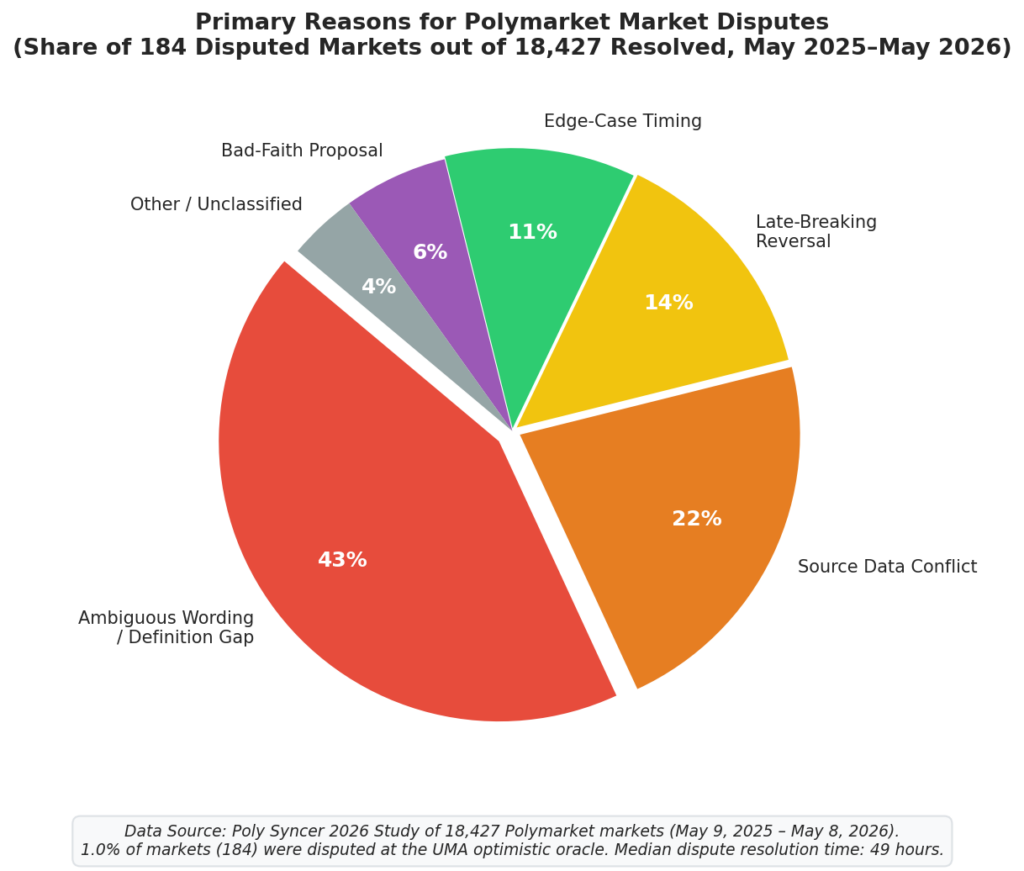
Data covering more than 18,000 resolved markets over a recent twelve-month window showed that roughly one percent reached formal dispute. Among those disputes, ambiguous wording or definitional gaps accounted for 43 percent of cases. Source conflicts and late-breaking reversals added further complexity. The median time from event end to undisputed resolution remained under an hour, yet disputed markets stretched into multiple days, freezing capital and amplifying uncertainty.
Why Concentration of Voting Power Amplifies the Damage
Token-weighted voting was intended to harness skin-in-the-game incentives. Instead, it has produced a plutocratic filter. When nine wallets control nearly half of all voting power across years of disputes, the system concentrates decisive authority in a small, often anonymous cohort of “whales”. Many of those same wallets maintain active trading accounts on the prediction platforms themselves. Investigations have linked a substantial share of active voters to positions in the very markets under adjudication. In more than 300 examined disputes, at least one voter held a direct financial stake in the outcome being decided.
The economic incentive is straightforward. A large tokenholder who also holds a directional position can influence settlement in a manner that favors that position. Even when no direct conflict exists, the repeated success of the largest wallets creates a coordination point around their voting signals. Smaller traders begin trading the anticipated vote rather than the underlying event. Market prices therefore incorporate an additional layer of governance risk that is never fully transparent to outside users of the probability data.
Platform operators have experimented with mitigations. Whitelists now restrict who may propose resolutions and debate periods have been formalized. Yet the fundamental voting structure remains unchanged. Capital still determines influence, as you might say it does in political election contests. As long as that remains true, contested reality will continue to produce contested payouts. The more money that flows into ambiguous contracts, the greater the incentive for sophisticated actors to acquire both trading positions and voting power simultaneously.
Regulated venues that rely on named authoritative sources face fewer but still nontrivial interpretation problems. When official scorekeeping contains later-corrected errors, or when cultural events defy binary definitions, settlement discretion reappears. The contrast is instructive. Centralized rulebooks can still generate ambiguity, but the decentralized model multiplies it by introducing an additional layer of tokenholder politics.
The Broader Consequences for Informational Integrity
Prediction markets derive social value from the claim that prices embody the best available collective estimate of future states. When resolution risk becomes material, that claim weakens. A contract trading at 70 cents no longer represents a straightforward 70 percent probability of the stated event. It represents that probability multiplied by the probability that the settlement process will recognize the event according to the same interpretation held by most traders. In highly liquid, objective markets, the second factor approaches one. In contested or loosely worded markets, it can fall substantially lower.
This divergence carries practical effects beyond individual trading accounts. Media organizations, corporate planners, and public officials increasingly publicize prediction-market prices as inputs to decision-making. When those prices embed unresolved governance uncertainty, the informational signal becomes noisy. Traders who specialize in rule interpretation and tokenholder behavior extract value, while those who focus purely on external information face systematic disadvantage. The wisdom-of-crowds mechanism therefore tilts toward a narrower, more professionalized subset of actors who understand the secondary game.
In addition, the mere existence of large disputed markets creates public feedback loops. Once a high-volume contract enters dispute, social channels fill with advocacy for one interpretive frame or another. Influencers and large holders post detailed rationales and prices move in response. The debate itself becomes part of the information environment that later voters consult. What begins as an attempt to settle a factual question ends as a contest of narrative dominance conducted under economic incentives.
The long-term, broader risk is reputational. Platforms that market themselves as truth machines cannot indefinitely tolerate outcomes that diverge from widely shared perceptions of reality without inviting skepticism and external market variables. Serious capital that might otherwise use the markets for hedging or information discovery will demand clearer settlement certainty or simply stay away. Without it, the venues risk remaining dominated by speculative sports and entertainment-driven volume rather than the high-stakes forecasting applications originally envisioned.
Pathways Toward More Robust Design
Addressing resolution ambiguity requires changes at multiple layers. Market creators must invest far more effort in precise, machine-checkable criteria before listing. Precedence rules, ranked source hierarchies, explicit time semantics, and default outcomes for edge cases can reduce the scope for later dispute. Some research has already proposed formal predicate specifications that would allow automated checking of potential loopholes at the drafting stage.
Oracle design itself needs structural reform. Quadratic voting, position-disclosure requirements, or caps on individual voting power would dilute the influence of the largest wallets. Separating the set of eligible voters from active traders on the same platform would reduce conflicts of interest. Longer challenge windows combined with clearer evidence standards could improve the quality of the information that reaches the final vote.
One interesting methodology used by X to evaluate the elevation of Community Notes requires cross-ideological agreement—meaning users who have historically disagreed must converge on a note’s utility before it is displayed. This prevents historically similar interests from working together to elevate a Community Note.
Hybrid models also deserve exploration. Named authoritative sources can serve as primary resolvers for objective events, with decentralized voting reserved strictly for residual interpretive questions. Artificial-intelligence systems locked to specific models and prompts at market creation offer another experimental avenue, provided the selection process itself remains transparent and resistant to later influence. None of these approaches eliminates ambiguity entirely. The goal is to shrink the zone in which narrative warfare can profitably occur and diminish the number of edge cases.
Platform operators face a commercial tension. Tight, unambiguous rules limit the range of markets that can be listed and may reduce short-term volume. Loose rules can generate engagement and attention. The platforms that resolve this tension in favor of long-term integrity should ultimately attract the deeper, more sophisticated capital that can sustain the industry beyond its current speculative phase. Those that continue to prioritize volume over clarity will find that each new high-profile dispute further undermines the very trust they need to scale.
References
- Rules-based disorder: why prediction markets struggle if reality is contested – The Economist
- Prediction markets need better rules – The Economist
- Polymarket Rules ‘No’ on $237M Controversial Bet Over Zelenskyy’s Suit – Decrypt
- Volodymyr Zelensky’s Clothing Has Sparked a Polymarket Rebellion – WIRED
- Polymarket’s $345 million Iran peace bet is stuck because nobody can agree on what “permanent” means – The Next Web
- Resolution – Polymarket Documentation
- Only 9 Wallets Control Nearly Half of UMA Voting Power on Polymarket: Bloomberg – Crypto Times
- How Long Does Polymarket Take to Resolve? 2026 Study – Poly Syncer
- How Prediction Markets Resolve: UMA Oracle Explained – crypto. news
- Who Decides What’s True? Jonathan Zittrain in Conversation with Polymarket’s Shayne Coplan – YouTube
- OpenAI Digs A Moat, Ethereum Foundation Loses Talent, And Polymarket’s UMA Problem | The Breakdown – YouTube
- Draft: List of disputes on Polymarket – Wikipedia
- Crypto bettors’ uproar over Titan submarine puts spotlight on ‘decentralized truth’ – DL News
- How prediction-market resolution works on Polymarket and Kalshi – RivoMarkets
- Prediction Market Oracles & Resolution Guide 2026 – Track360
- Prediction markets are expanding beyond the relatively straightforward two-way bets – The Economist on X
- Nine crypto whales dominate polymarket disputes worth billions – Moneyweb
- Nine Wallets Hold Decisive Power Over Polymarket Dispute Outcomes, Report Finds – BitcoinWorld
- Do prediction market odds equal probability? Not quite – crypto.news
- How AI judges can scale prediction markets – a16z crypto