
In a significant turnaround for Kalshi in its ongoing legal skirmishes with state regulators, a federal district court in Nashville, Tennessee, has granted the platform’s motion for a preliminary injunction against the state. The ruling, issued on February 19, 2026, by U.S. District Judge Aleta A. Trauger of the Middle District of Tennessee, determines that sports-related event contracts offered by Kalshi qualify as “swaps” under the Commodity Exchange Act (CEA). This classification places them under the exclusive jurisdiction of the Commodity Futures Trading Commission (CFTC), preempting Tennessee’s attempts to regulate them as unlicensed sports betting. The decision ends Kalshi’s recent string of defeats in similar cases across Maryland, Massachusetts, and Nevada, highlighting a deepening divide in judicial interpretations of federal preemption in prediction markets.
The case, KalshiEX LLC v. William Carver et al., stemmed from a cease-and-desist letter sent by the Tennessee Sports Wagering Council (SWC) to Kalshi, demanding the platform halt offerings of sports event contracts to Tennessee residents, void existing contracts, and refund deposits. The SWC threatened fines, civil penalties, and potential criminal referrals, asserting that Kalshi was operating as an unlicensed sportsbook under the Tennessee Sports Gaming Act. Kalshi swiftly filed suit against SWC officials in their official capacities, seeking declaratory and injunctive relief to continue operations without state interference.
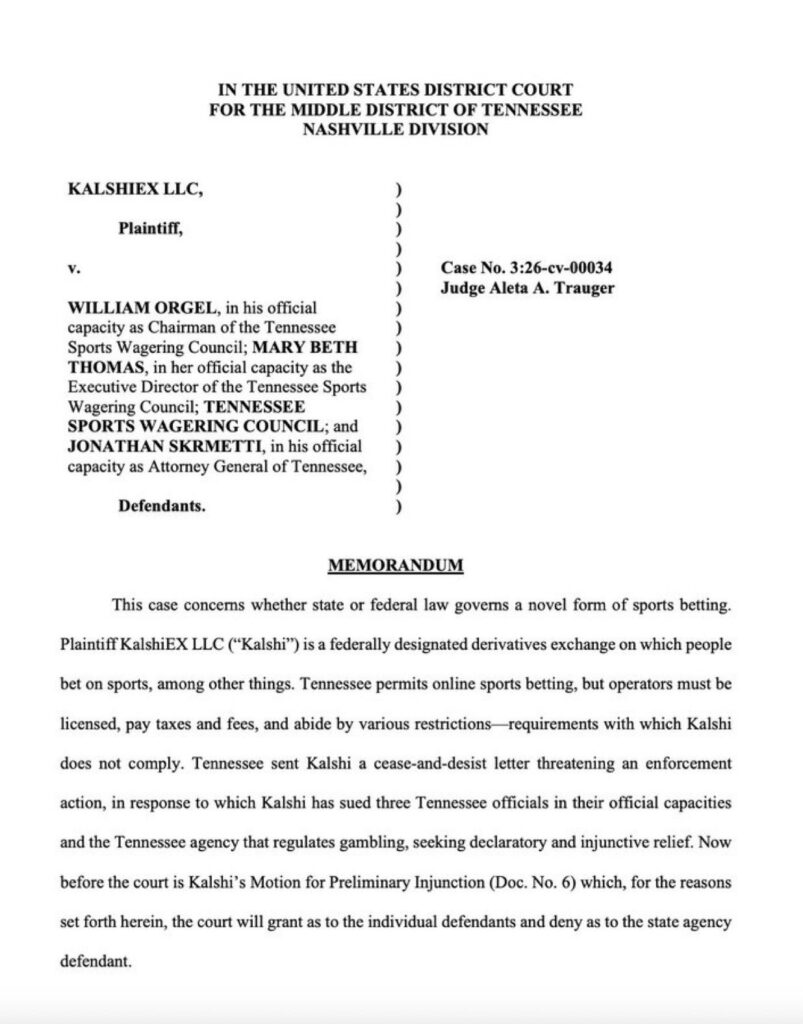
Judge Trauger’s 25-page memorandum opinion carefully dissected the key issues. She framed the central question as whether Kalshi’s event contracts constitute “swaps” under the CEA’s broad definition, which includes contracts dependent on the occurrence or nonoccurrence of an event with potential financial, economic, or commercial consequences. Rejecting Tennessee’s argument that sports outcomes do not qualify as “events” or “occurrences,” the judge ruled that outcomes are inherently part of events, stating, “the outcome of an event can be an occurrence, too.” This interpretation aligns with the plain language of the statute, bolstering Kalshi’s claim of federal exclusivity.
Furthermore, the court found that Kalshi is likely to succeed on its preemption argument under conflict preemption principles. Tennessee’s enforcement would make compliance with both federal and state laws impossible, as Kalshi operates as a CFTC-registered designated contract market (DCM). The judge emphasized that the CEA grants the CFTC “exclusive jurisdiction” over such swaps, overriding state gambling laws that conflict with federal regulation. As part of the injunction, Kalshi was ordered to post a $500,000 security bond to cover potential damages, but the ruling allows the platform to continue offering sports contracts in Tennessee pending the full resolution of the case.
Divergent Judicial Paths in Prediction Markets Litigation
The Tennessee ruling underscores a stark split in how courts across the United States are approaching these prediction market cases. Legal experts note that judges have adopted two primary analytical frameworks, leading to inconsistent outcomes that could ultimately require appellate or Supreme Court intervention. Ultimately, the sparring between individual state gaming regulators and the CFTC/CEA as to who can and should place guardrails on prediction markets needs to be settled across all 50 states.
In cases like New Jersey and now Tennessee, courts have zeroed in on the technical classification of event contracts as “swaps.” For instance, in April 2025, U.S. District Judge Edward Kiel in New Jersey granted Kalshi a preliminary injunction, concluding that the CEA preempts state wagering laws when applied to federally regulated swaps. The New Jersey decision, currently under appeal in the Third Circuit, devoted significant analysis to the CEA’s definitions and the CFTC’s role, much like Judge Trauger’s opinion in Nashville. These rulings prioritize the statutory text, finding that sports contracts fit squarely within the swap definition, thus invoking exclusive federal jurisdiction.
Contrastingly, courts in Massachusetts and Maryland have taken a broader view, emphasizing congressional intent as the key determinant. In January 2026, Suffolk County Superior Court Judge Christopher Barry-Smith in Boston granted Massachusetts Attorney General Andrea Joy Campbell’s motion for a preliminary injunction, barring Kalshi from offering sports contracts without a state license. The Massachusetts court, relying on the District of Maryland’s August 2025 decision by U.S. District Judge Adam B. Abelson, held that Congress did not intend the CEA to displace longstanding state authority over gambling. Judge Abelson denied Kalshi’s injunctive relief in Maryland, arguing that the CEA’s savings clauses and special rules indicate no clear preemption of state police powers in gaming regulation. These decisions frame prediction markets as essentially gambling operations, subject to state oversight despite CFTC involvement.
Nevada’s litigation presents a hybrid approach, combining elements of both frameworks. Initially, in April 2025, U.S. District Judge Andrew P. Gordon in Las Vegas granted Kalshi a preliminary injunction, aligning with the “swaps” focus. However, in a reversal on November 25, 2025, Judge Gordon dissolved the injunction, citing the Maryland ruling and concluding that federal law does not preempt Nevada’s gaming laws. The Ninth Circuit Court of Appeals denied Kalshi’s request for an administrative stay in February 2026, allowing state enforcement to proceed. Nevada’s case illustrates how courts can blend technical definitions with intent analysis, often tipping the scales toward states when conflicts arise.
The following table summarizes the key court decisions in prediction markets litigation:
| State | Court Focus | Outcome for Kalshi | Key Reasoning | Status |
|---|---|---|---|---|
| Tennessee (Nashville) | Swaps Definition | Win (Preliminary Injunction Granted) | Contracts are swaps under CEA; federal preemption applies. | Ongoing; Bond Posted |
| New Jersey | Swaps Definition | Win (Preliminary Injunction Granted) | CEA exclusive jurisdiction preempts state laws. | Appealed to 3rd Circuit |
| Massachusetts (Boston) | Congressional Intent | Loss (Injunction Granted to State) | No intent to preempt state gambling authority. | Emergency Stay Granted; Appeal Pending |
| Maryland | Congressional Intent | Loss (Injunction Denied) | CEA does not displace state gaming powers. | Appealed to 4th Circuit |
| Nevada (Las Vegas) | Hybrid (Swaps + Intent) | Loss (Initial Win Reversed) | State laws not preempted; compliance possible. | Appealed to 9th Circuit; Stay Denied |
This table highlights the fractured legal landscape, with outcomes hinging on whether judges prioritize narrow statutory interpretation or broader legislative purpose.
Strategic Lessons for States: Prioritizing Congressional Intent Over Technical Definitions
Legal analysts, including gaming law expert Daniel Wallach, have pointed out that states’ choice of arguments significantly influences court decisions. In the blurb that inspired this analysis, Wallach noted on X (formerly Twitter): “For the states, the lead argument should always be the lack of congressional intent. Leading with ‘swaps’ is an unforced error, especially since the MA and MD court rulings said it was irrelevant whether sports-related event contracts could satisfy the technical definition of a ‘swap.'”
Wallach’s observation rings true in the Tennessee case, where the state’s emphasis on disputing the “swaps” classification played into Kalshi’s strengths. By contrast, Maryland and Massachusetts successfully argued that the CEA, amended by the Dodd-Frank Act in 2010, includes provisions like the Special Rule and savings clauses that preserve state authority over gambling. These clauses suggest Congress intended to regulate derivatives without encroaching on states’ traditional police powers in gaming, especially post the 2018 Supreme Court decision in Murphy v. NCAA that struck down the federal ban on sports betting.
This strategic misstep serves as a cautionary tale for other states contemplating action against prediction markets. Nevada’s hybrid approach, while ultimately successful for the state, still incorporated the swaps debate, prolonging litigation. As more states like New York, Connecticut, Ohio, Illinois, and Michigan issue cease-and-desist letters, regulators looking for wins would be wise to center their cases on congressional intent to avoid the pitfalls seen in Tennessee and New Jersey.
Implications for the Prediction Markets Industry and Broader Regulatory Landscape
The Tennessee victory provides Kalshi with much-needed momentum, potentially encouraging the platform to expand offerings amid a surge in trading volume—reportedly reaching $1 billion on Super Bowl contracts alone in February 2026. However, the split decisions across circuits (Third, Fourth, and Ninth) signal an impending circuit split that could escalate to the U.S. Supreme Court. Appellate hearings are scheduled: the Fourth Circuit in May 2026 for Maryland, the Ninth Circuit in April for Nevada, and the Third Circuit ongoing for New Jersey. The stakes are incredibly high for all parties involved, both legally and financially.
Beyond the courts, the CFTC has publicly defended its exclusive jurisdiction, filing amicus briefs in several cases to assert federal primacy. Yet, bipartisan congressional pressure is mounting, with senators urging the CFTC to clarify that sports contracts are not preempted from state taxation and regulation. This political dimension adds uncertainty, as lawmakers view prediction markets as a “loophole” for unlicensed gambling, blurring lines between financial derivatives and betting.
For Tennessee residents in cities like Nashville, Memphis, and Knoxville, the ruling means continued access to Kalshi’s sports contracts without state barriers—for now. Industry observers predict that if the Supreme Court intervenes, it could redefine the intersection of federal commodities law and state gaming authority, impacting not just Kalshi but competitors like Polymarket and Robinhood.
Future Outlook: A Cautionary Tale and the Road Ahead
As Wallach aptly summarized, the divergent paths in these cases represent “a cautionary tale for states.” By leading with technical arguments like the swaps definition, regulators risk unfavorable rulings in federal courts sympathetic to statutory literalism. Instead, emphasizing the absence of clear congressional intent to preempt state gambling laws has proven more effective, as seen in Massachusetts and Maryland.
Looking forward, the prediction markets sector faces a pivotal year. With appeals pending and potential Supreme Court review, the legal battles could culminate in a definitive ruling by late 2026 or early 2027. Until then, Kalshi’s Tennessee win offers a respite, but the industry’s fate hangs in the balance amid this jurisdictional tug-of-war. Stakeholders in Tennessee and beyond will watch closely as the drama unfolds, shaping the future of event contracts in America.
“`