
As of February 18, 2026, a significant change has taken place in the realm of sports trading on prediction markets. The introduction of taker fees on Polymarket in select high-volume sports categories represents a strategic move toward sustainable monetization. Specifically targeting NCAA basketball and Italian Serie A (premier soccer league in Italy) events, this update implements a fee-curve structure designed to balance costs while incentivizing participation. This shift not only addresses the growing demand in these popular markets but also aims to bolster overall market health through improved liquidity provisions.
The decision to apply fees to these particular markets underscores their prominence in the trading ecosystem. NCAA basketball, known for its intense tournaments and widespread appeal in the United States, and Italian Serie A, a cornerstone of European football with global followings, have seen substantial trading activity. By introducing fees here, the platform seeks to capitalize on this volume while ensuring that the economic model supports long-term growth and stability in sports trading.
Understanding the Taker Fee Model in Sports Markets
The new fee model is tailored exclusively to takers, those who accept existing offers in the market (“takers”), while providing rebates to those who create liquidity by posting buy and sell orders (“makers”). This asymmetric approach is intended to encourage more makers to participate, thereby deepening the order books and reducing spreads. For the specified sports markets, takers will incur fees based on a calculated curve, with makers receiving a 25% rebate on the collected fees. This rebate is distributed daily, providing a direct incentive for liquidity providers.
The fee application begins at midnight UTC on February 18, 2026, affecting all newly created events in NCAA basketball (NCAAB) and Serie A. Existing events before this date remain unaffected, ensuring a smooth transition for ongoing trades. The first rebate payouts occurred on February 19, 2026, marking the operational start of this monetization phase.
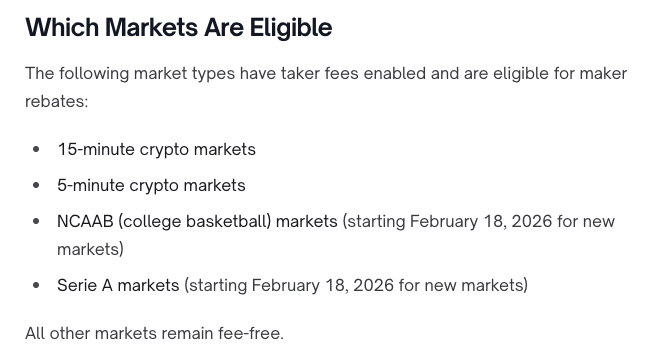
This structure mirrors elements seen in other high-frequency trading environments but is adapted to the unique dynamics of prediction markets. The focus on takers ensures that aggressive trading incurs a cost, while passive liquidity provision is rewarded, fostering a more balanced and efficient market environment.
(For simplicity’s sake, think about rewarding the suppliers of products to a store and taxing buyers a small amount to cover the cost of rewarding the suppliers. The net effect: you get more suppliers, more products for sale.)
The Fee Curve Structure: Formula and Parameters
At the core of this update is the fee-curve mechanism, which calculates fees dynamically based on trade parameters. The formula used is fee = C × feeRate × (p × (1 – p))^exponent, where C represents the number of shares traded, p is the share price (probability), feeRate is 0.0175 for these sports markets, and the exponent is 1. This results in fees that peak at mid-probability levels and taper off toward the extremes, aligning costs with market uncertainty.
Unlike the more aggressive parameters in short-term crypto markets (feeRate of 0.25 and exponent of 2), the sports configuration yields lower overall fees, with a maximum effective rate of approximately 1.56% at 50% probability. This design choice reflects the longer-duration nature of sports events, where liquidity needs to be sustained over extended periods.
To illustrate, consider trading 100 shares. The fees vary symmetrically around the 0.50 price point, ensuring fairness regardless of whether the trade leans toward yes or no outcomes. This symmetry is crucial in binary prediction markets, where probabilities are complementary.
Fee Table for NCAA Basketball and Serie A Markets (Based on 100 Shares)
| Price ($) | Trade Value ($) | Fee (USDC) | Effective Rate (%) |
|---|---|---|---|
| 0.01 | 1 | 0.00 | 0.00 |
| 0.05 | 5 | 0.003 | 0.06 |
| 0.10 | 10 | 0.02 | 0.20 |
| 0.15 | 15 | 0.06 | 0.41 |
| 0.20 | 20 | 0.13 | 0.64 |
| 0.25 | 25 | 0.22 | 0.88 |
| 0.30 | 30 | 0.33 | 1.10 |
| 0.35 | 35 | 0.45 | 1.29 |
| 0.40 | 40 | 0.58 | 1.44 |
| 0.45 | 45 | 0.69 | 1.53 |
| 0.50 | 50 | 0.78 | 1.56 |
| 0.55 | 55 | 0.84 | 1.53 |
| 0.60 | 60 | 0.86 | 1.44 |
| 0.65 | 65 | 0.84 | 1.29 |
| 0.70 | 70 | 0.77 | 1.10 |
| 0.75 | 75 | 0.66 | 0.88 |
| 0.80 | 80 | 0.51 | 0.64 |
| 0.85 | 85 | 0.35 | 0.41 |
| 0.90 | 90 | 0.18 | 0.20 |
| 0.95 | 95 | 0.05 | 0.06 |
| 0.99 | 99 | 0.00 | 0.00 |
This table demonstrates how fees are minimal at extreme probabilities, where outcomes are more certain, and highest at balanced odds, where trading is most speculative. Fees are rounded to four decimal places, with a minimum of 0.0001 USDC, meaning very small trades may effectively be fee-free.
Visualizing the Fee Curve: Chart Analysis
To better understand the fee dynamics, consider the following chart depicting the effective fee rate against share price. The bell-shaped curve highlights the peak at 0.50, emphasizing the model’s focus on mid-range trades.
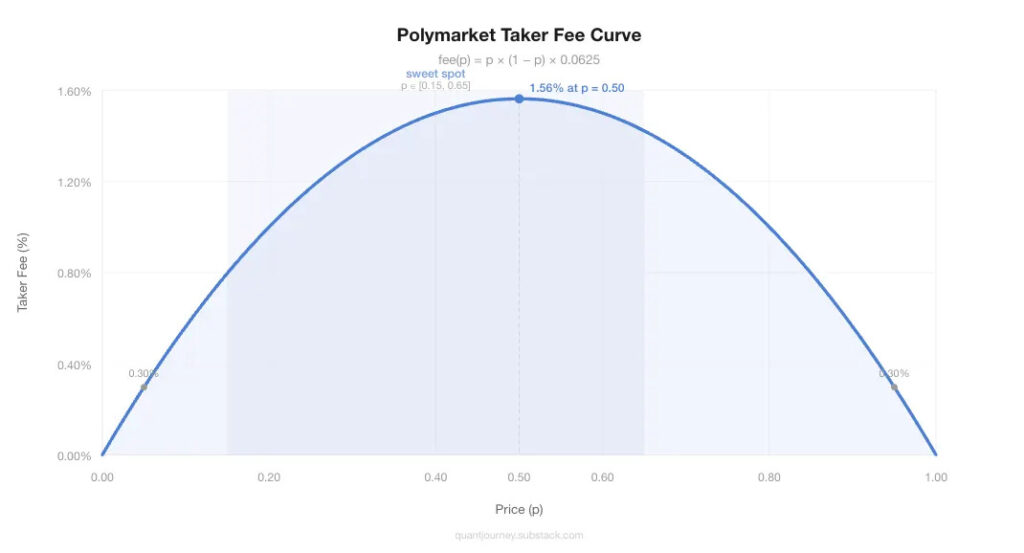
The chart illustrates how the effective fee rate forms a symmetric curve, peaking at 1.56% when the share price is $0.50, corresponding to a 50% probability. This design encourages trading at the extremes where fees are low, potentially increasing volume in lopsided events, while charging more for balanced, high-uncertainty trades. Such a structure is particularly relevant for NCAA basketball games in the US, where upset potentials are high, and for Serie A matches in Italy, where competitive balance can vary.
Impact on Market Makers and Liquidity
The 25% rebate for makers is a key component, redistributing collected taker fees to those who provide liquidity. This rebate is higher than the 20% offered in crypto markets, reflecting the platform’s emphasis on attracting makers to sports trading. By rewarding order posting, the model aims to create tighter spreads and deeper markets, benefiting all participants through better pricing and reduced slippage.
In practice, this could lead to more robust liquidity in NCAA basketball markets, where seasonal events like March Madness drive spikes in interest. Similarly, for Serie A, with its weekly fixtures and international fanbase, enhanced liquidity could mean more accurate probability assessments and increased trading efficiency. The overall goal is to transform high-volume sports trading into a self-sustaining ecosystem where fees fund liquidity improvements.
Strategic Shift Toward Monetization in Sports Trading
This fee introduction marks a pivotal shift from a fee-free model in most markets to one that monetizes specific high-activity segments. With sports accounting for approximately 39% of total transaction activity, the potential revenue impact is significant. Estimates suggest that extending fees to sports could generate substantial annual income, aligning operational costs with platform growth.
The pilot in NCAA basketball and Serie A serves as a test bed, with plans to expand to other sports if successful. This phased approach allows for adjustments based on market response, ensuring that monetization does not deter participation. For traders in the US focusing on college basketball or those in Italy engaged with Serie A, this change introduces a new cost consideration but also promises improved market quality.
Potential Effects on Trading Behavior and Volume
Traders may adapt by favoring maker strategies to capture rebates, potentially increasing order book depth. Takers, facing fees, might become more selective, focusing on high-conviction trades. Overall, this could lead to more efficient pricing in NCAA basketball outcomes, such as tournament winners or game spreads, and in Serie A, like match results or player performances.
While fees add a cost, the low rates—peaking at 1.56%—are competitive compared to traditional sportsbooks, which often have higher vigs. This positions the platform as an attractive alternative for informed traders seeking value in US college sports or Italian football leagues.
Future Outlook: Expansion and Revenue Potential
Looking ahead, successful implementation could see fees rolled out to additional sports markets, further boosting revenue. With prior weekly earnings from crypto fees exceeding $1 million, incorporating sports could push annual figures over $200 million. This revenue stream supports Polymarket platform enhancements, potentially attracting more users to NCAA and Serie A trading.
For US-based traders passionate about NCAA basketball or Italy-focused enthusiasts of Serie A, this evolution promises a more mature market environment. As the model matures, it could set a standard for monetizing prediction markets in sports, balancing growth with sustainability.
In conclusion, the introduction of taker fees in these select markets represents a thoughtful step toward monetizing high-volume sports trading. Through the fee-curve structure and maker rebates, the aim is to enhance liquidity while generating revenue, ultimately benefiting the trading community in both the US and Italy. This should be a net positive for the markets, despite the underlying appearance of Polymarket introducing fees for revenue enhancement.