Prediction markets tap into collective intelligence in ways that deliver strikingly accurate forecasts time after time. These platforms let everyday participants trade contracts on future events, and the resulting prices often reveal truths that traditional methods miss. The “wisdom of crowds” principle lies at the heart of this success, showing how diverse groups aggregate scattered information to produce superior predictions.
This dynamic explains why prediction markets consistently beat polls and individual forecasters across elections, corporate sales targets, and sports outcomes. Traders place real stakes on their beliefs, which forces them to make honest assessments and uncovers hidden insights that no single voice could provide alone.
The concept traces back centuries, yet it powers today’s most dynamic forecasting tools. When conditions align properly, crowds produce results that surprise even the most seasoned professionals. Prediction markets harness this power through financial incentives, turning opinions into actionable probabilities. Participants buy and sell shares that pay out based on real-world results, creating a living, breathing forecast that updates instantly with new information. This mechanism explains the edge over static surveys or expert panels that lack skin in the game.
Enthusiasts watch these markets deliver edge after edge because they reward accuracy and punish guesswork. The prices reflect not just what people think but what they truly believe is worth betting on. As a result, prediction markets serve as powerful tools for anyone seeking reliable foresight.
The Origins of the Wisdom of Crowds Concept
Francis Galton observed a striking phenomenon at a 1906 county fair in Plymouth. Attendees guessed the weight of an ox after it was slaughtered and dressed. The average guess came within one pound of the actual weight, outperforming most individual estimates, including those from butchers and farmers. This anecdote illustrates the core idea that large groups can arrive at remarkably accurate conclusions when their judgments combine in the right way.
James Surowiecki later popularized the concept in his influential 2004 book, The Wisdom of Crowds, demonstrating how the many often prove smarter than the few across domains ranging from stock picking to problem solving.
Surowiecki examined cases where crowds excelled because they drew on varied experiences and private knowledge. The book highlights how markets, democracies, and even simple averaging mechanisms capture this collective edge. Prediction markets represent the purest modern expression of this idea, blending financial motivation with group input. Traders contribute fragments of information through their trades, and the resulting price aggregates everything into a single probability estimate.
This foundational insight reshaped how forecasters approach uncertainty. Instead of relying on a handful of voices, systems now leverage thousands of participants, each holding a unique piece of the puzzle. The result delivers forecasts that adapt rapidly and incorporate details experts might overlook. Prediction markets, therefore, stand as living proof that collective intelligence thrives when structured correctly.
View this detailed breakdown of how crowds surpass individual judgment in real scenarios.
The Four Conditions That Make Crowds Wise
- Diversity of opinion
- Independence of judgments
- Decentralization
- Aggregation of judgments
Diversity of opinion forms the first essential condition. Participants must bring different perspectives, backgrounds, and information sources to the table. When traders hail from diverse industries, regions, and levels of expertise, their combined input cancels out individual blind spots and produces a fuller picture. Prediction markets naturally attract this mix because anyone with capital and conviction can participate.
Independence ranks as the second pillar. Each person must form judgments without influence from the group or dominant voices. This separation prevents herd behavior and preserves unique insights. In prediction markets, traders act on personal research and hunches, which keeps the collective signal clean and robust. The platform design further encourages this by displaying only aggregate prices rather than individual trades.
Decentralization provides the third key element. No central authority dictates what information matters or how to interpret it. Participants decide for themselves what data to weigh, allowing specialized knowledge to surface organically. This setup mirrors real-world information flow, where local details often hold the most value. Prediction markets thrive precisely because they decentralize the forecasting process across thousands of motivated individuals.
Aggregation completes the quartet. The system must combine all private judgments into one coherent output. Market prices perform this task elegantly by balancing supply and demand in real time. Every trade adjusts the probability estimate, creating a dynamic consensus that reflects the latest collective wisdom. These four conditions together explain why prediction markets generate forecasts that routinely surpass those from isolated forecasters.
Prediction Markets: The Ultimate Aggregation Machine
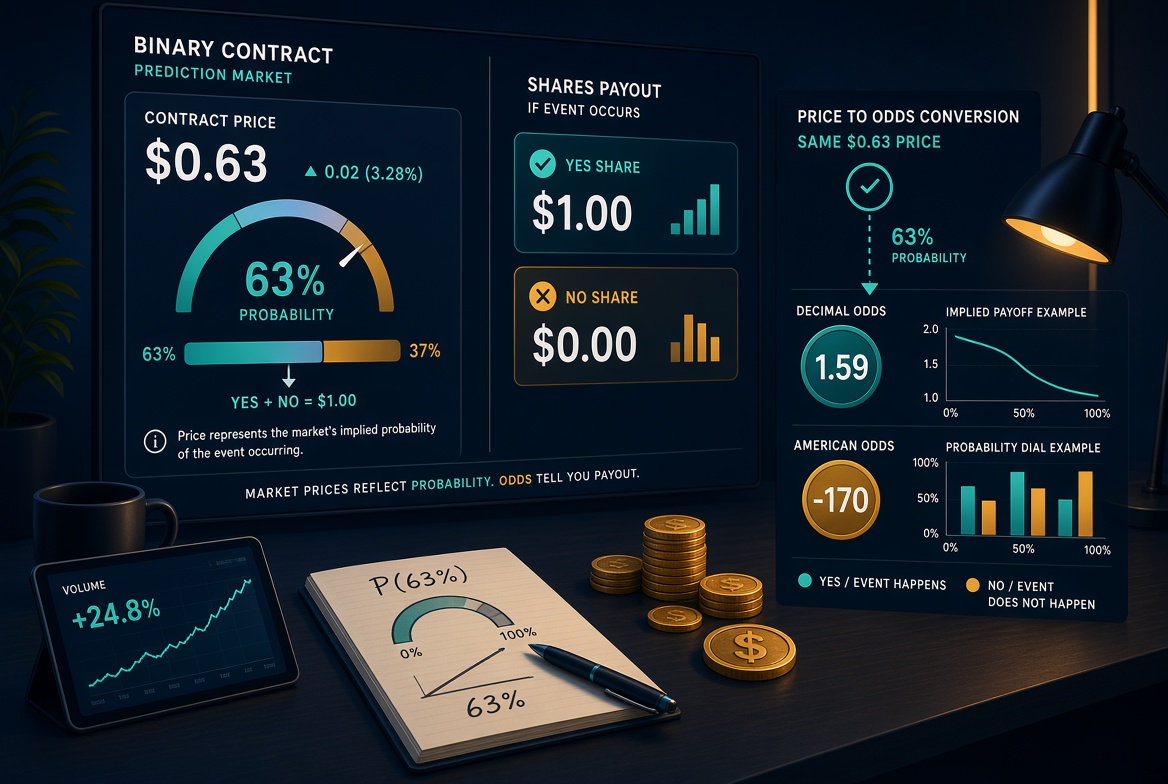
Participants buy and sell contracts tied to specific outcomes, such as a candidate winning an election or a product hitting sales targets. The price of each contract represents the market’s implied probability of that event occurring. If a contract trades at 65 cents, traders collectively assign a 65 percent chance to the outcome. This price mechanism aggregates information far more effectively than opinion polls that simply average stated beliefs.
Real money changes hands, which sharpens focus and rewards accuracy. Traders who possess superior information profit by buying undervalued contracts or selling overvalued ones. This incentive structure draws out private knowledge that might otherwise stay hidden. Meanwhile, the continuous trading process allows the forecast to evolve instantly as new data emerges. Prediction markets, therefore, function as high-speed information processors that outperform slower, less motivated alternatives.
Platforms like the Iowa Electronic Markets and Polymarket demonstrate this aggregation in action. They handle billions in volume during major events, incorporating signals from global participants. The resulting prices often incorporate nuances that polls miss, such as turnout effects or shifting sentiment. This real-time synthesis gives prediction markets their decisive edge over static expert assessments.
Table 1: Prediction Market Accuracy Compared to Polling Data in US Presidential Elections (1988-2004)
| Metric | Iowa Electronic Markets | Traditional Polls (964 total) |
|---|---|---|
| Frequency closer to the outcome | 74% | 26% |
| Average absolute error (overall) | 1.82 percentage points | 3.37 percentage points |
| Average absolute error (>100 days out) | 2.65 percentage points | 4.49 percentage points |
| Average absolute error (election eve) | 1.20 percentage points | 1.62 percentage points |
Historical Triumphs: Iowa Electronic Markets vs. Traditional Polling
The Iowa Electronic Markets launched in 1988 and quickly established a track record of precision. University of Iowa researchers compared these forecasts against 964 national polls across five presidential elections. The markets proved closer to the actual vote share 74 percent of the time. This performance held strong both close to election day and many months in advance. Traders incorporated subtle shifts in public mood that pollsters often captured too late or missed entirely.
In 2004, the markets predicted the final two-party vote split with an average error of just 1.33 percentage points on election eve. Polls from the same period averaged 1.62 points off. The advantage grew larger the further from election day, as markets reacted more quickly to campaign developments. Participants traded on emerging information, such as debate performances and economic releases, which continuously refined the forecast. This responsiveness explains why the Iowa markets delivered superior results year after year.
Corporate applications echoed the same pattern. Hewlett-Packard ran internal prediction markets to forecast printer sales. Employee traders achieved 99.5 percent accuracy on gift card sales projections, while paid forecasters missed by 5 percent. A separate holiday sales experiment saw the crowd miss by only 0.1 percent compared to experts who erred by 7 percent. These internal successes confirmed that the wisdom of crowds translates beyond politics into business forecasting with striking reliability.
Corporate Success Stories: Companies Betting on Collective Smarts
Google operated internal prediction markets to anticipate product launches and revenue milestones. Employees from engineering, sales, and marketing contributed diverse viewpoints, which produced forecasts that outperformed official projections. The platform encouraged traders to act on specialized knowledge without fear of group pressure. As a result, the aggregated prices signaled risks and opportunities that senior leaders had not yet recognized. This approach allowed the company to adjust strategies earlier and with greater confidence.
Other firms adopted similar tools to improve supply chain planning and demand estimation. Employees traded contracts on quarterly targets, incorporating frontline observations that rarely made it into executive summaries. The markets revealed discrepancies between official forecasts and ground-level realities, which prompted timely corrections. Prediction markets, therefore, function as early-warning systems that harness distributed intelligence across large organizations.
These corporate experiments underscore a broader truth. When financial incentives align with accurate forecasting, ordinary employees often outperform specialized planning teams. The markets reward those who spot trends first, which accelerates organizational learning. Companies that embrace this method report sharper decision-making and reduced forecasting errors over time.
Modern Marvels: Polymarket and the 2024 Election
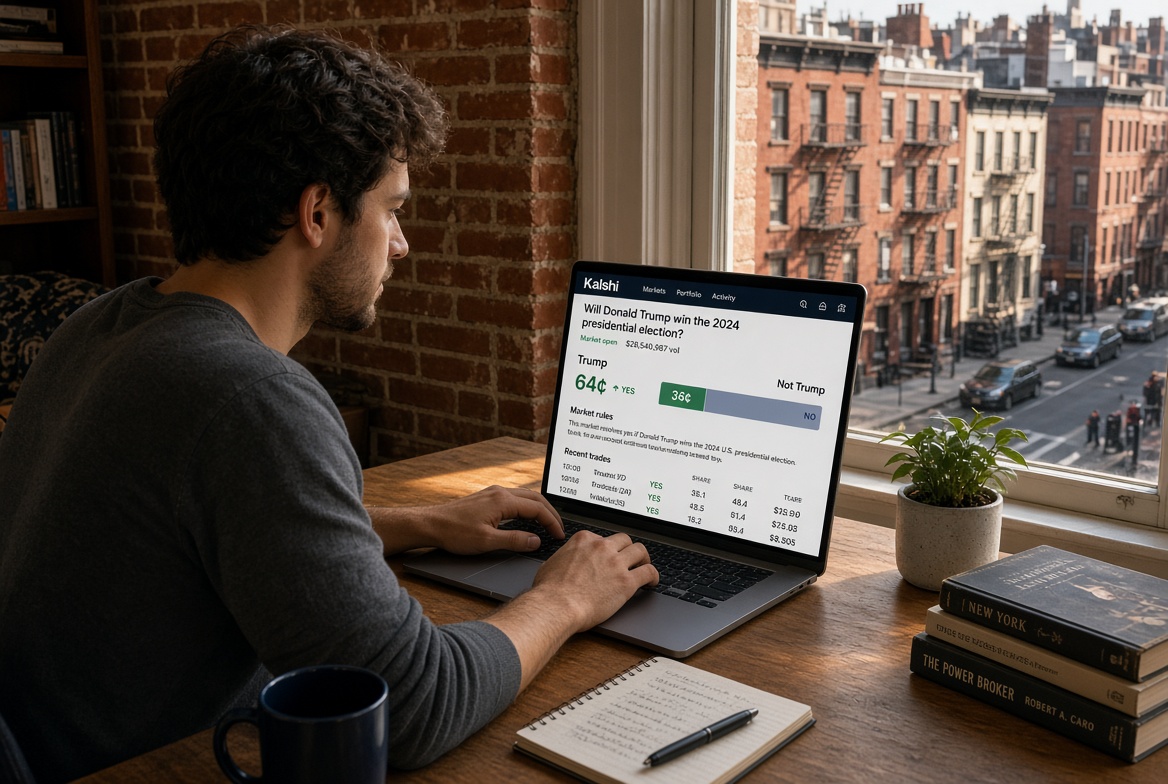
Polymarket captured global attention during the 2024 presidential race by showing Donald Trump with a solid lead, even as most polls described the contest as deadlocked. Traders on the platform pushed Trump’s implied probability above 58 percent in the final weeks, a call that proved correct. The market incorporated signals such as betting patterns, social media sentiment, and turnout models that traditional surveys struggled to quantify. This real-time adjustment highlighted how prediction markets process complex information faster than conventional methods.
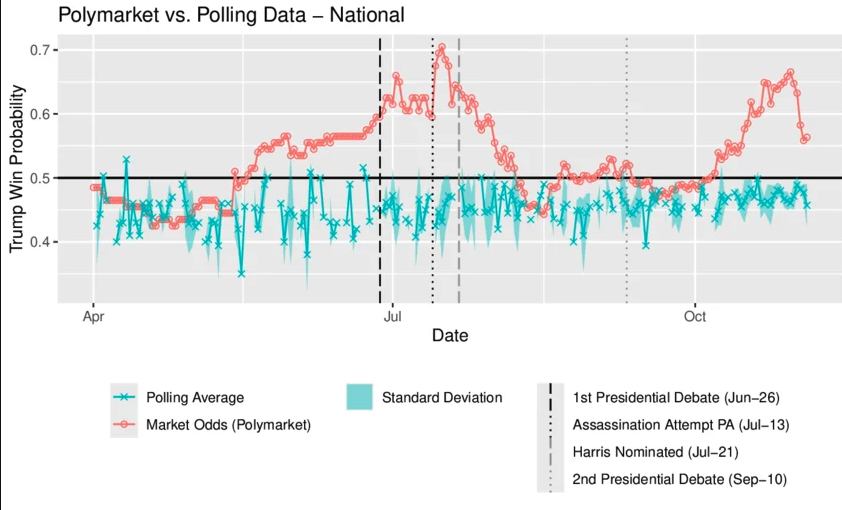
Volume on Polymarket surged to billions of dollars, drawing participants from around the world. The platform’s design enabled small bets to influence prices, thereby democratizing the forecasting process. As new polls and events unfolded, traders responded instantly, refining the probabilities with each trade. The final prices closely aligned with the actual results, reinforcing the platform’s reputation for accuracy in high-stakes political events.
This performance echoed the Iowa markets’ long history while operating on a vastly larger scale. Polymarket demonstrated that the wisdom of crowds scales effectively when technology lowers barriers to participation. The platform continues to expand into sports, entertainment, and policy questions, delivering forecasts that command attention from decision-makers worldwide.
Explore this overview of how prediction markets deliver superior results compared to traditional approaches.
The Mechanics of Superiority: Incentives and Information Flow
Financial stakes create accountability that polls lack. Traders lose money when wrong and profit when right, which motivates thorough research and honest pricing. This skin-in-the-game dynamic weeds out casual guesses and elevates informed views. Prediction markets, therefore, distill high-quality signals from a sea of opinions, producing forecasts that reflect genuine conviction rather than stated preferences.
Information flows freely through the price mechanism. A trader who learns of an unreported poll or economic indicator can act immediately by buying or selling contracts. The resulting price shift alerts the entire market to the new data. This continuous feedback loop incorporates details that might take weeks to appear in official reports. Consequently, the collective forecast stays ahead of slower aggregation methods.
Psychological factors also play a role. Independence reduces conformity bias, while diversity prevents echo chambers. Traders focus on probabilities rather than narratives, which keeps emotions in check. The market price serves as an objective scorecard that participants must confront. This structure channels human judgment into precise numerical estimates that prove remarkably reliable over time.
When Crowds Falter: Important Caveats
Prediction markets do not perform perfectly in every scenario. Low trading volume can distort prices when few participants are active. Events with limited public interest often suffer from this liquidity shortfall, which reduces the diversity and independence that drive accuracy. Platforms address the issue by attracting broader audiences or using hybrid designs that combine markets with structured polls.
Manipulation attempts occasionally surface, yet strong designs limit their impact. Large traders might try to push prices temporarily, but counter-bets from informed participants quickly restore balance. Historical data show that such efforts rarely succeed over meaningful timeframes. Regulatory oversight and transparent trading records further deter bad actors and maintain market integrity.
Complex or highly uncertain events can challenge even the best crowds. When information remains genuinely scarce, collective forecasts reflect that uncertainty through wider price spreads. In these cases, the markets still provide the clearest available probability distribution, which helps decision-makers quantify risk more effectively than vague expert pronouncements.
Applying Wisdom to Everyday Decisions
Individuals can harness similar principles without formal platforms. Asking a diverse group for independent estimates and then averaging the results often yields better personal forecasts. Friends, colleagues, and online communities supply the necessary variety when structured properly. The key lies in requesting numerical probabilities rather than yes-or-no opinions, which mirrors the precision of market contracts.
Business leaders integrate crowd-sourced forecasts into strategic planning. Internal mini-markets or simple averaging tools deliver quick insights on project timelines and customer demand. These lightweight approaches capture the same aggregation benefits that power large-scale platforms. Teams report improved alignment and fewer surprises when they trust collective input over top-down mandates.
Investors also benefit by monitoring public prediction markets for signals on economic trends or sector performance. The prices reveal probabilities that complement traditional analysis and highlight discrepancies worth investigating. This hybrid approach sharpens portfolio decisions and risk management across asset classes.
The Future Horizon for Prediction Markets
Technology continues to expand access and improve accuracy. Blockchain platforms enable global participation with lower fees and greater transparency. Artificial intelligence tools now assist traders by surfacing relevant data, which enhances the information pool without compromising independence. These advances promise even sharper forecasts in the years ahead.
Policy applications are growing as governments explore prediction markets for budgeting and risk assessment. Early experiments suggest that collective wisdom can improve public spending forecasts and identify emerging threats faster than bureaucratic processes. Regulators balance innovation with safeguards to preserve the core conditions that make crowds wise.
Prediction markets stand poised to influence decision-making across industries. Their proven track record of outperforming isolated judgment positions them as essential tools for navigating uncertainty. As more people recognize the power of collective intelligence, these platforms will likely become standard fixtures in forecasting and strategy.
Conclusion
Prediction markets demonstrate the wisdom of crowds in its most refined form. They aggregate diverse, independent judgments through a mechanism that rewards truth and punishes error. The resulting forecasts consistently deliver superior accuracy compared to polls or individual assessments. This edge stems from financial incentives, real-time information flow, and proper structural conditions that Surowiecki first outlined decades ago.
From the Iowa Electronic Markets’ long dominance to Polymarket’s recent triumphs, the pattern remains clear. Collective intelligence thrives when given the right environment. Decision-makers who embrace these tools are better positioned to anticipate change than those who rely solely on traditional methods. The future belongs to those who trust the crowd’s remarkable capacity for insight.
References
- Investopedia: Understanding the Wisdom of Crowds
- Berg et al. (2008) – Prediction Market Accuracy in the Long Run
- Atanasov et al. (2017) – Distilling the Wisdom of Crowds: Prediction Markets vs. Prediction Polls
- CNN: How Prediction Markets Saw Something the Polls and Pundits Missed
- Wikipedia: Iowa Electronic Markets
- Wikipedia: The Wisdom of Crowds by James Surowiecki
- Penn State: Prediction Markets and the Wisdom of Crowds
- Gruca et al. (2024) – Forecasting the 2024 US Presidential Election with Iowa Electronic Markets
- Medium: The Wisdom of Crowds – How Prediction Markets Tap Collective Intelligence
- IESE Insight: Betting (and Winning) on the Wisdom of Crowds
- Manhattan West: Why Prediction Markets Aggregate Knowledge Better Than Experts
- Semantic Scholar: Atanasov et al. Study Summary
- arXiv: Are Betting Markets Better than Polling in Predicting Presidential Elections?
- PollyVote: Iowa Electronic Markets 2024 Analysis
- Jacobin: Gambling on the Wisdom of Crowds Is a Bad Bet
- BettorEdge: How Prediction Markets Outperform Experts
- Farnam Street: The Wisdom of Crowds and The Expert Squeeze
- ResearchGate: Distilling the Wisdom of Crowds Full Paper
- ACM: Atanasov et al. 2017 Abstract
- ScienceDirect: The Wisdom of the Crowd and Prediction Markets