
In an era where forecasting future events is crucial for decision-making in politics, finance, and beyond, prediction markets have emerged as powerful tools for aggregating information and forming probabilities. These markets allow participants to bet on the outcomes of events, turning individual beliefs into collective forecasts that often prove more accurate than traditional methods like opinion polls or expert analyses. But how exactly do they work? This article delves into the mechanisms behind prediction markets, explaining how they gather dispersed information from diverse traders and translate it into probabilistic estimates. We’ll explore the theoretical foundations, real-world examples, advantages, limitations, and future implications.
Prediction markets, also known as information markets or event futures, operate on the principle that markets can efficiently process and reflect information through prices. When traders buy and sell contracts tied to specific outcomes—such as “Will Candidate X win the election?”—the resulting market price represents the crowd’s consensus probability. For instance, if a contract trades at $0.60, it implies a 60% chance of the event occurring. This process leverages the “wisdom of crowds,” where aggregated judgments from many individuals often outperform single experts, especially when financial incentives align with accuracy.
The appeal of prediction markets lies in their ability to incentivize truthful revelation of information. Unlike polls, where respondents have no skin in the game, traders in these markets risk real money, encouraging them to incorporate all available data and insights. As new information emerges—be it a scandal, economic report, or insider knowledge—traders adjust their positions, causing prices to fluctuate and update the implied probability in real-time. This dynamic aggregation makes prediction markets a fascinating intersection of economics, psychology, and data science, with applications ranging from election forecasting to corporate decision-making.
We’ll help you understand not just the “how” but also the “why” behind prediction markets’ effectiveness, backed by historical context, mathematical insights, and current examples like Polymarket and the Iowa Electronic Markets (IEM). Whether you’re a student, investor, or curious reader, this guide will equip you with the knowledge to appreciate these innovative forecasting tools.
What Are Prediction Markets?
At their core, prediction markets are platforms where individuals trade contracts based on the predicted outcomes of future events. These contracts are typically binary—paying out $1 if the event occurs and $0 if it doesn’t—or scaled to reflect probabilities directly. The market price of these contracts serves as a direct indicator of the collective probability assigned to the event by participants.
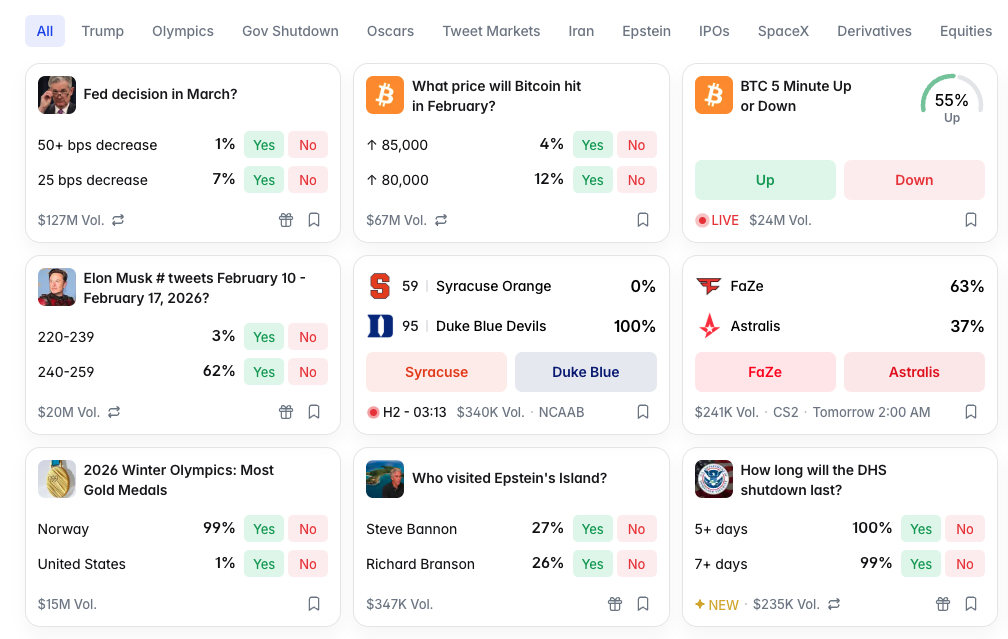
Unlike traditional stock markets, which trade shares in companies, prediction markets focus on events. Platforms like Polymarket allow users to bet on a wide array of topics, from political elections to sports outcomes and even cryptocurrency prices. For example, a contract might ask, “Will Bitcoin exceed $100,000 by the end of 2026?” Traders buy “Yes” shares if they believe it will, or “No” shares if not. The price at which these shares trade—say, 45 cents for “Yes”—translates to a 45% probability.
This screenshot of the Polymarket interface illustrates how users view and trade on various events, with probabilities displayed prominently.
Key platforms include:
- Polymarket: A decentralized platform built on blockchain technology, popular for its crypto integration and global accessibility.
- PredictIt: A regulated market focused on political events, with caps on individual bets to comply with U.S. laws.
- Iowa Electronic Markets (IEM): An academic platform run by the University of Iowa, known for its accuracy in election predictions since 1988.
These markets differ from gambling sites in their informational purpose: they aggregate beliefs to produce forecasts, not just entertain. As economist Justin Wolfers notes, prices in efficient prediction markets perfectly aggregate dispersed information about event probabilities.
Historical Background
The concept of prediction markets dates back centuries. In the 16th century, Italian city-states used betting markets to predict papal elections. Modern incarnations began in the late 20th century with the IEM, which demonstrated superior accuracy over polls in U.S. presidential elections. Over five elections from 1988 to 2004, IEM forecasts were closer to actual outcomes than polls 74% of the time.
In the 2000s, companies like Google and Hewlett-Packard experimented with internal prediction markets to forecast sales or project timelines, harnessing employee knowledge. The rise of blockchain in the 2010s enabled decentralized platforms like Augur and Polymarket, bypassing traditional regulations and expanding accessibility.
By 2025, prediction markets gained mainstream attention, with Polymarket’s trading volume surging during the U.S. presidential election, often outperforming polling aggregates like FiveThirtyEight. This evolution underscores their growing role in information aggregation.
How Prediction Markets Aggregate Information
Prediction markets aggregate information through a process akin to the efficient market hypothesis (EMH), which posits that asset prices reflect all available information. In these markets, “assets” are event contracts, and “information” is traders’ beliefs about outcomes.
The aggregation begins with diverse participants bringing unique insights. A trader with insider knowledge might buy shares if the price undervalues their information, pushing the price up. Conversely, if overvalued, they sell, lowering it. This trading continues until the price stabilizes, reflecting a consensus.
Incentives are key: financial risk encourages accuracy. Traders with better information or analysis profit, while those with poor judgments lose, naturally weighting the market toward informed opinions.
Market makers and liquidity providers ensure smooth trading, allowing information to flow efficiently. In decentralized markets like Polymarket, automated market makers (AMMs) use algorithms to set initial prices and adjust based on trades.
The Role of Crowdsourcing and the Wisdom of Crowds
Prediction markets embody crowdsourcing, deliberately designed to elicit and aggregate beliefs. As per James Surowiecki’s “The Wisdom of Crowds,” diverse, independent groups make better decisions than individuals. Markets enforce independence through anonymity and diversity via global participation.
Experimental evidence supports this: lab studies show markets aggregate information even under partial information, with prices converging to true probabilities.
Forming Probabilities in Prediction Markets
Probabilities form through the equilibrium price of contracts. In a binary market, the price p represents the probability of “Yes,” with 1-p for “No.” This interpretation holds under risk-neutral assumptions, where traders bet based on expected value.
For example, if a contract pays $1 on “Yes,” buying at $0.70 yields a $0.30 profit if correct, but a $0.70 loss if wrong. Rational traders only buy if their subjective probability exceeds 70%.
Over time, as trades incorporate new data, prices update via Bayesian reasoning—adjusting priors with evidence. Markets thus act as collective Bayesian updaters.
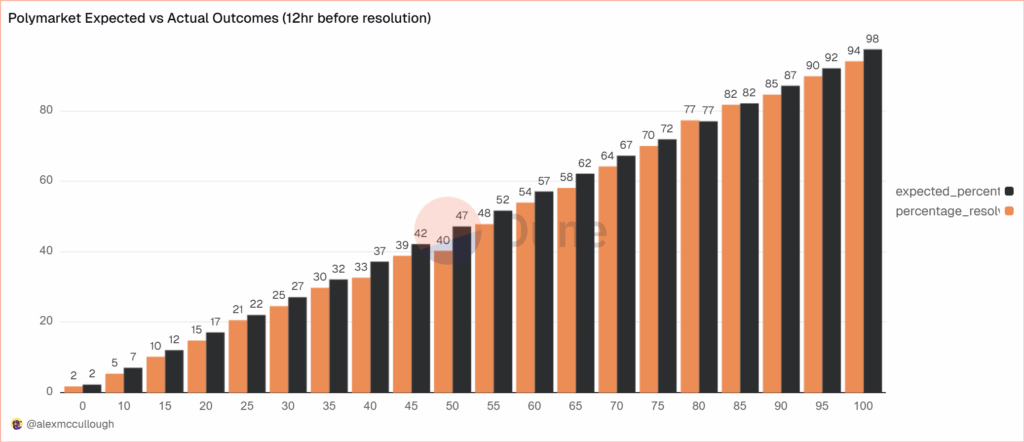
This calibration chart shows how well prediction market probabilities align with actual outcomes, with dots close to the diagonal line indicating good calibration.
Mathematical Foundations
Formally, consider a market with n traders, each with a private signal s_i about event E with true probability π. Traders maximize utility U = p * (1 – price) if buying “Yes,” assuming risk neutrality.
Under EMH, price converges to the posterior probability given all signals: P(E | s_1, …, s_n).
In practice, scoring rules like logarithmic scoring ensure truthful reporting: score = log(p) if E occurs, log(1-p) otherwise. Markets approximate this collectively.
| Concept | Description | Example |
|---|---|---|
| Implied Probability | Price p = P(event) | $0.55 = 55% chance |
| Expected Value | EV = P * payoff – cost | EV = 0.6 * 1 – 0.55 = $0.05 profit |
| Bayesian Update | P posterior = (likelihood * prior) / evidence | Adjusting odds after news |
Real-World Examples and Applications
The IEM has consistently outperformed polls. In the 2020 U.S. election, IEM prices reflected shifting probabilities amid the pandemic and protests, as shown in this graph.
Polymarket, during the 2024 election, aggregated information rapidly, with prices reacting to debates and polls faster than traditional media. For instance, after a key event, probabilities shifted from 50% to 70% within hours, incorporating trader insights.
Beyond politics, companies use internal markets for forecasting. Google predicted product launch success rates accurately using employee bets.
Comparison to Other Forecasting Methods
| Method | Strengths | Weaknesses |
|---|---|---|
| Prediction Markets | Incentivized accuracy, real-time updates, aggregates diverse info | Regulatory hurdles, potential manipulation |
| Opinion Polls | Large samples, demographic insights | Response bias, static snapshots |
| Expert Forecasts | Deep knowledge | Overconfidence, groupthink |
Studies show prediction markets beat polls 74% of the time in elections.
Advantages of Prediction Markets
One major advantage is superior accuracy due to incentives. Research by Wolfers and Zitzewitz highlights how markets reward better models and judgment.
They provide continuous, probabilistic forecasts, unlike binary polls. This granularity aids risk assessment in finance or policy.
Markets are resilient to bias, as profit motives override ideology. In 2025, Polymarket’s neutral aggregation contrasted with biased media narratives.
Challenges and Limitations
Despite strengths, prediction markets face challenges. Manipulation is possible if large traders sway prices, though markets often correct quickly.
Regulatory issues persist; in the U.S., they straddle gambling and commodities laws, limiting scale. Low liquidity in niche markets can distort prices.
Risk aversion affects probabilities; risk-averse traders demand higher returns, biasing prices. Ethical concerns arise with sensitive topics like assassinations.
Addressing Limitations
Platforms mitigate issues with caps on bets and oracle systems for resolution. Decentralized tech enhances transparency.
The Future of Prediction Markets
As of 2026, prediction markets are integrating with AI and big data. ICE’s investment in Polymarket signals mainstream adoption, monetizing probability data for finance.
Potential expansions include climate forecasting or pandemic tracking. With blockchain, global, censorship-resistant markets could democratize forecasting.
Challenges remain, but as Scott Duke Kominers argues, optimizing market design will unlock their full potential.
Conclusion
Prediction markets aggregate information by harnessing market forces to form probabilities that reflect collective intelligence. Through trading incentives, diverse participation, and efficient pricing, they often surpass traditional forecasts. While not perfect, their evolution promises transformative applications.
As we navigate uncertain futures, understanding these markets equips us to interpret and perhaps participate in this innovative form of collective wisdom. Whether for elections, economics, or everyday decisions, prediction markets offer a window into tomorrow’s probabilities today.

The PolyPunter staff works tirelessly to bring you the latest and most insightful news, information, and tips on the fast-growing economic, financial, and social phenomenon that is prediction markets.


