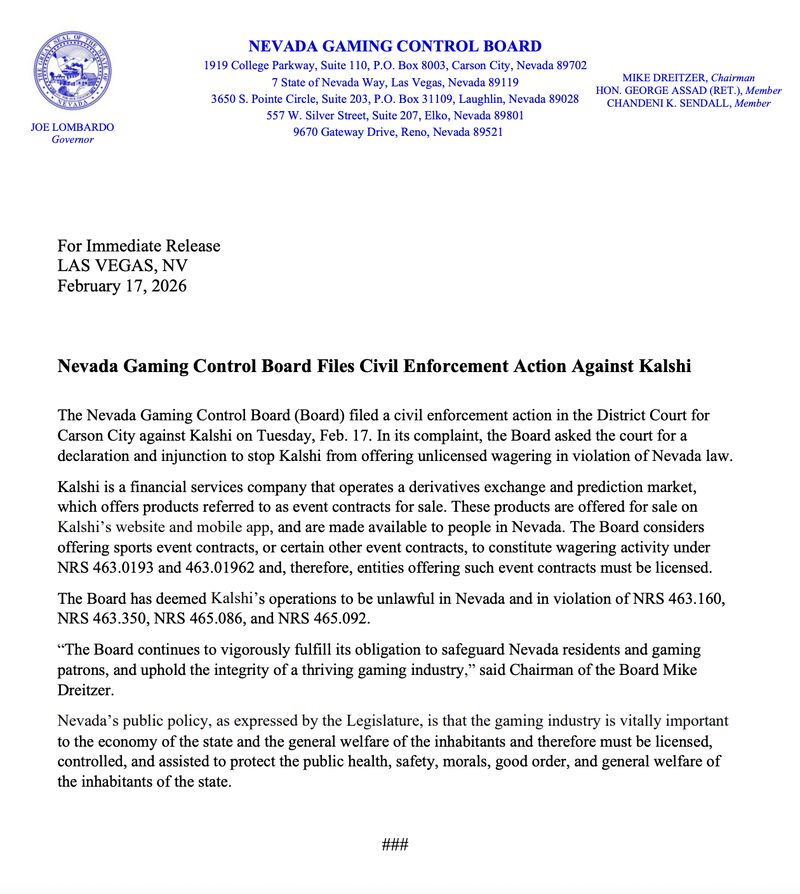
On February 17, 2026, the Nevada Gaming Control Board (NGCB) initiated a significant legal move by filing a civil enforcement action against Kalshi in the District Court for Carson City. This lawsuit, spearheaded by Nevada Attorney General Aaron D. Ford, seeks to declare Kalshi’s operations in violation of state gaming laws and to secure an injunction halting the company’s activities within Nevada. The action comes amid escalating tensions between state regulators and federally regulated entities, highlighting Carson City’s role as a battleground for gaming enforcement.
This development follows a February 17 ruling by the U.S. Court of Appeals for the Ninth Circuit, which denied Kalshi’s emergency request for a stay. The denial cleared the path for Nevada to proceed with enforcement, asserting that Kalshi’s sports event contracts constitute unlicensed wagering under state statutes. In Las Vegas, where the gaming industry generates billions annually, this case could set precedents affecting local operators and residents.
Details of the NGCB’s Civil Enforcement Action in Carson City
The complaint filed by the NGCB accuses Kalshi of offering event contracts accessible to Nevada residents via its website and mobile app, which the board classifies as wagering activities. Specifically, contracts tied to sports outcomes are alleged to violate NRS 463.0193 and NRS 463.01962, requiring entities to obtain gaming licenses. Without such licensing, Kalshi’s operations are deemed unlawful under NRS 463.160, NRS 463.350, NRS 465.086, and NRS 465.092.
NGCB Chairman Mike Dreitzer emphasized the action’s alignment with Nevada’s public policy to regulate gaming for economic benefits and public welfare. The lawsuit requests a declaratory judgment confirming these violations and a permanent injunction to prevent Kalshi from continuing such offerings in the state. This filing marks Nevada as a frontrunner in state-level challenges, following similar successes against platforms like Coinbase and Polymarket. Nevada remains in a legal battle with Crypto.com who has the support of the CFTC in terms of declaring itself the rightful regulatory body.
| Statute | Description | Alleged Violation |
|---|---|---|
| NRS 463.0193 | Defines wagering activities | Operation without a state license |
| NRS 463.01962 | Specifies sports wagering requirements | Unlicensed offering to Nevada residents |
| NRS 463.160 | Prohibits unlicensed gaming | Operation without state license |
| NRS 463.350 | Regulates associations with gaming | Illegal facilitation of wagers |
| NRS 465.086 | Addresses unlawful acts in gaming | Violation through app and website access |
| NRS 465.092 | Penalties for unlicensed wagering | Potential civil penalties sought |
This table outlines the core legal foundations of the NGCB’s case, emphasizing Carson City’s enforcement priorities in protecting the state’s gaming monopoly.
Legal Arguments: State vs. Federal Jurisdiction in Nevada’s Gaming Landscape
Nevada contends that Kalshi’s contracts, allowing bets on sports like football and basketball, bypass state regulations designed to prevent underage wagering and insider betting. The state highlights the absence of safeguards against match-fixing and age restrictions, arguing these undermine public trust in Las Vegas’s licensed sportsbooks.
In response, Kalshi promptly removed the case to federal court in Reno, asserting exclusive Commodity Futures Trading Commission (CFTC) jurisdiction over its swaps-like contracts. The CFTC supported this in an amicus brief filed the same day, claiming federal preemption over state gaming laws. This clash underscores Nevada’s determination to maintain control, with Attorney General Ford leading the charge to preserve state authority in Carson City and beyond.
The Ninth Circuit’s denial of Kalshi’s stay, issued on February 17, was pivotal. It dissolved a prior injunction from November 2025 that had blocked Nevada’s enforcement, allowing the NGCB to act swiftly. Legal experts in Las Vegas note this as a victory for state sovereignty, potentially influencing similar disputes in states like Massachusetts.
Comparison with Other States: Nevada Leads the Charge
Nevada’s action follows Massachusetts’ February 5, 2026, injunction against Kalshi, though a stay was granted pending appeal. Nine other states, including California and New York, have issued cease-and-desist letters. In Tennessee, a U.S. District Judge granted Kalshi a preliminary injunction on February 11, contrasting with Nevada’s denial of relief.
| State | Action Taken | Outcome | Date |
|---|---|---|---|
| Nevada | Civil enforcement lawsuit | Removed to federal court; seeking injunction | February 17, 2026 |
| Massachusetts | Injunction issued | Stay granted on appeal | February 5, 2026 |
| Tennessee | Kalshi sought injunction | Granted preliminary injunction | February 11, 2026 |
| California, New York, etc. | Cease-and-desist letters | Ongoing | Various 2025-2026 |
This comparative table illustrates Nevada’s aggressive stance, positioning Carson City and Las Vegas as key players in national regulatory debates.
Implications for Nevada’s Gaming Industry and Las Vegas Economy
In Las Vegas, where gaming revenue exceeded $15 billion in 2025, the NGCB’s lawsuit aims to protect licensed operators from unregulated competition. Critics argue Kalshi’s platforms erode the integrity of Nevada’s sports betting market, potentially leading to revenue losses for state coffers funding education and infrastructure.
Economic analysts in Reno project that unchecked operations could divert millions from local casinos, impacting jobs in Clark County. The case also raises questions about innovation in gaming, with some Las Vegas stakeholders viewing federal preemption as a threat to state-tailored regulations.
Furthermore, the lawsuit emphasizes Nevada’s commitment to consumer protections, such as age verification and anti-match-fixing measures, absent in Kalshi’s model. For residents in Henderson and North Las Vegas, this could mean stricter enforcement, ensuring fair play in local betting environments.
Stakeholder Reactions: From Carson City to Wall Street
In Las Vegas, gaming executives praised the NGCB’s proactive stance, while Wall Street observers in New York monitored potential impacts on Kalshi’s valuation.
“I do want to thank the board for its clarity around predictive markets and predictive gaming,” Hornbuckle said. “The clarity helps us. Obviously, we have some work to do in some other states and you’ve probably all followed that story closely.”
— MGM Resorts International CEO and President Bill Hornbuckle
Nevada officials, including Ford, reiterated the need to safeguard the state’s economy from unlicensed entities.
Future Outlook: Court Battles and Regulatory Shifts in Nevada
As the case moves to federal court in Reno, experts predict prolonged litigation. A win for Nevada could embolden other states, reshaping operations in gaming hubs like Atlantic City and beyond. Conversely, CFTC preemption might expand access in Nevada, challenging Las Vegas’s dominance.
Timeline projections suggest hearings in Carson City or Reno by March 2026, with appeals possibly reaching the Supreme Court. For Nevada residents, this underscores the state’s vigilance in maintaining gaming integrity amid evolving financial landscapes.
| Date | Event | Location |
|---|---|---|
| November 2025 | Injunction dissolved by federal judge | Reno Federal Court |
| February 10, 2026 | NGCB notifies intent to sue | Ninth Circuit |
| February 17, 2026 | Ninth Circuit denies stay | San Francisco (Ninth Circuit) |
| February 17, 2026 | NGCB files lawsuit | Carson City District Court |
| February 17, 2026 | Kalshi removes to federal court | Reno Federal Court |
| February 17, 2026 | CFTC files amicus brief | Reno Federal Court |
This timeline captures the rapid escalation in February 2026, centering on Nevada’s key cities like Carson City and Reno.
Conclusion: Nevada’s Stand Against Unlicensed Operations
The NGCB’s civil enforcement action against Kalshi represents a critical juncture for state gaming regulation. As proceedings unfold in Carson City and Reno, the outcome could redefine boundaries in Las Vegas’s thriving industry. Stay tuned for updates on this pivotal Nevada lawsuit.