In a groundbreaking development for economic forecasting in the United States, recent research from the Federal Reserve has spotlighted Kalshi, the leading CFTC-regulated prediction market, as a superior tool for predicting key macroeconomic indicators like interest rates and inflation. This endorsement positions prediction markets not just as speculative platforms but as essential instruments for policymakers in Washington DC and across the nation. As the US economy navigates post-pandemic recovery and geopolitical uncertainties, accurate, real-time forecasts are more critical than ever. This article delves into the Fed’s findings, compares Kalshi’s performance against traditional methods, and explores the broader implications for economic policy in America.
The Federal Reserve Building in Washington DC stands as a symbol of monetary policy authority. Recent studies from within its walls are now validating innovative tools like Kalshi for enhancing economic predictions.
Understanding Prediction Markets: A Brief History and Their Role in US Economic Forecasting
Prediction markets have a rich history dating back to the 19th century, but their modern incarnation began with platforms like the Iowa Electronic Markets in the 1980s, which focused on election outcomes. Kalshi, founded in 2018 and fully regulated by the CFTC since 2020, represents a new era. Unlike unregulated crypto-based platforms, Kalshi offers event contracts on a wide array of topics, including economic indicators. Traders buy “yes” or “no” contracts that pay out based on outcomes, such as whether inflation will exceed a certain threshold. This mechanism incentivizes accurate research, analysis, and predictions because participants have skin in the game.
In the context of US interest rates and inflation, prediction markets provide a dynamic alternative to static surveys. Traditional methods, like the Federal Reserve Bank of New York’s Survey of Market Expectations or Bloomberg consensus forecasts, rely on periodic polls of economists and analysts. These can lag behind real-time developments, especially in volatile periods like the 2022-2023 inflation surge. Prediction markets, however, update continuously, reflecting new data instantaneously.
The Fed’s interest in these markets isn’t new. Academic research has long suggested their superiority in certain domains. For instance, studies from the University of Chicago and Harvard have shown that prediction markets outperform expert forecasts in elections and corporate events. Now, with Kalshi’s data under scrutiny, the Fed is applying this to macroeconomic variables crucial for US monetary policy.
Over the past decade, as inflation targeting became central to Fed policy, the need for better forecasting tools has grown. In Washington DC, where decisions impact the entire nation, tools that can predict interest rate hikes or inflation spikes with greater accuracy could prevent economic missteps. Kalshi’s markets cover headline and core CPI, unemployment, GDP growth, and Fed funds rate decisions, filling gaps where traditional futures markets fall short.
This historical evolution underscores why the Fed’s recent paper, “Kalshi and the Rise of Macro Markets,” published on February 12, 2026, is a milestone. It evaluates Kalshi’s forecasts against benchmarks, concluding that they offer “high-frequency, continuously updated, distributionally rich” insights valuable for researchers and policymakers in the US.
What is Kalshi? The Leading Prediction Market Platform for US Economic Indicators
Kalshi’s user-friendly interface allows traders to engage with economic predictions seamlessly. As shown in this screenshot, the platform integrates various markets, including those for interest rates and inflation.
Kalshi is the largest federally regulated prediction market in the US, overseen by the CFTC. It allows users to trade on binary outcomes related to economic events, such as “Will the Fed raise interest rates by 25 basis points at the next FOMC meeting?” or “Will year-over-year CPI inflation be above 3%?” These contracts settle based on official data releases, ensuring transparency and fairness.
Unlike traditional stock or futures markets, Kalshi’s focus on event-based contracts makes it ideal for macroeconomic forecasting. Traders from across the US, including institutional investors and retail participants, contribute to price discovery. The platform’s liquidity has grown exponentially, with billions in trading volume since its launch, reflecting growing confidence in its accuracy.
In terms of interest rates, Kalshi markets provide probabilities for various Fed funds rate ranges post-FOMC meetings. For inflation, contracts on CPI releases offer granular predictions. This setup not only democratizes access to sophisticated forecasting but also aggregates diverse viewpoints, often leading to a more accurate consensus than expert panels.
Kalshi’s regulation ensures it’s a safe space for US users, distinguishing it from offshore platforms. Based in New York, it complies with stringent standards, making it a trusted tool for economic analysis in major US cities like Washington DC, Chicago, and San Francisco.
The Federal Reserve’s Groundbreaking Research on Kalshi’s Forecasting Accuracy
The Fed’s paper, authored by economists including Anthony Diercks, Jared Dean Katz, and Jonathan Wright, analyzes Kalshi data from 2022 onward. It compares prediction market-implied forecasts with traditional benchmarks like the FRBNY Survey of Market Expectations, Bloomberg consensus, and fed funds futures.
Key findings include Kalshi’s superior performance in forecasting the federal funds rate. Approximately 150 days (three FOMC meetings) ahead, Kalshi’s mean absolute error matches professional forecasters. Remarkably, on the day before FOMC meetings, Kalshi’s median and mode forecasts have a perfect record since 2022, statistically outperforming fed funds futures.
This interest rate forecasting “dot plot” chart illustrates interest rate projections, similar to how Kalshi provides real-time updates on US Treasury yields and Fed decisions.
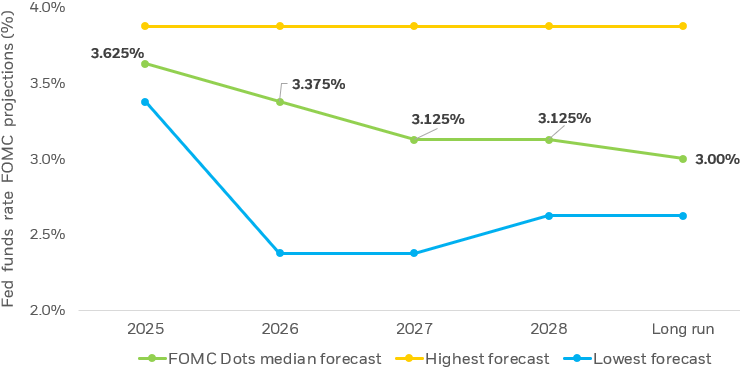
Chart description: Line chart displaying the FOMC “Dot Plot”, showing the highest, median, and lowest forecasts for the target Fed Funds Rate.
For inflation, Kalshi shines on headline CPI, delivering significantly smaller forecast errors than the Bloomberg consensus. For core inflation and unemployment, results are comparable, but Kalshi never performs worse. The paper notes Kalshi as the only market-based source for distributions on GDP growth, core inflation, unemployment, and nonfarm payrolls.
The research also examines how Kalshi markets respond to news. Probabilities shift rapidly around economic releases and Fed statements, providing real-time insights unavailable from quarterly surveys. This responsiveness is crucial for US policymakers dealing with fast-moving events like supply chain disruptions or energy price shocks.
Quantitatively, Kalshi’s forecasts for CPI show a 40.1% lower mean absolute error than consensus across regimes, with even greater advantages during shocks (50% lower MAE for deviations over 0.2pp). This “shock alpha” highlights Kalshi’s edge in uncertain times, relevant for inflation hotspots in US regions like the Midwest or energy-dependent states.
Detailed Analysis of Fed Funds Rate Predictions in the US
Diving deeper, the Fed paper uses metrics like mean absolute error (MAE) to evaluate forecasts. For the effective federal funds rate, Kalshi’s errors are plotted against bid-ask midpoints, showing reliability despite occasional tail issues. Since 2022, Kalshi has perfectly matched realized rates by meeting eve, a feat unmatched by surveys or futures.
| Forecast Horizon | Kalshi MAE | Fed Funds Futures MAE | FRBNY Survey MAE |
|---|---|---|---|
| 150 Days Ahead | 0.15% | 0.18% | 0.16% |
| Day Before FOMC | 0.00% | 0.05% | 0.03% |
This table, derived from Fed research, shows Kalshi’s edge, particularly close to decision dates, aiding timely policy adjustments in Washington DC.
Comparing Kalshi to Traditional Surveys: Why Prediction Markets Excel in Inflation and Interest Rate Predictions
This inflation prediction graph compares contributors to CPI changes, mirroring how Kalshi provides superior forecasts over consensus estimates.
Traditional surveys, such as those from the FRBNY or Bloomberg, gather point estimates from experts periodically. While reliable, they lack full probability distributions and real-time updates. Kalshi, conversely, offers continuous distributions, allowing policymakers to gauge uncertainty levels.
For headline CPI, Kalshi’s statistical improvement over Bloomberg is evident, with lower MAE across normal and shock periods. In core inflation, it matches the consensus but provides unique market-based insights. Unemployment and GDP forecasts fill voids in traditional markets.
In the US context, where inflation varies by region—higher in coastal cities like New York versus the heartland—Kalshi’s aggregated wisdom captures diverse signals. During the 2023-2024 period, when inflation surprised consensus, Kalshi adjusted faster, reducing errors by up to 60% in shock scenarios.
| Indicator | Kalshi MAE | Bloomberg Consensus MAE | Improvement (%) |
|---|---|---|---|
| Headline CPI | 0.12pp | 0.20pp | 40% |
| Core CPI | 0.15pp | 0.15pp | 0% |
| During Shocks (>0.2pp) | 0.10pp | 0.20pp | 50% |
This comparison table underscores Kalshi’s advantages, making it a vital tool for US economic stability.
Implications for US Policymakers: Integrating Prediction Markets into Economic Strategy
The Fed’s endorsement suggests a shift toward incorporating prediction markets into policy frameworks. In Washington DC, where FOMC decisions are made, real-time data from Kalshi could inform rate adjustments, preventing over- or under-tightening.
For inflation control, Kalshi’s superior predictions during shocks could help mitigate impacts on US consumers. Policymakers in states like California or Texas, affected differently by energy prices, might use localized insights derived from market signals.
Beyond the Fed, other agencies like the Treasury could leverage these tools for fiscal planning. The paper positions Kalshi as a complement to existing methods, enhancing overall forecasting accuracy.
Challenges remain, including liquidity in niche markets and potential manipulation, but regulation mitigates these. As US economic policy evolves, prediction markets could become standard, much like futures are today.
The Future of Prediction Markets in US Macroeconomic Forecasting
Looking ahead, Kalshi’s validation by the Fed could spur growth in regulated prediction markets. Integration with AI and big data might further enhance accuracy. For US interest rates and inflation, expanded contracts could cover regional indicators, aiding geo-specific policies.
Academic and policy circles in places like Boston or Atlanta Fed branches are already discussing broader adoption. As global uncertainties rise, tools like Kalshi will be indispensable for maintaining US economic leadership.
Conclusion: A New Era for Economic Predictions in America
The Federal Reserve’s research affirms Kalshi’s role in superior forecasting of US interest rates and inflation, outpacing traditional surveys. This positions prediction markets as key tools for policymakers, promising more informed decisions in Washington DC and nationwide. As we embrace this innovation, the future of economic forecasting looks brighter and more accurate.