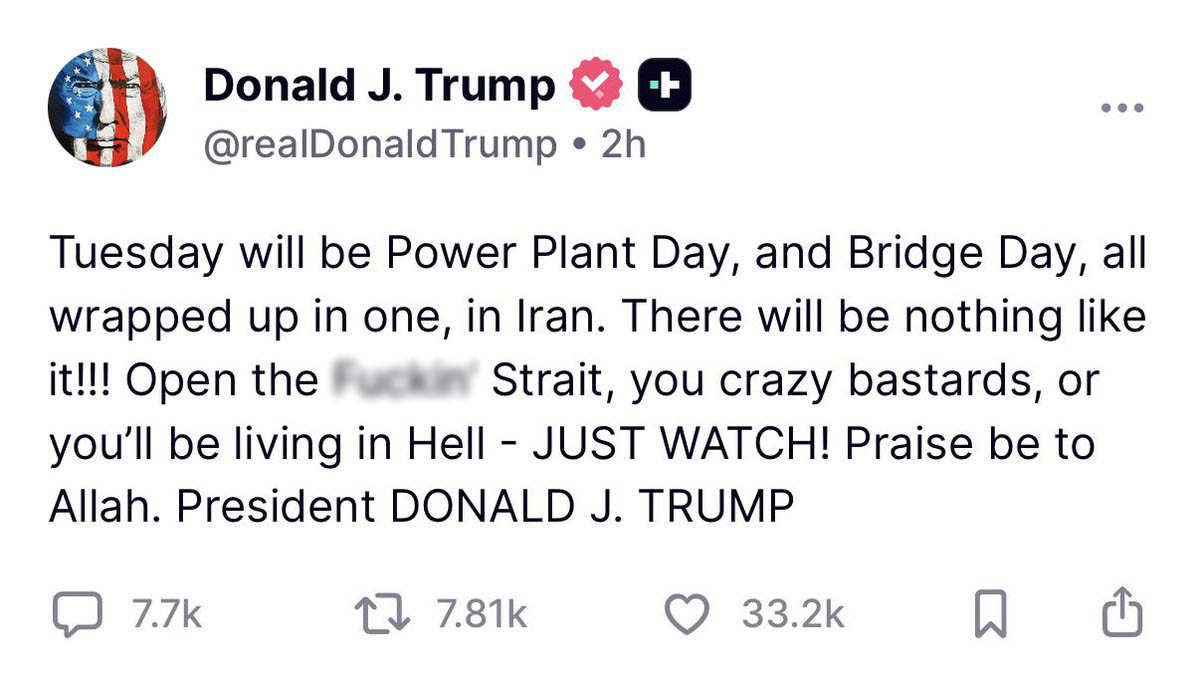
President Donald Trump delivered a fiery ultimatum on Truth Social, demanding Iran reopen the Strait of Hormuz or face devastating strikes on power plants and bridges starting Tuesday. The expletive-laden post sent immediate ripples through prediction markets tracking US-Iran ceasefire timelines and energy supply disruptions. Traders slashed near-term resolution probabilities while oil futures climbed sharply amid fears of a prolonged blockade.
Prediction market participants repriced contracts rapidly after the latest Trump-Iran ultimatum. Polymarket volumes on ceasefire dates surpassed $94 million as sentiment hardened against quick diplomatic breakthroughs. The development underscores how presidential statements directly drive repricing in high-stakes geopolitical prediction contracts.
Trump Strait of Hormuz Ultimatum Crushes Near-Term Ceasefire Probabilities on Polymarket
President Donald Trump posted a profanity-filled warning on Truth Social, labeling Tuesday as “Power Plant Day and Bridge Day” in Iran. He demanded Iran open the critical shipping lane or suffer unprecedented consequences. The message extended prior deadlines and eliminated optimism for swift de-escalation in ongoing US-Iran tensions.
Polymarket traders responded by driving the probability of the April 7 ceasefire down to just 3 percent. The April 15 contract settled around 15 percent, while the April 30 contract reached 24 percent. May 31 stood at 42 percent, June 30 at 52 percent, and December 31 at 74 percent. Combined trading volume on these US-Iran ceasefire markets exceeded $94 million.
The sharp drop reflects a collective trader assessment that the hardened rhetoric reduces the chances of an immediate compromise. Iranian officials countered by insisting on compensation for damages before any reopening. Prediction markets captured this standoff in real time through shifting share prices.
Volumes surged as participants adjusted positions ahead of the Tuesday deadline. The Trump-Iran ultimatum transformed market expectations from cautious optimism to sustained confrontation scenarios. Details of the post appear in coverage from the BBC and Al Jazeera.
Polymarket Ceasefire Odds Following Trump Strait of Hormuz Ultimatum
| Ceasefire Date | Yes Probability | Trading Volume |
|---|---|---|
| April 7, 2026 | 3% | $11,950,012 |
| April 15, 2026 | 15% | $14,078,111 |
| April 30, 2026 | 24% | $11,903,658 |
| May 31, 2026 | 42% | $4,086,253 |
| June 30, 2026 | 52% | $3,388,000 (approx.) |
These real-time figures from Polymarket highlight the steep decline in short-term ceasefire expectations after the latest presidential warning. Predictions about the reopening of the Strait of Hormuz and the end dates for military action show similar caution. Data continues to update as new statements or actions emerge from the involved parties.
Oil Prices Surge on Trump Iran Threat as Prediction Markets Price in Extended Hormuz Closure
Brent crude futures jumped more than 1 percent immediately after the Trump Strait of Hormuz ultimatum, while West Texas Intermediate gained similar ground. The increases stem from traders’ fears that the continued closure of the vital waterway will further tighten global energy supplies. Prediction contracts tied to oil price thresholds moved in lockstep with escalating rhetoric.
Participants incorporated the Tuesday deadline into forecasts for prolonged disruptions. Contracts betting on higher oil benchmarks before any resolution gained momentum. Weekend trading activity intensified as markets digested the potential impact of infrastructure strikes on Iranian energy facilities.
Gas prices in the United States climbed toward $4.11 per gallon amid the uncertainty. This level approaches multi-year highs and reflects cascading effects from restricted shipping lanes. Prediction markets linking ceasefire timelines to oil price recovery captured the interconnected risks, as reported in CNN coverage of oil price movements.
The combination of presidential threats and market repricing created heightened volatility across energy sectors. Traders monitored both political developments and prediction market signals for directional cues.
Prediction Markets Reveal Trader Skepticism Toward Quick Strait of Hormuz Reopening After Trump Warning
High-volume bets on Polymarket focused on extended timelines for normalization of traffic through the Strait of Hormuz. Participants allocated significant capital to scenarios beyond April as the ultimatum reduced flexibility for near-term agreements. The latest Trump-Iran statement reinforced expectations of drawn-out challenges.
Related contracts on military operation conclusions and infrastructure damage risks saw elevated activity. Traders favoring longer horizons dominated order books following each escalation signal. This consistent pattern emerged across multiple prediction market categories tied to the conflict.
Collective pricing introduced the possibility of retaliatory actions and further supply disruptions. Market participants weighed official communications against the hardened positions displayed in recent exchanges. The data painted a picture of caution prevailing in crowd-sourced forecasts.
Trump Truth Social Post Ignites Fresh Activity in US-Iran Prediction Markets
President Donald Trump shared the detailed ultimatum directly via Truth Social on Sunday morning. The post (and various reposts on other platforms) reached tens of millions and prompted swift repositioning among prediction market users. Participants cited the explicit deadline and strong language as key factors in revising their assessments.
The message included colorful phrasing that amplified global attention on the standoff. Traders interpreted the content as limiting room for short-term diplomatic progress. Activity levels rose sharply across platforms as positions realigned to the new reality.
Iranian responses emphasizing compensation demands compounded the effect on probabilities. Prediction markets locked in lower odds for April and early May outcomes. Users continued to monitor for any signs of a breakthrough or further escalation in the hours ahead, as detailed in reports from The New York Times.
Interconnected Prediction Contracts Link Trump Ultimatum to Broader Energy Market Volatility
Prediction markets linked ceasefire probabilities directly to oil price movements and supply-recovery forecasts. Contracts betting against rapid resolution are aligned with higher energy-cost expectations. The current environment reflects deep concerns about sustained disruptions to global trade routes.
Participants tracked these relationships dynamically as events unfolded. A single high-profile statement triggered repricing across outcome categories. The resulting data provided a fast-moving snapshot of collective expectations on conflict duration and economic consequences.
Trading volumes remained elevated as the Tuesday deadline approached. The interplay between political communications and prediction market pricing sustained intense focus. The episode illustrated the rapid influence of geopolitical developments on financial forecasts.
Future movements will hinge on reactions from all sides involved in the dispute. Prediction platforms are prepared to adjust probabilities quickly in response to incoming information. Current configurations indicate prevailing skepticism toward optimistic near-term scenarios in the US-Iran conflict.
References
- Trump Truth Social post on Iran ultimatum
- US x Iran ceasefire by…? Predictions & Odds on Polymarket
- Trump issues expletive-laden threat to Iran over Hormuz
- Trump threatens ‘hell’ for Iran over Hormuz Strait
- Trump says the US will target Iran’s infrastructure on Tuesday
- Oil prices climb after Trump threatens Iran over Strait of Hormuz
- Iran War Live Updates: Trump Escalates Threats
- Trump’s FINAL ultimatum to Iran over Strait of Hormuz tensions