
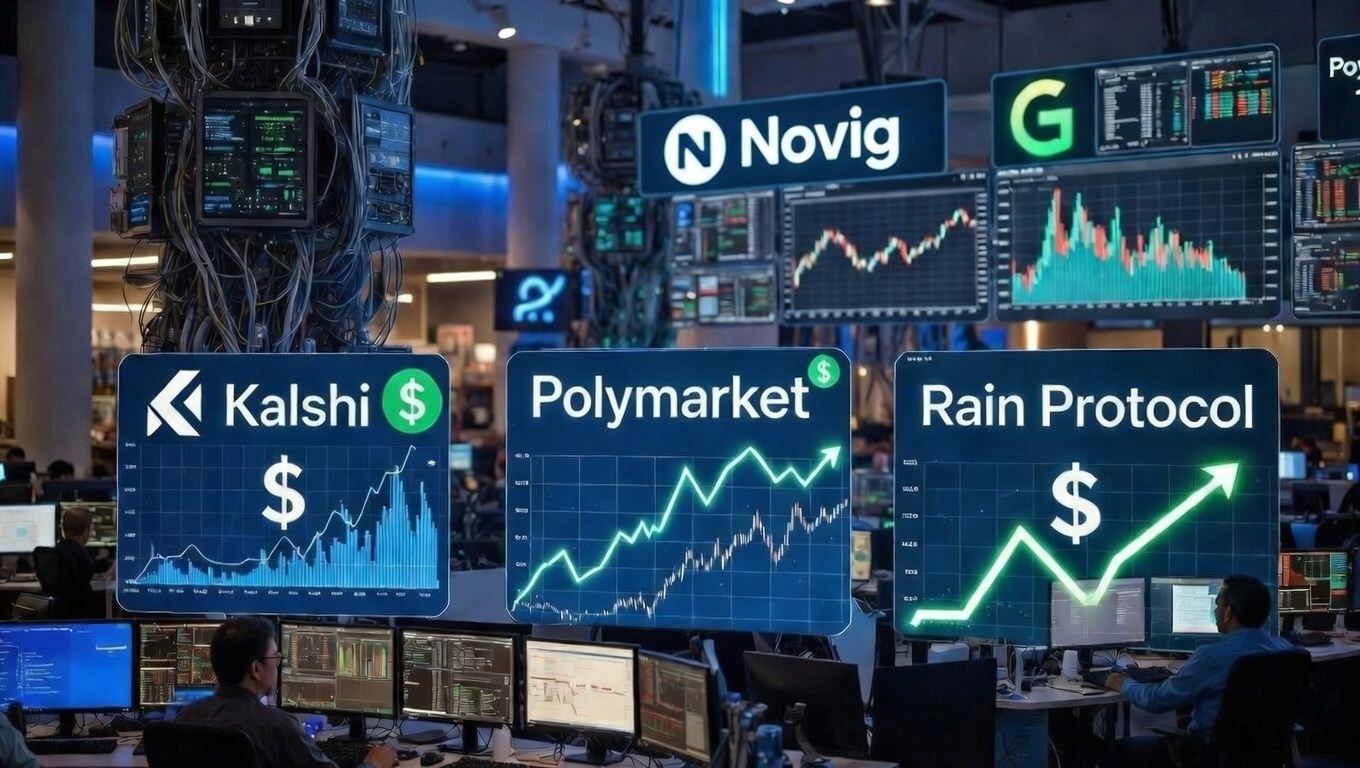
Valuations in the prediction market sector reached new heights in 2026. Platforms captured significant investor interest through substantial funding rounds and strategic expansions. Let’s look at the top-ranked entities by reported market valuation. Data draws from recent funding disclosures and industry analyses. The rankings highlight a competitive landscape dominated by a few key players. Observers note the sector’s rapid evolution amid increasing trading volumes.
Leading Platforms by Market Valuation
Kalshi secured the top position with an $11 billion valuation. The platform achieved this milestone following a major funding round in late 2025. Investors valued its regulatory compliance and broad market offerings. Polymarket followed closely at $9 billion, bolstered by its acquisition strategies and volume growth. Rain Protocol ranked third at $1.95 billion, reflecting its protocol-based approach and integration capabilities. These valuations underscore the sector’s appeal to institutional capital.
| Rank | Platform | Valuation | Key Funding Round | Notable Features |
|---|---|---|---|---|
| 1 | Kalshi | $11B | $5B round in 2025 | CFTC-regulated, USD/USDC settlements |
| 2 | Polymarket | $9B | Acquisition of QCEX for $112M | USDC on Polygon, global events |
| 3 | Rain Protocol | $1.95B | Recent protocol expansions | Decentralized liquidity provision |
| 4 | Novig | $500M | Private funding | Event contract focus |
| 5 | Gnosis | $376M | Ongoing token metrics | Decentralized oracle integration |
| 6 | Opinion Labs | $300.82M | Token generation event | High-volume notional trades |
| 7 | Limitless | $207.31M | Platform growth funding | Perpetual markets |
| 8 | Sport.Fun | $36.99M | $4.5M token sale | Sports-focused predictions |
| 9 | SX Bet | $35M | Market expansion | Betting integrations |
| 10 | Probable | Estimated $200M+ | Volume-based growth | Newcomer liquidity |
Valuations are based on post-money assessments and fully diluted metrics. Platforms like Kalshi and Polymarket dominate due to their scale. Smaller entities show potential for upward mobility. Market dynamics influence these figures regularly. Analysts track funding announcements for updates.
Deep Dive into Top-Ranked Platforms
Kalshi: Dominating with Regulatory Edge
Kalshi maintained its lead with an $11 billion valuation in 2026. The platform’s CFTC regulation facilitated partnerships with major brokers. Trading volumes exceeded $2.7 billion weekly in recent periods. Investors appreciated its focus on macro and political contracts. Expansion into sports and climate events broadened its appeal. Data from industry reports confirm its position as a benchmark for valuation trends.
Partnerships with entities such as Robinhood boosted revenue. The integration generated an estimated $300 million annually for collaborators. Kalshi’s user base grew through seamless onboarding processes. As detailed in PolyPunter’s guide to betting on Kalshi, the platform offers straightforward access for newcomers. This accessibility contributed to its high valuation. Competitors monitor Kalshi’s strategies closely.
Future projections suggest sustained growth. Analysts forecast doubled volumes by year-end. Regulatory stability provides a competitive advantage. The platform’s event contracts cover diverse categories. Valuation stability reflects investor confidence. Market participants view Kalshi as a stable force in the sector.
Polymarket: Crypto-Native Growth Leader
Polymarket achieved a $9 billion valuation through strategic acquisitions. The purchase of QCEX for $112 million enabled U.S. re-entry. Volumes reached $2.4 billion weekly, rivaling top platforms. Its USDC settlement on Polygon attracted crypto users. Global event coverage expanded its international footprint. Reports highlight its role in high-liquidity trades.
The platform faced state-level legal challenges in 2026. Disputes over sports contracts involved regulators in Nevada and New York. Polymarket defended its financial market status. As noted in CNBC’s coverage, these battles test jurisdictional boundaries. Resolution could impact future valuations. The company’s beta relaunch drew sign-ups to the waitlist.
Investor backing from blue-chip firms supported its rise. Monthly volumes hit $2.6 billion in late 2025. Polymarket’s prediction accuracy outperformed traditional polls. Social media discussions, such as this X post on top valuations, underscore its prominence. The platform’s adventure features engage users. Valuation reflects its innovative edge.
Outlook remains positive amid sector expansion. Polymarket targets $1 trillion annual volume by decade’s end. Crypto integration drives user adoption. Challenges include manipulation concerns. The platform implements controls to mitigate risks. Market observers anticipate further valuation increases.
Rain Protocol and Emerging Challengers
Rain Protocol held third place at $1.95 billion. Its decentralized model emphasized liquidity provision. Integration with chains like BNB boosted adoption. Cumulative volumes surpassed $3.1 billion shortly after launch. The protocol’s bonding mechanisms attracted developers. Valuation growth is tied to its permissionless environment.
Novig followed at $500 million. The platform focused on event contracts with low fees. Its U.S. operations complied with regulations. Growth stemmed from user-friendly interfaces. Valuation metrics improved through partnerships. Emerging platforms view Novig as a model for scaling.
Gnosis ranked fifth at $376 million. Decentralized oracles enhanced their reliability. Token economics supported steady valuation. The platform’s TVL contributed to its ranking. Integration with DeFi ecosystems expanded reach. Analysts note its resilience in volatile markets.
Opinion Labs secured $300.82 million. High notional volumes of $362 million weekly drove interest. The platform’s token event generated buzz. Social features differentiated it from its peers. Valuation reflected strong community engagement. Future expansions target new categories.
Limitless achieved $207.31 million. Perpetual markets formed its core offering. Volume growth positioned it competitively. The platform’s innovations in trading tools appealed to quants. Valuation trends upward with sector momentum. It represents the mid-tier’s potential.
Sport.Fun and SX Bet rounded out the lower ranks. Sport.Fun’s $36.99 million came from a $4.5 million token sale. Sports focus captured niche users. SX Bet’s $35 million emphasized betting integrations. Both platforms show room for growth. Smaller valuations allow agile adaptations.
Valuation Trends and Market Dynamics
Prediction market valuations surged in 2026. Total sector trading volume approached $63.5 billion in 2025 alone. Platforms like Kalshi and Polymarket led this expansion. Investor interest shifted toward regulated entities. Decentralized options gained traction among crypto natives. The landscape features a mix of fiat and digital settlements.
Funding rounds doubled valuations for top players. Kalshi’s $5 billion raise set a precedent. Polymarket’s acquisitions mirrored this strategy. Emerging platforms like Rain Protocol benefited from protocol innovations. Market concentration at the top persists. Mid-tier entities seek differentiation through features.
Weekly volumes illustrate competitive intensity. Kalshi reported $2.7 billion, while Polymarket hit $2.4 billion. Opinion Labs and Probable followed with hundreds of millions. These figures correlate with valuation rankings. Higher volumes attract more capital. Platforms invest in liquidity to sustain growth.
| Platform | Weekly Volume | Market Share Percentage |
|---|---|---|
| Kalshi | $2.7B | 31% |
| Polymarket | $2.4B | 28% |
| Opinion Labs | $362M | 4% |
| Probable | $346M | 4% |
| Predict.Fun | $173M | 2% |
The table demonstrates volume distribution. The top two platforms command over half the market. This concentration influences valuation disparities. Smaller platforms leverage niches for gains. Volume data informs investor decisions. Trends suggest continued consolidation.
Regulatory environments shape valuations. CFTC approvals enhance credibility. Platforms like Polymarket navigated fines to regain access. State challenges persist for sports contracts. Successful resolutions could elevate valuations further. Compliance remains a key valuation driver.
Investor sentiment favors platforms with strong TVL. Polymarket’s $327 million TVL led the pack. Opinion Labs followed at $114 million. These metrics signal user commitment. Higher TVL correlates with valuation stability. Platforms prioritize TVL growth strategies. This focus sustains sector momentum.
Comparative Analysis of Valuation Drivers
Valuation drivers vary across platforms. Regulatory status boosts Kalshi’s premium. Polymarket’s crypto integration appeals to digital asset holders. Rain Protocol’s decentralization attracts protocol builders. Novig emphasizes low-cost event trading. Gnosis leverages oracle technology for accuracy.
Funding sources influence rankings. Venture capital fueled Kalshi’s rise. Token sales supported Sport.Fun’s entry. Acquisitions like Polymarket’s QCEX deal accelerated growth. Diverse funding reflects sector maturity. Platforms balance equity and token models. This hybrid approach optimizes valuations.
User engagement metrics underpin valuations. High weekly volumes indicate active trading. Social features on platforms like Opinion Labs enhance retention. As outlined in PolyPunter’s glossary of prediction market terms, concepts such as liquidity mining drive participation. Education tools lower entry barriers. Engaged users contribute to sustained valuation growth.
Market share battles intensify. Kalshi and Polymarket vie for dominance. Emerging challengers target underserved categories. Sports and politics remain high-volume areas. Crypto trends integrate with traditional events. Platforms adapt offerings to capture share.
Risk factors affect valuations. Manipulation concerns prompt enhanced controls. Geopolitical events influence trading spikes. Platforms mitigate through diverse contracts. Valuation resilience ties to risk management. Investors assess these elements carefully. Strong frameworks support premium valuations.
Future Outlook for Prediction Market Valuations
Projections indicate further valuation increases. Sector volume could reach $1 trillion by 2030. Platforms expand into new categories, such as AI outcomes. Global adoption drives growth. U.S. regulatory clarity accelerates domestic expansion. International markets offer untapped potential.
Innovation shapes future rankings. AI bots for trading emerge on platforms. Bayesian models enhance prediction accuracy. As discussed in social analyses, such as this X post on TVL rankings, metrics evolve with tech integrations. Platforms invest in quant tools. These advancements could redefine valuations.
Consolidation trends loom. Larger platforms acquire smaller ones. Partnerships with brokers expand reach. Valuation multiples rise with scale. Mid-tier entities seek mergers for competitiveness. The landscape may feature fewer but stronger players.
Economic factors influence trajectories. Interest rate decisions impact trading. Platforms offer contracts on Fed actions. Valuation sensitivity to macro events persists. Resilient platforms maintain premiums. Diversification mitigates downturn risks.
Investor opportunities abound. High-valuation platforms attract stock investments. Related stocks like DraftKings benefit indirectly. U.S. News highlights top picks in the space. Prediction markets integrate with broader finance. This convergence elevates sector valuations.
Challenges include legal hurdles. State gaming laws clash with federal oversight. Platforms advocate for clear distinctions. Successful advocacy could unlock new markets. Valuation upside ties to regulatory wins. The sector navigates these dynamics strategically.
References
- 3 of the Best Prediction Market Stocks to Buy in 2026 – Nasdaq
- Complete Prediction Markets Guide for 2026 – Rotowire
- Top 7 Prediction Market Apps in 2026 – LegalBison
- Best Prediction Markets for 2026 – Federal News Network
- Top Prediction Market Categories to Watch in 2026 – MetaMask
- Best Prediction Market Platforms in 2026 – The Block
- Top 5 Prediction Markets in the U.S. (2026 Ranked List) – Gambling Insider
- Best Prediction Markets in the USA 2026 – OddsShark
- Top 5 Decentralized Prediction Markets of 2026 – MobileAppCircular
- Largest IPO by Market Cap in 2026 – Polymarket
- List of Prediction Market Sites in the US (March 2026) – DeFi Rate
- Polymarket Official Site
- Prediction Markets at Scale: 2026 Outlook – Insights4VC
- 3 of the Best Prediction Market Stocks to Buy in 2026 – AOL
- 8 Top Prediction Markets to Trade Event Contracts in the US – Finder
- Best Prediction Market Apps 2026: Top US Platforms – Casino.org
- 8 Best Prediction Market Stocks to Buy – U.S. News Money
- The Top 5 Prediction Markets in 2026 – Quadcode
- Ultimate Glossary of Prediction Markets Terms and Slang (2026 Edition) – PolyPunter
- How to Bet on Kalshi: A Step-by-Step Guide for Beginners – PolyPunter
- Polymarket Is Back in the U.S. — What To Know About Prediction Markets – CNBC
- Top Prediction Markets by Valuation – X Post by Predictefy
- Top Prediction Markets by Total Value Locked – X Post by Predictefy