
Beyond the popular-culture hype around prediction markets, they are, at their core, a set of economic and mathematical principles played out in a peer-to-peer marketplace of staked forecasts.
Prediction markets offer a powerful tool for teaching probability, Bayesian updating, and calibration, yet their dominant real-money designs risk normalizing short-term profiteering and speculation over critical thinking. These platforms turn collective opinions about future events into prices that serve as live probability estimates, giving learners a chance to practice revising their beliefs as new information arrives. At the same time, commercial versions optimized for continuous trading increasingly resemble gambling apps.
Educators using prediction markets for study face a clear choice: deploy play-money and classroom versions to build rigorous probabilistic skills, or allow current high-engagement formats to prioritize speculative habits.
Probabilistic reasoning remains underdeveloped in many, if not all, modern curricula. Students often treat uncertain events as either certain or impossible. Prediction markets counter this by requiring continuous reassessment. As an example, a contract trading at $0.65 signals a 65 percent estimated chance. Learners must judge whether that price is too high or too low, then adjust as evidence changes. In the process, they practice Bayesian updating: revising prior beliefs in light of new data, rather than the natural human tendency to hold firm to initial beliefs.
How Prediction Markets Convert Prices into Probability Lessons
Binary event contracts settle at $1.00 if the event occurs and $0.00 if it does not, so market prices map directly onto standard percentages. This simple mapping lets instructors illustrate expected value, calibration, and the gap between subjective belief and objective frequency without relying solely on newly learned formulas. Students who buy undervalued contracts and sell overvalued ones feel the positive consequences of miscalibration at once, and vice versa.
Bayesian updating arises naturally during trading. New information moves prices, forcing learners to revise personal estimates and decide whether to act on any discrepancy. Over repeated rounds, participants absorb the logic of priors and likelihoods. Calibration receives equal attention: accurate forecasters see virtual portfolios improve relative to those who systematically overestimate or underestimate. Markets make long-run frequency tangible, showing that a 70 percent claim should prove correct roughly seven times out of ten.
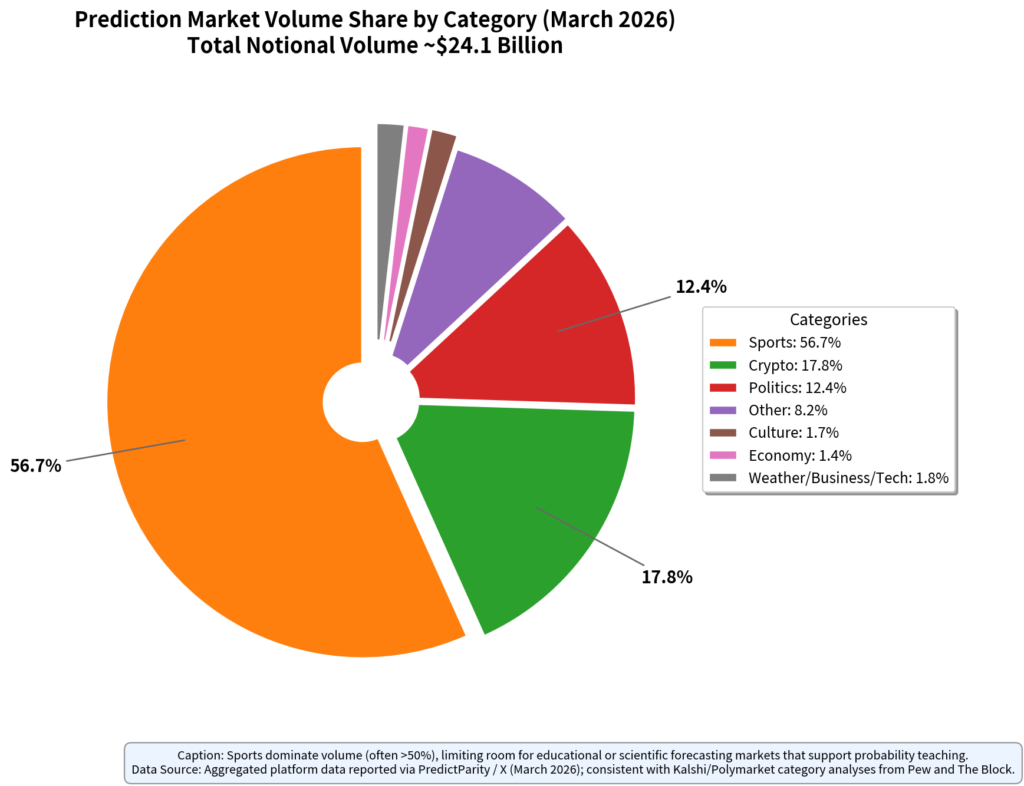
Play-money versions (used in classrooms and online on various typically entertainment-related sites) preserve these incentives while removing financial pressure. Virtual points for prizes or course-credit bonuses still reward careful forecasting yet mitigate addictive potential. Instructors can create markets tied to course content such as forecasting exam results, project timelines, or experimental outcomes. Classroom environments have shown that learning benefits do not require cash stakes, though something of value must be at stake.
Classroom Evidence for Educational Prediction Markets
Empirical work supports the idea of carefully designed educational markets. One case study embedded a custom market in an undergraduate risk-management module and found students searched more actively for information, incorporated new data into forecasts, and refined risk assessments through trading. Construction project management classes reported similar results: the game-like process increased interest in risk identification and helped quantify uncertainties that lectures had left students feeling theoretical and abstract.
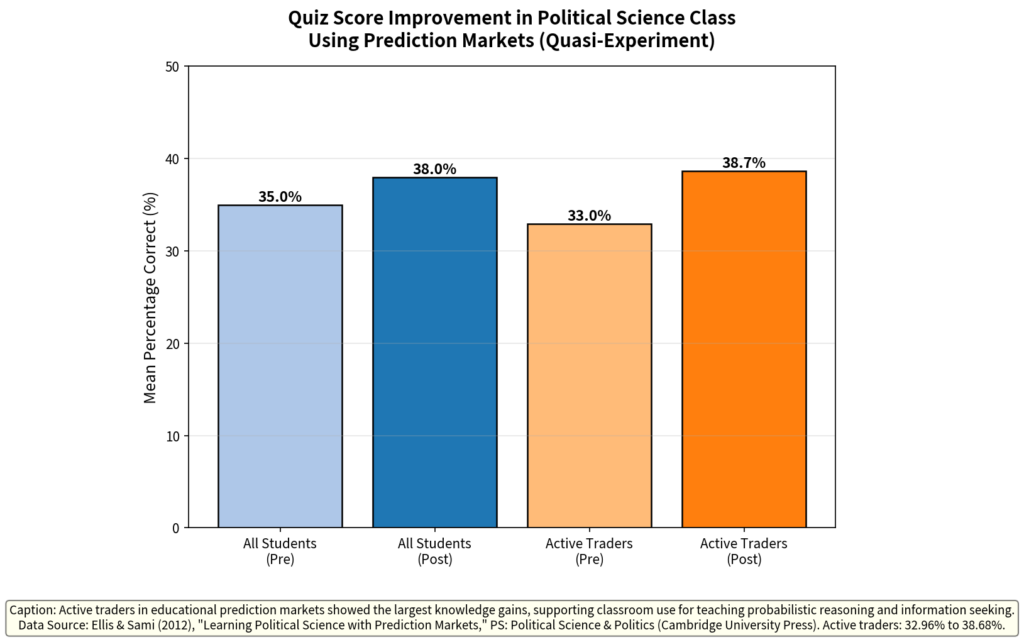
Political science experiments showed that active traders often began with stronger information-seeking habits and enjoyed the market component even when overall enthusiasm gains were modest. University-operated platforms such as the Iowa Electronic Markets, one of the most prominent and earliest university-hosted prediction markets, further illustrate the model. Faculty primarily run them to train finance and economics students through supervised trading in response to political, economic, and corporate outcomes, with an emphasis on skill development.
These implementations share a common design: markets illuminate probabilistic thinking. Instructors control topics, duration, and resolution criteria. They pause trading for debriefs, require written justifications, or link performance to reflective essays on Bayesian principles. Scaffolding turns the activity into structured inquiry rather than open-ended speculation.
Real-Money Designs and the Risk of Normalizing Speculation
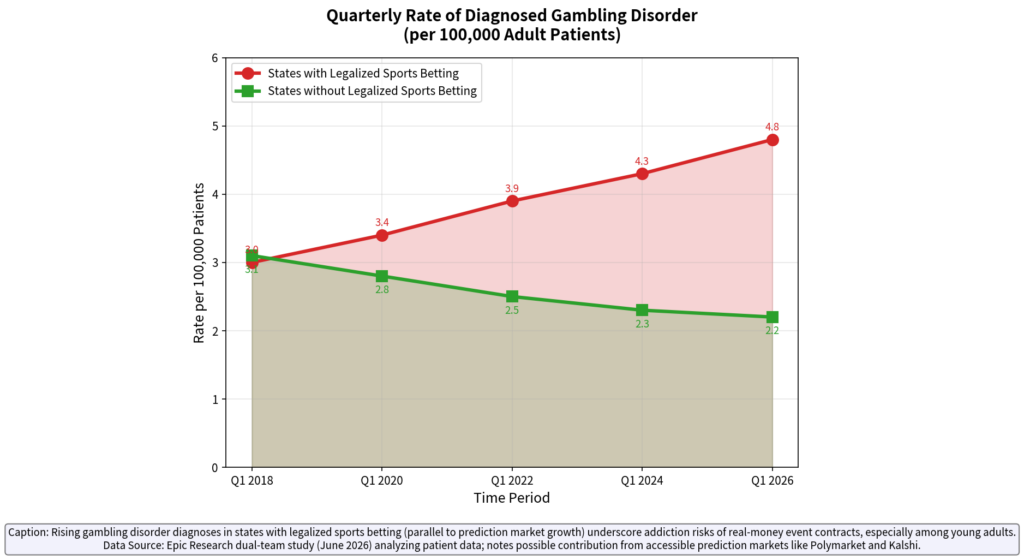
Commercial prediction market platforms present a different picture. High-engagement interfaces, continuous contracts, and frictionless mobile trading prioritize time and trades on the platform over deliberate forecasting. Clinicians treating gambling disorders report identical behavioral cycles: anticipation, action, chasing losses, secrecy, and disruption of daily life. This pattern is the same among clients using prediction markets and those using traditional sportsbooks. One clinical director described the experience as different doors into the same room.
Young adults appear especially vulnerable because impulse-control regions of the brain continue developing into the mid-twenties. Treatment providers describe patients moving fluidly between sportsbooks and prediction platforms, often after advertising aimed at college-age users. The same accessibility and rapid feedback that make markets educationally potent also raise addiction risk once real money and unlimited hours enter the equation.
Design choices amplify the problem. Short-term, high-drama contracts generate more volume than longer-horizon scientific or policy questions, so commercial platforms favor liquid sports and cultural markets that reward quick reactions. Public-health researchers have begun framing commercial prediction markets as a potential behavioral-addiction threat because gambling-like interfaces wrap scientific language around engagement mechanics. Individuals already prone to compulsive news consumption find the platforms transforming passive information intake into active monetary stakes, intensifying cycles of monitoring and reacting.
There is a specific chemical reaction in the brain that reinforces this behavior in some percentage of the population with a compulsive quality.
Why Play-Money Versions and Structured Classrooms Matter
Educational upside does not require commercial designs. Play-money markets retain every cognitive benefit while eliminating monetary harm. Students still face consequences for incorrect forecasts and celebrate accurate updates, yet those consequences remain limited to virtual balances or academic evaluation. Instructors keep full control over topics, ensuring markets reinforce learning objectives rather than merely wins and losses.
Structured debriefs after games are closed convert experience into transferable knowledge. After resolution, classes examine whose probabilities proved best calibrated, which sources moved prices most effectively, and why, and where common biases appeared. These discussions reinforce Bayesian principles more vividly than lectures alone and equip students to apply the same discipline to personal decisions, scientific claims, and civic judgments.
Scaling requires intentional effort. Open-source software already exists for local adaptation. Professional development can cover market design and facilitation of probability discussions. Partnerships between education researchers and developers can produce ready classroom kits with sample contracts, rubrics, and safety guidelines. Commercial operators, meanwhile, will face continued and growing pressure to add age gates, spending limits, self-exclusion tools, and clear labeling that separates research-oriented platforms from high-engagement retail “wagering”.
A Practical Path Toward Probabilistic Literacy
Educators, curriculum designers, and platform builders share responsibility for steering development toward learning-centered designs. Expanding supervised educational markets, prioritizing play-money versions in schools, and requiring stronger consumer protections on commercial sites can preserve teaching power while containing cultural risks. The downside associated with real-money, commercially focused prediction markets should not dissuade educators from using these market mechanics as teaching and training environments.
Probability literacy is essential in a world of abundant uncertainty. Properly framed, prediction markets remain one of the most promising tools for cultivating that literacy, provided the classroom, not the casino, sets the terms.
References
- Iowa Electronic Markets – University of Iowa Tippie College of Business educational and research project
- Prediction markets: can betting be good for the world? (YouTube explanation of prices as probabilities)
- AP News – Clinicians on addiction cycles in prediction markets
- ScienceDirect – Case study on prediction markets as rich environments for active learning
- Cambridge Core – Learning Political Science with Prediction Markets experimental study
- ResearchGate – Educational Prediction Markets construction project management case study
- Alliance for Decision Education – Thinking Probabilistically in the Classroom
- PubMed – Using prediction markets to estimate reproducibility of scientific research
- CNN Business – College-age adults and prediction market addiction concerns
- GamblingHarm.org – Doomscrolling addiction and prediction markets
- Science – Prediction markets as a public health threat (policy forum abstract)
- The Gazette – Iowa Electronic Markets educational value for students
- SAGE Journals – The IEM Movie Box Office Market experiential learning
- SIGecom Exchanges – Prediction Markets for Education experimental study
- arXiv – Active Learning with Bayesian Reasoning POGIL pedagogy
- PMC – Able Construction spreadsheet activity for teaching Bayes’ theorem
- Interactive Brokers – Practical Use of Prediction Markets trading lesson
- CoinRithm – How Prediction Market Probabilities Work
- LDG Blog – Financial markets in the classroom experiments
- Rensselaer Polytechnic – Instructor Rating Markets design and study

The PolyPunter staff works tirelessly to bring you the latest and most insightful news, information, and tips on the fast-growing economic, financial, and social phenomenon that is prediction markets.