
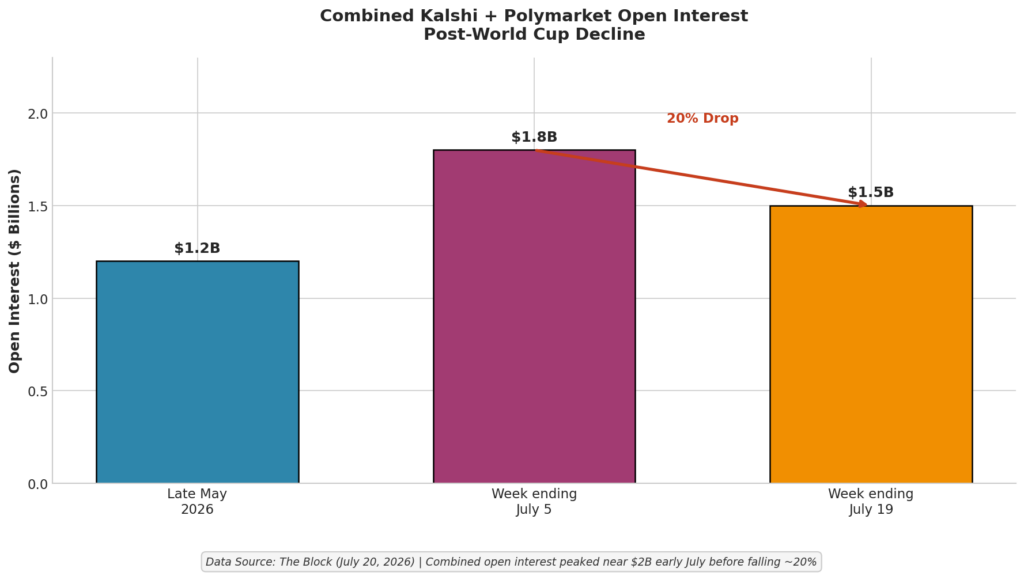
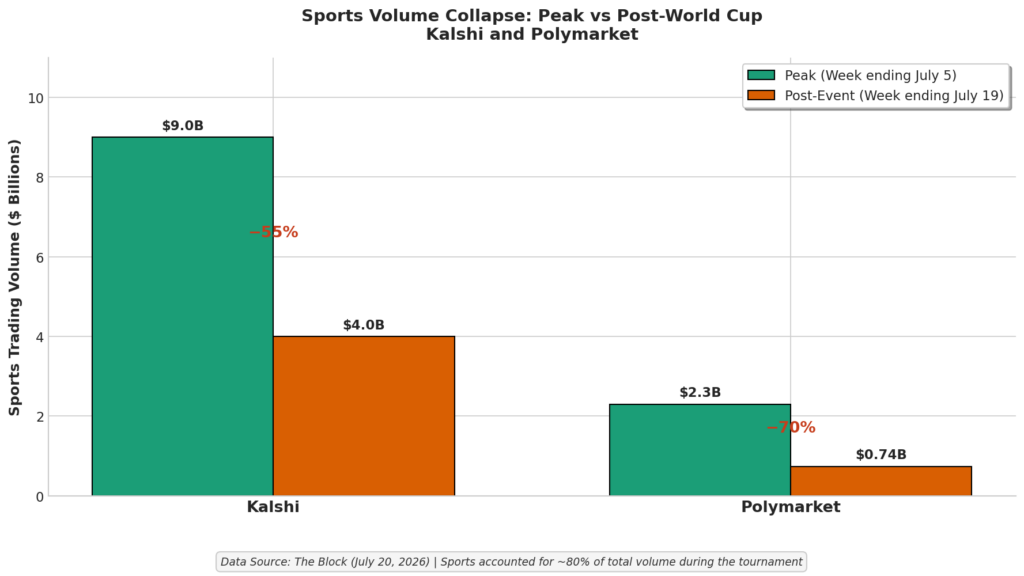
The collapse of prediction market volume after major events has moved from theory to clear evidence. Leading platforms that captured record trading during the recent FIFA World Cup 2026 now face a sharp retreat. Combined prediction market open interest (total number of active, unsettled contracts) dropped 20 percent from a peak near $2 billion, while sports trading fell roughly 55 percent on one major venue and nearly 70 percent on another. These figures expose a structural fragility rooted in heavy reliance on short-lived event pipelines.
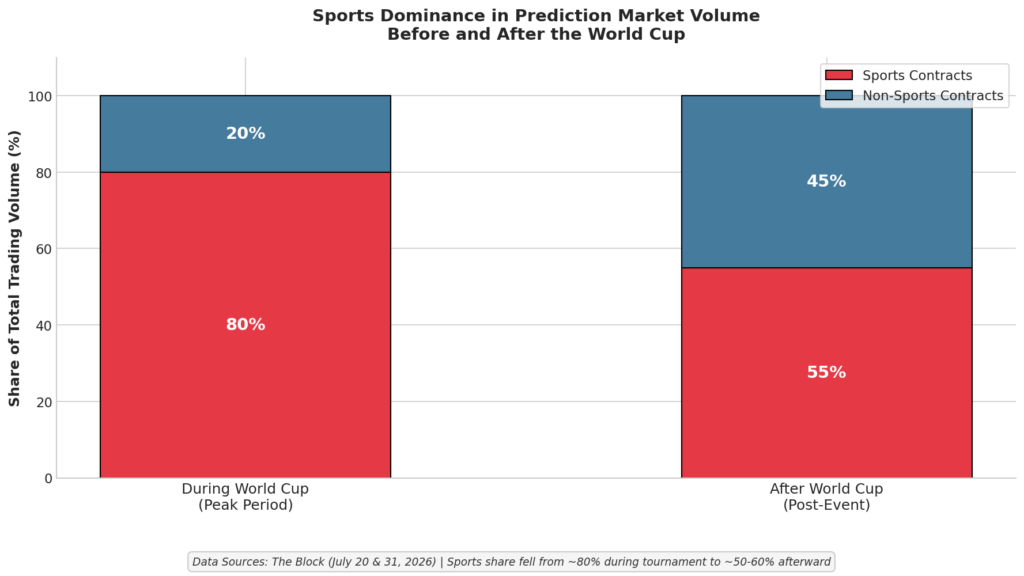
Dense World Cup match schedules once supplied a steady stream of contracts that kept order books active and capital circulating. Sports contracts accounted for about 80 percent of total volume across the two largest platforms at the height of the month-long tournament. Once the bracket narrowed and the final match concluded, daily turnover collapsed. Open interest declined more slowly because outstanding positions unwind only as contracts resolve over time, yet the overall pattern remains unmistakable: without continuous high-density catalysts, liquidity fades quickly.
This post-event trading decline raises urgent questions about the long-term viability of prediction markets. Platforms that lean primarily on sports calendars lock themselves into repeated boom-and-bust cycles, as you see in traditional sports betting, where a 5-month football season drives a large percentage of annual total numbers. Political markets, often cited as the next natural catalyst, generate different rhythms: longer holding periods and lower daily turnover. They cannot fully replace the match-by-match intensity that drove the recent surge.
Event Density Created the Surge and Then the Retreat
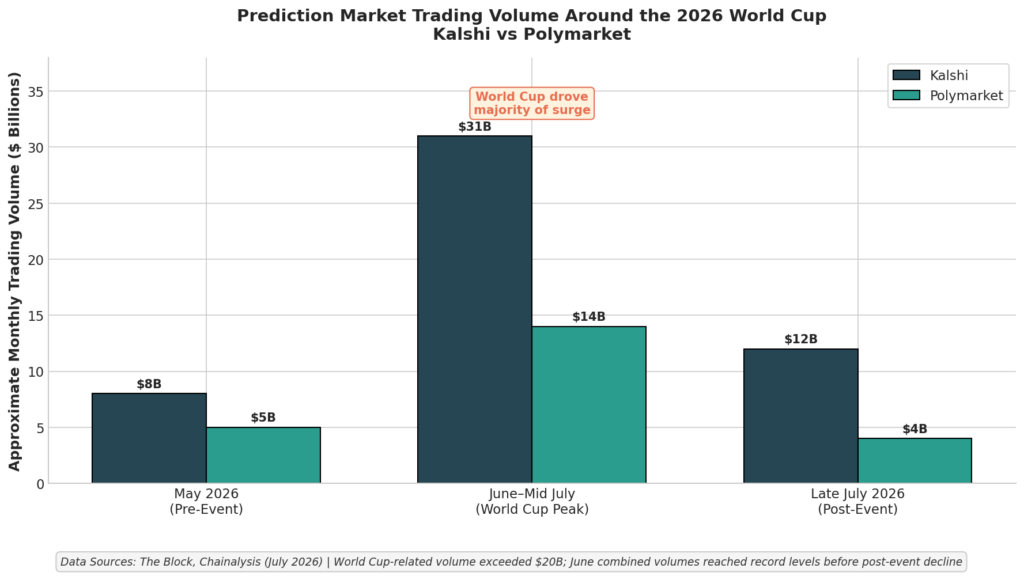
During the World Cup group stage, dozens of matches each week produced binary and multi-outcome contracts that invited rapid capital rotation. Research from Chainalysis shows the broader competition generated more than $20 billion in prediction market volume from the start of the year through the final. On-chain activity alone reached $5.7 billion across the five main weeks. Kalshi and Polymarket together processed roughly $54 billion in sports-related contracts during the same time window.
Volume soared because the event calendar itself functioned as a liquidity engine. Matches arrived almost daily, drawing both directional traders and market makers. As knockout rounds progressed, the supply of available contracts shrank. By the week ending July 19, one platform’s sports volume had fallen from a peak near $9 billion to around $4 billion, while the other’s dropped from nearly $2.3 billion to $740 million. The final produced a last burst of activity, yet it could not reverse the pronounced structural thinning.
Open interest followed a milder path, retreating from roughly $2 billion early in July to about $1.5 billion by mid-month. Data from The Block highlight the key distinction: volume tracks daily turnover that vanishes when matches disappear, while open interest reflects capital still locked in unresolved positions. Once those positions settle, much of the capital exits rather than rotating into quieter categories. These were World Cup-only traders.
Consequently, average daily volumes across several venues returned to or fell below pre-tournament baselines within days. Fee revenue, which had climbed sharply, also softened, with some platforms experiencing steeper percentage declines than others. The incremental activity had been highly concentrated around the sports event calendar.
Why the Post-Event Decline Reveals Structural Fragility
The speed of the retreat underscores a core vulnerability. Markets positioned as continuous information aggregators still rely heavily on external event calendars rather than on prediction markets as a financial tool for most retail engagement. When those calendars empty, sticky non-sports use cases have so far proven insufficient to maintain scale. Political contracts, economic indicators, and corporate events exist, yet they rarely match the turnover density or trading volume of sports markets.
Moreover, the composition of peak volume amplifies the risk. Sports dominated activity, leaving other categories underdeveloped. After the tournament, the sports share declined but remained elevated relative to earlier norms. Platforms, therefore, carry user bases and market-maker networks formed around high-frequency sports action into quieter periods, where retaining them becomes harder.
In addition, profit-and-loss data from one major platform showed that most individual outcomes stayed under $100. A broad base of smaller retail traders drove much of the activity. When the event ends, that base has fewer immediate reasons to stay engaged day after day. Growth arriving in concentrated bursts leaves residual capacity and expectations that quieter stretches cannot satisfy.
As a result, platform infrastructure scaled for peak loads sits underutilized, and marketing teams that celebrated record weeks must explain softer metrics to management and investors. Capital that flowed in during the surge can exit just as readily once resolution occurs, and if the specific interest is no longer present in the markets, it often does.
Midterm Cycles Offer Only Limited Relief
Many platform statements highlight the approaching midterm election cycle as the next catalyst. Trading in related contracts has already surpassed $200 million across more than 1,000 markets. Kalshi launched a dedicated hub combining live odds, polling averages, and fundraising data, demonstrating genuine interest in political forecasting.
Nevertheless, political markets differ fundamentally from sports tournaments. Election contracts often span months rather than hours. Traders tend to establish positions earlier and adjust them less frequently, resulting in lower daily turnover even as overall open interest builds. A midterm cycle can deliver meaningful volume, yet it is unlikely to replicate the multi-billion-dollar weekly sports figures of June and early July.
Furthermore, political markets carry their own seasonality. Activity intensifies as election day approaches and contracts sharply afterward. Major election cycles only occur every two years, and every four years for Presidential markets. Treating midterms as a reliable bridge between sports peaks simply shifts the boom-bust pattern onto a different calendar. Without a broader set of recurring, high-frequency non-sports contracts, the underlying external calendar dependency remains intact.
Meanwhile, competition for trader attention intensifies. Traditional sportsbooks and newer event-contract platforms continue to vie for the same capital. Users who discovered prediction markets through soccer may reduce engagement or return to familiar wagering alternatives when no comparable spectacle is underway.
Sticky Non-Sports Use Cases Remain the Central Challenge
Long-term viability depends on markets that generate consistent activity independent of tentpole or seasonal events. Economic releases, corporate earnings, weather outcomes, and regulatory decisions offer potential, yet liquidity in these categories has lagged. Traders seeking frequent opportunities still favor sports because the supply of contracts is denser and the feedback and “thrill” loop faster. Dopamine rushes aren’t the same on multi-month time horizons.
Platforms have tested shorter-duration contracts and novel underlyings. Some short-horizon price-linked markets attracted automated trading and raised integrity concerns, illustrating the difficulty of designing liquid yet resistant products. Longer-horizon contracts reduce certain risks but also reduce turnover. Balancing frequency with durability continues to challenge operators.
In contrast to pure sports volume, informational markets could support more stable open interest. Users who treat prices as ongoing signals rather than pure wagers may hold positions longer and deepen order books. Early signs from one platform indicate a substantial share of visitors already monitor forecasts without trading. Converting that interest into sustained capital commitment is the next critical step.
However, conversion remains incomplete. Marketing that emphasizes high-drama sports outcomes draws in and trains users to expect frequent resolution action and short-term profiteering. Shifting expectations toward quieter, higher-quality information markets requires deliberate design, education, and incentives that reward longer engagement, not the least of which is addressing the time-value-of-money issue we’ve discussed previously on PolyPunter. Few platforms have yet demonstrated a clear path.
Implications for Strategy and Industry Direction
The post-event volume collapse carries concrete consequences for capital allocation, product roadmaps, and growth narratives. Platforms that raised funding on the back of record weeks now face pressure to prove that activity can persist. Retention metrics, non-sports volume share, and the ability to keep market makers engaged through lean periods will receive closer scrutiny.
Prediction market product teams must prioritize contracts that renew regularly and attract overlapping groups of traders. A calendar filled only with occasional political or sports peaks leaves large gaps. Expanding into recurring economic indicators or technology milestones could help, provided resolution criteria stay clear and resistant to manipulation.
At the same time, chasing volume through ever-shorter or more exotic contracts risks integrity questions. Sustainable liquidity depends on trust in markets as much as on turnover. Transparent settlement and robust monitoring become more important when activity levels fall, and remaining trades face greater attention.
Industry-wide, the post-World Cup drop-off calls for recalibrating growth stories. Celebrating peak weekly notional figures without acknowledging the subsequent retreat creates unrealistic expectations that the media and investment community will eventually frame as a decline. A more mature approach would emphasize average daily volume across full cycles, the share of activity outside sports, and order book depth during non-event periods.
Platforms that treat the current decline as both a diagnostic and a call to arms to diversify contract categories, rather than a temporary setback, stand the best chance of building durable businesses. Those that simply await football season or the next major election risk repeating the same cycle. Structural fragility is not inevitable, yet overcoming it requires investment in the markets that proved least able to absorb capital after the final whistle.
The available data make the stakes clear. Volumes that more than doubled during the peak returned toward baseline within days. Open interest retreated even while residual positions remained. Fee streams softened. These outcomes are the predictable result of an event-dependent model operating without sufficient offsetting demand.
Prediction markets have shown impressive capacity to aggregate attention and capital around global spectacles. They have not yet shown the ability to retain that capital once the spectacle ends. Solving the post-event trading decline is the central test of whether these venues can evolve from calendar-driven phenomena into reliable, continuous markets for information and risk transfer.
References
- Kalshi, Polymarket open interest falls 20% as World Cup frenzy winds down | The Block
- Polymarket Sports Volume Falls 70% After World Cup Final
- The 2026 World Cup On-Chain: $20 Billion in Crypto Flows
- World Cup 2026 prediction markets topped $20 billion | The Block
- Data Review: How Much Did Prediction Markets Gain from a World Cup?
- SBJ Betting: Kalshi’s $1 billion-a-day World Cup surge
- Polymarket’s $3.3B World Cup boom exposes the longshot trap
- World Cup Could Bring Billions in Volume to Prediction Markets: Bernstein
- $197 million traded in Kalshi, Polymarket midterm election markets
- Kalshi launches Midterms Hub with live election odds and poll data
- Some Of The Smartest World Cup Bets Weren’t In Sportsbooks | The Brainstorm 137
- The World Cup turned Polymarket into a $5B market
- Kalshi Makes $430 Million In Fees During World Cup
- Kalshi and Polymarket Open Interest Falls 20% After World Cup
- World Cup boom sends Polymarket volume up 300% while Kalshi sets open interest records

The PolyPunter staff works tirelessly to bring you the latest and most insightful news, information, and tips on the fast-growing economic, financial, and social phenomenon that is prediction markets.