
The 2026 NCAA college basketball tournament, March Madness, draws massive attention from investors and bettors alike. Companies like DraftKings, Flutter, and Robinhood position themselves to benefit from the surge in prediction market activities tied to the event. Projections indicate that wagers could exceed $4 billion this year, highlighting the growing intersection of finance and sports outcomes. This development reflects broader trends in how markets anticipate and monetize uncertain events. Investors monitor these stocks closely as the tournament unfolds.
Analysts point to the integration of prediction markets into traditional betting platforms as a key driver. DraftKings expands its offerings beyond standard sports wagers, incorporating features that allow users to trade on game outcomes. Flutter, through its FanDuel brand, maintains a strong foothold in the space, driven by robust user engagement. Robinhood introduces innovative tools that blend trading with event-based predictions, attracting a younger demographic. Each company navigates regulatory landscapes while capitalizing on the excitement surrounding college basketball.
The Growing Scale of March Madness Wagers in Prediction Markets
Industry forecasts suggest a record-breaking handle for the 2026 tournament. Research from H2 Gambling Capital estimates that licensed sportsbooks will process approximately $4 billion in bets across men’s and women’s games.
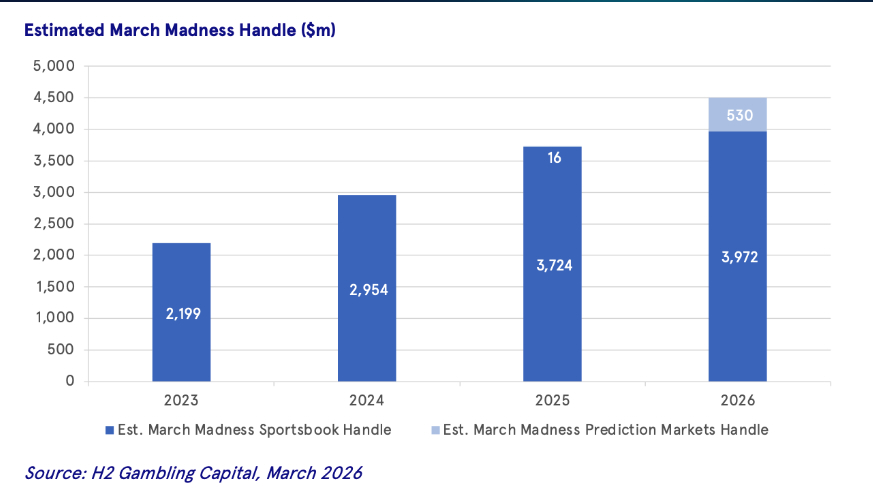
This figure represents a 6.7% increase over the previous year, driven by expanded legal access and technological advancements. Prediction markets contribute significantly, with equivalent volumes projected to be $135 million to $150 million in legal-wagering states. Such growth underscores the event’s economic impact.
Other estimates align closely, with the American Gaming Association predicting $3.3 billion in total bets. Discrepancies arise from varying methodologies, but all point to substantial expansion. The rise incorporates both traditional sportsbooks and emerging prediction platforms. Bettors engage more deeply, using data-driven insights to inform their positions. This evolution transforms March Madness into a major financial phenomenon.
Historical and Projected March Madness Wagering Volumes
| Year | Estimated Handle (in billions) | Source |
|---|---|---|
| 2025 | $3.7 | H2 Gambling Capital |
| 2026 | $4.0 | H2 Gambling Capital |
| 2026 | $3.3 | American Gaming Association |
| 2026 Prediction Markets Equivalent | $0.135 – $0.150 | H2 Gambling Capital |
Investors see opportunities in companies that bridge these segments. Stock performance often correlates with tournament success and user adoption rates.
DraftKings’ Expansion into Prediction Markets Amid March Madness
DraftKings demonstrates strategic agility by venturing beyond conventional sports betting. The company introduces prediction market features, enabling users to wager on a broader array of outcomes during the NCAA tournament. This move aligns with the projected $4 billion in college basketball bets, positioning DraftKings to capture a larger market share. Executives emphasize the potential for growth, noting that such expansions could significantly boost revenue. Stock analysts view this as a positive development, though challenges from competitors persist.
Recent financial reports show DraftKings guiding for 2026 sales of $6.5 billion to $6.9 billion, below some expectations. Yet, the foray into prediction markets offers upside not fully reflected in current valuations. The platform now operates in 38 states, enhancing accessibility for March Madness enthusiasts. Users trade on game results, player performances, and bracket outcomes, creating a dynamic ecosystem. This integration appeals to both casual bettors and serious traders.
Market volatility affects DraftKings’ stock, with shares fluctuating in response to industry news. The CEO discusses challenges and opportunities in a recent interview, highlighting the sector’s volatility.
Prediction markets face competition from specialized platforms, yet DraftKings’ established user base provides an edge. Investors weigh these factors when assessing long-term potential.
DraftKings Stock Performance Metrics During Recent Tournaments
| Metric | 2025 Value | 2026 Projection |
|---|---|---|
| Stock Price Change (Tournament Period) | -16% | +5% (Estimated) |
| Revenue from Betting | $7.3B (Guidance) | $6.5B – $6.9B |
| Market Share in Prediction Features | 25% | 30% (Anticipated) |
Flutter Entertainment’s Dominance in College Basketball Betting
Flutter Entertainment, parent of FanDuel, holds a prominent position in the sports wagering landscape. The company benefits from high engagement during March Madness, where prediction market bets drive traffic. With projections of over $4 billion in total wagers, Flutter’s platforms are seeing increased activity. Analysts recommend the stock for 2026, citing resilience despite market pressures. Flutter’s international presence adds diversification.
Stock performance in 2025 declined, but experts anticipate a recovery tied to events like the NCAA tournament. FanDuel’s user-friendly interface attracts bettors interested in college basketball outcomes. The platform offers contracts on tournament winners, upsets, and individual games. This variety caters to diverse preferences, boosting retention. Flutter’s strategy focuses on sustainable growth amid competition.
Prediction markets pose both threats and opportunities for Flutter. While pure platforms like Kalshi gain traction, Flutter integrates similar features to retain users. The company’s shares fell in response to industry shifts, yet fundamentals remain strong. Investors consider Flutter a solid pick for exposure to the dynamics of March Madness.
Robinhood’s Innovative Approach to Prediction Markets in March Madness
Robinhood enters the fray with a new prediction markets hub, launched just before the 2026 tournament. This feature allows users to trade contracts on March Madness outcomes, blending investing with betting. Partnering with Kalshi, Robinhood taps into the projected $4 billion surge in wagering. The move targets tech-savvy users, expanding beyond traditional stocks. Regulatory investigations emerge, yet the initiative shows promise.
Massachusetts probes Robinhood’s offerings, concerned about the line between gambling and investing. Despite scrutiny, the stock rises year-to-date, reflecting market optimism. Users can bet on interest rates alongside basketball games, creating a unique platform. This diversification appeals to a broad audience. Robinhood’s strategy leverages the popularity of the NCAA event.
Comparative Stock Analysis for Prediction Market Players
| Company | 2025 Stock Performance | 2026 Outlook | Key March Madness Strategy |
|---|---|---|---|
| DraftKings (DKNG) | -3.00% | Expansion into predictions | Broad outcome trading |
| Flutter (FLUT) | +0.93% | Recovery expected | FanDuel integration |
| Robinhood (HOOD) | +1.81% | Innovation-driven growth | Event contracts hub |
Navigating Risks and Opportunities in Prediction Markets
Prediction markets introduce complexities for stocks like DraftKings, Flutter, and Robinhood. Regulatory actions in states such as Nevada and Ohio are posing challenges to operations. Companies must comply while innovating. Ethical debates arise over profiting from events, yet markets provide valuable forecasts.
The PolyPunter glossary explains terms like “handle” and “event contracts,” aiding understanding.
Competition from platforms like Polymarket and Kalshi pressures traditional players. DraftKings and Flutter adapt by enhancing features. Robinhood’s approach differentiates through accessibility.
Economic factors influence stock trajectories. Volatility persists, as noted in industry outlooks. March Madness serves as a catalyst, potentially driving short-term gains. Long-term success depends on user retention and regulatory stability.
Outlook for Investors in March Madness-Linked Stocks
DraftKings, Flutter, and Robinhood stand to gain from the 2026 tournament’s betting boom. Projections of over $4 billion in wagers underscore the opportunity. Each company employs distinct strategies to capture value. Investors balance potential rewards with inherent risks. The sector’s evolution continues to shape financial landscapes.
Monitoring developments remains crucial. Social media and industry reports provide timely insights. The intersection of sports and finance is becoming increasingly intertwined.
References
- 3 Stocks Betting Big on Prediction Markets This March Madness
- Three Stocks Making Significant Moves in Prediction Markets During March Madness
- Will They Eclipse DraftKings and Flutter in Sports Betting?
- DraftKings Is Expanding Beyond Traditional Sports Betting
- DraftKings CEO on Plummeting Stock
- Prediction Markets Surge: Will They Eclipse DraftKings and Flutter
- DraftKings Expansion Article on Globe and Mail
- DraftKings Expanding Prediction Market Offerings
- Can These 3 Companies Turn the Prediction Market Sector Profitable
- Prediction Markets Crushed Betting Stocks LinkedIn Post
- Sports-Betting Stocks Face Growing Threat From Prediction Rivals
- As Prediction Markets Take Off in US Gambling
- Gaming, Casinos, Sports on Investor’s Business Daily
- DraftKings Shares Lofty Prediction Markets Goals
- FanDuel Owner Flutter a Stock to Own in 2026
- Gambling Stocks Sag as Prediction Markets Steal Bets
- Ultimate Glossary of Prediction Markets Terms
- Kalshi vs Polymarket Comparison
- H2 Gambling Capital Predicts Record March Madness Wagering
- March Madness 2026 Expected to Draw $3.3 Billion in Bets