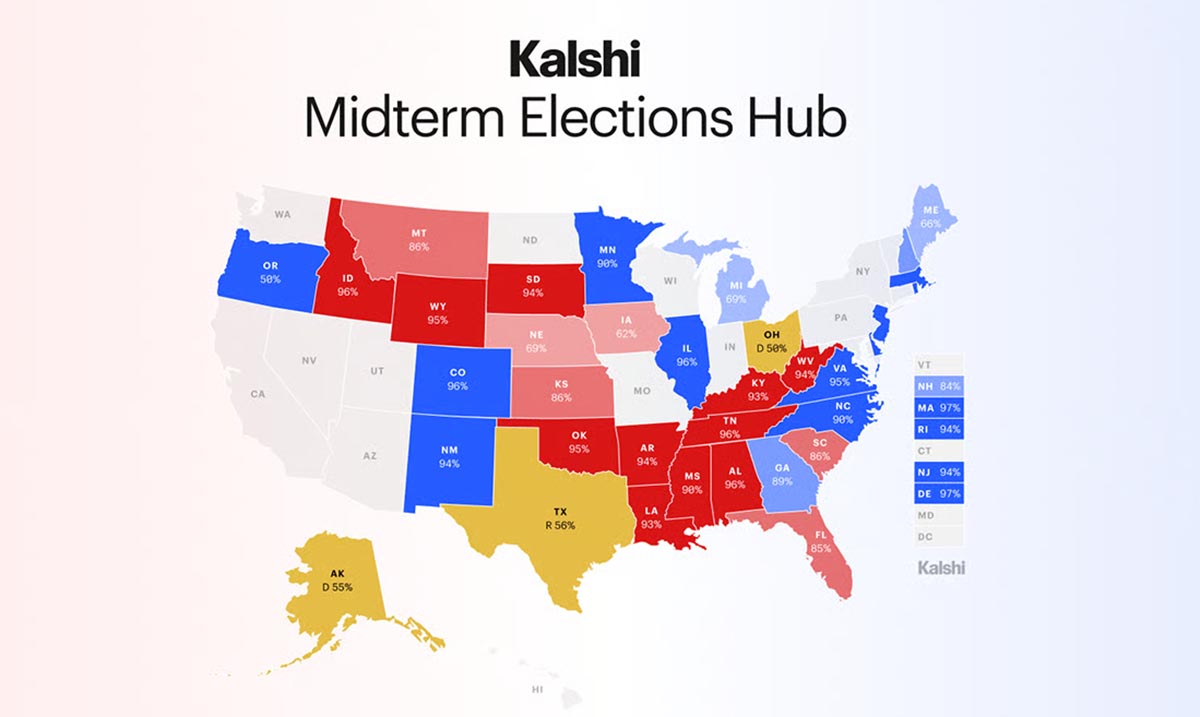
Prediction market traders assign Democrats an 85 percent probability of winning control of the House in the 2026 midterms. This sharp tilt reflects intense betting activity that has already pushed volume past four million dollars on the leading platform. Bettors see a narrow Republican majority from the prior cycle as highly vulnerable to reversal.
House Flip Probability Climbs Steadily in Real-Time Trading
Traders continue to drive Democratic shares higher across major contracts. The probability sits at 85 percent on Polymarket while Kalshi shows 84.5 percent. This convergence highlights broad agreement among participants who actively buy and sell contracts tied to the outcome of the November 2026 election. Recent shifts in pricing demonstrate how fresh polling data and policy developments keep the market dynamic and responsive.
Volume on the flagship House control contract exceeds four million dollars on Polymarket and surpasses seven million dollars on Kalshi. Bettors have committed substantial capital as the election cycle gains momentum. Such figures underscore the growing financial stakes that participants place on accurate forecasting of congressional power shifts.
Current House Control Prediction Market Odds
| Platform | Democrats Win House | Republicans Win House | Trading Volume |
|---|---|---|---|
| Polymarket | 85% | 16% | $4,008,774 |
| Kalshi | 84.5% | 15.5% | $7,170,914 |
Senate Remains Competitive as Traders Hedge Positions
Republicans hold a slim edge in Senate control markets with roughly a 52 percent probability on Kalshi, while Democrats sit close behind. This near-even split keeps participants engaged in multi-outcome strategies that combine House and Senate results. Bettors adjust positions rapidly whenever new candidate announcements or fundraising reports emerge.
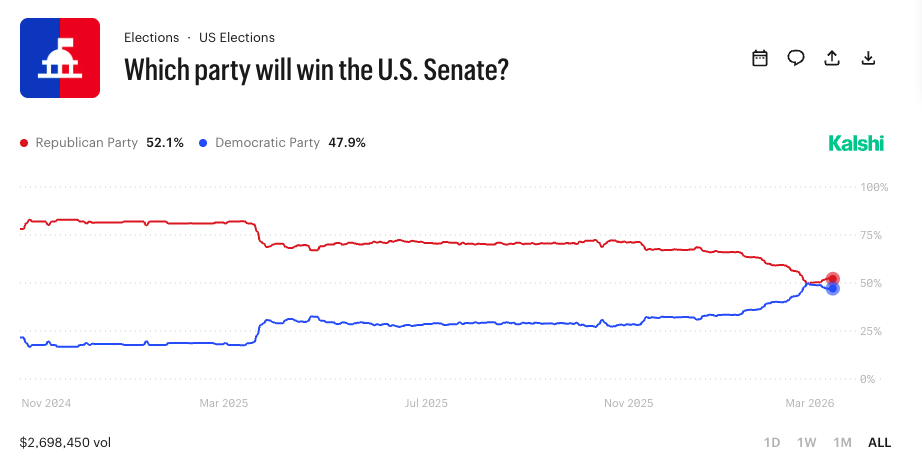
Key Senate contests draw dedicated liquidity on platforms such as the Kalshi Senate winner market. Participants price individual state races while layering in broader chamber-control bets. The interplay between these markets creates opportunities for sophisticated hedging, amplifying overall trading interest.
Balance of Power Scenarios Dominate Multi-Outcome Contracts
Market participants favor a Democratic sweep at 49 percent probability on Polymarket. The next most likely outcome shows Republicans retaining Senate control while Democrats capture the House at 37 percent. Full Republican control trades around 14 percent, while the reverse split registers under one percent. These probabilities evolve continuously as traders react to shifts in national sentiment.
Combined House-Senate contracts attract heavy volume, now surpassing two million dollars on Kalshi. Bettors treat these scenarios as interconnected events rather than isolated races. The resulting price discovery offers a nuanced view of expected congressional composition heading into the next presidential term.
2026 Midterms Balance of Power Scenarios
| Outcome | Probability (Kalshi) | Volume Insight |
|---|---|---|
| Democrats Sweep Both Chambers | 47% | Leading scenario with strong trader conviction |
| Republican Senate, Democratic House | 36.9% | Popular hedge position |
| Republican Sweep Both Chambers | 14.7% | Lower probability reflecting midterm history |
| Democratic Senate, Republican House | 2% | Least favored by current pricing |
Millions in Volume Signal Intense Early Interest
Traders have poured millions into 2026 midterm contracts well ahead of primary season peaks. The House market alone exceeds four million dollars in cumulative trades on Polymarket, while Senate and balance-of-power contracts add substantial additional liquidity. This early capital deployment reveals strong participant appetite for positioning on long-horizon political events.
Activity extends beyond chamber control into popular vote margins and seat ranges. Participants price Democratic margins between six and eight percent as the current favorite in related contracts. Such granular markets allow bettors to express detailed views on election magnitude while contributing to overall volume growth.
Historical Patterns and Current Sentiment Drive Pricing
The president’s party typically loses seats during midterm cycles, and traders incorporate this pattern into current pricing across platforms. Low approval ratings for the sitting administration further tilt expectations toward Democratic gains in the House. Participants weigh these factors alongside candidate recruitment and early polling trends that favor challengers.
Public dissatisfaction with key policy areas appears to be motivating the surge in prices. Traders monitor economic indicators and legislative gridlock that could amplify anti-incumbent voting. The resulting market consensus reflects collective judgment rather than any single data point.
Watch this detailed breakdown of the recent surge in Democratic House probabilities on major prediction markets from The TEC Show.
Gubernatorial and State-Level Markets Add Depth
Prediction market activity covers governor races as well as federal contests on platforms like Kalshi and Polymarket. Participants price outcomes in competitive states while integrating them into broader power-balance strategies. These auxiliary markets enhance liquidity and provide additional signals about voter mood heading into November 2026.
Traders treat gubernatorial results as leading indicators for national trends. Pricing in these contracts often moves in tandem with House and Senate probabilities. The cross-pollination of data across race types enriches the overall forecasting environment.
Implications for Policy and Market Stability
A Democratic House majority would constrain executive initiatives and force bipartisan negotiation on spending bills. Traders price this outcome as highly probable and position accordingly across related economic contracts. The potential shift introduces uncertainty that participants actively trade rather than fear.
Market pricing also influences traditional polling and media narratives. Participants who buy Democratic shares cite momentum that could accelerate as the cycle progresses. The feedback loop between prediction markets and public discourse adds another layer of real-time insight into electoral dynamics.
Analysts tracking these contracts note the speed with which probabilities adjust to new developments on sites like DeFi Rate. Traders incorporating fresh polling data or candidate announcements create rapid repricing events. This responsiveness distinguishes prediction markets as forward-looking barometers of political risk.
Seat Projections Reveal Targeted Battlegrounds
Participants forecast Republican House seats to land between 190 and 194 with a 39 percent probability in a single granular Polymarket contract. Broader ranges indicate Democrats are likely to exceed the 218-seat threshold needed for control. These detailed projections allow bettors to refine strategies beyond simple chamber outcomes.
Senate seat counts also attract dedicated trading. Republicans appear positioned to hold a narrow majority in most scenarios, yet Democrats maintain viable paths through key pickups. The narrow margins keep participants alert to candidate quality and fundraising edges in individual races.
Why Traders Embrace 2026 Midterm Markets Now
Early positioning offers favorable pricing before volatility intensifies closer to election day. Participants lock in probabilities while liquidity remains deep and spreads stay tight on active platforms. The strategy rewards those who anticipate shifts driven by primary results and national events.
Volume growth signals maturing participant interest across both retail and institutional profiles. Contracts that once traded thinly now move millions as more capital enters the space. This expansion validates the predictive power that traders attribute to these platforms.
View additional commentary on how midterm history and current polling align with market pricing, including the Senate shift, in this analysis video.
Looking Ahead to Primary Season Momentum
Upcoming primaries will test current probabilities and potentially accelerate repricing. Traders monitor candidate fields and early voting patterns that could confirm or challenge the Democratic House tilt. The months ahead promise continued high-stakes activity as the election calendar advances.
Prediction market pricing already incorporates expectations of turnout and enthusiasm gaps. Participants weigh these variables against historical midterm disadvantages for the president’s party. The collective wisdom embedded in current odds continues to evolve with each new data point.
References
- Polymarket – Which party will win the House in 2026?
- Kalshi – Which party will win the U.S. House in 2026?
- Polymarket – Balance of Power: 2026 Midterms
- Kalshi – 2026 Midterms: Congress Balance of Power
- DeFi Rate – Democrats 85% to Flip the House in 2026 Midterms
- Kalshi – Which party will win the U.S. Senate?
- YouTube – 2026 House Odds SURGE to 78% for Democrats
- YouTube – Democrats SURGE to 51% Odds to Take Back Senate
- Polymarket – 2026 Midterms Predictions
- 270toWin – 2026 House Election Forecasts