

In the dynamic realm of crypto prediction markets, innovation continues to drive new approaches to trading efficiency. A recent case highlights how a crypto developer used artificial intelligence to create an automated system that turned a modest initial investment into substantial returns in a short period. This development underscores the growing role of AI-driven tools in optimizing trade execution on short-term markets.
The story revolves around a developer who engineered a bot named ClaudeBot, employing a technique known as the Fast-Loop strategy.
A Fast Loop strategy accelerates business growth and innovation by reducing the time between experimentation and learning. It involves launching, testing, and iterating rapidly using small, agile cycles rather than long-term planning. Key components include using AI for content, running 30-day trials instead of long contracts, and measuring success through rapid, data-driven feedback.
This method focuses on rapid, iterative decision-making to capitalize on fleeting opportunities in 5-minute and 15-minute market cycles. By running continuously on a dedicated server, the bot executed trades autonomously, demonstrating the potential of programmed strategies in high-frequency environments.
The Emergence of ClaudeBot in Polymarket Trading Strategies
Automated trading bots have become increasingly sophisticated, with developers integrating AI models to handle complex market analyses. In this instance, the developer utilized an AI assistant to generate and refine the bot’s code, resulting in a system capable of monitoring market conditions and placing orders without human intervention. The bot’s design emphasizes speed and precision, aligning with the demands of short-duration markets where timing is critical.
Reports indicate that the developer started with a $100 allocation, which the bot grew to $1,819 within 72 hours. This performance was achieved through a series of calculated trades on cryptocurrency price movements, leveraging real-time data feeds to inform decisions. The approach highlights how algorithmic trading on prediction platforms can amplify outcomes when configured effectively.
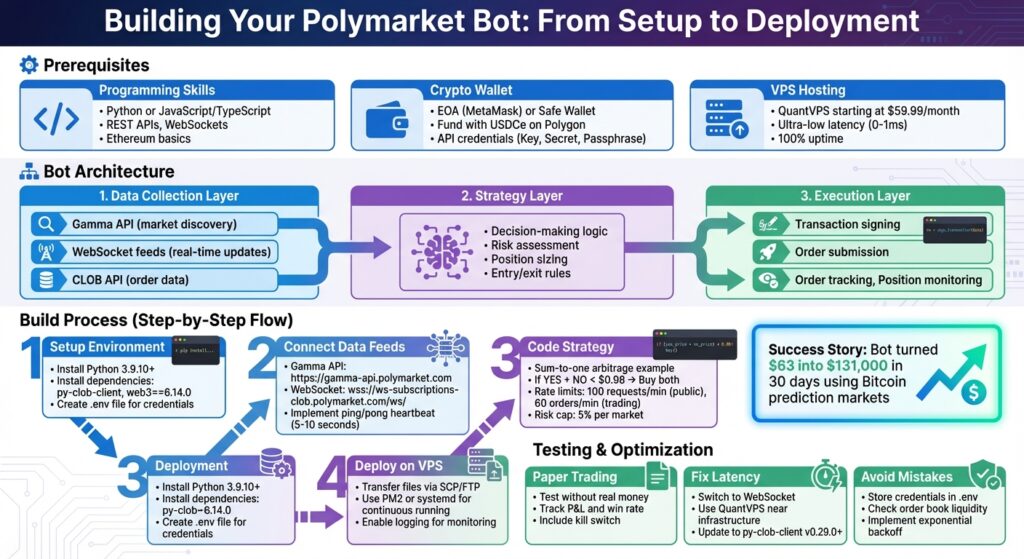
For those exploring the Polymarket Fast Loop AI Skill, this example illustrates a practical application. The strategy’s core involves continuous looping through data checks, signal generation, and trade execution, ensuring the bot remains responsive to market shifts.
Decoding the Fast-Loop Strategy for Automated Trading Bots
The Fast-Loop strategy is a streamlined approach to automation, in which the bot cycles through a sequence of operations at high speed. This includes fetching current market prices from centralized exchanges, comparing them against prediction market odds, and initiating trades based on predefined momentum signals. Such a loop allows for near-instantaneous responses, which is essential in markets resolving every few minutes.
Key elements of the strategy include momentum-based indicators that predict short-term price directions. By analyzing price changes over brief intervals, the bot determines whether to bet on upward or downward movements. This method avoids long-term forecasting, instead focusing on probabilistic edges derived from immediate data trends.
In practice, the strategy integrates with APIs for seamless data flow. Developers often incorporate error-handling and risk management protocols to mitigate potential losses from volatile swings. The result is a resilient system that operates 24/7, capitalizing on opportunities that manual traders might miss due to fatigue or timing constraints.
Technical Components of the ClaudeBot Implementation
Building on Python scripting, the bot’s architecture includes modules for API interactions, data processing, and trade logic. The developer reportedly used an AI tool to produce extensive code—around 4,000 lines in some similar builds—enabling rapid prototyping and deployment. This AI-assisted coding accelerates development, allowing focus on strategy refinement rather than basic implementation.
To summarize the bot’s operational framework, consider the following table:
| Component | Description | Function in Strategy |
|---|---|---|
| Data Fetching Module | Retrieves real-time prices from CEX APIs | Provides input for momentum calculations |
| Signal Generation | Analyzes price deltas over 1-3 minute windows | Determines ‘up’ or ‘down’ trade direction |
| Trade Execution Loop | Places orders in the final seconds before resolution | Ensures timely entry to capture edges |
| Risk Management | Sets position sizes and stop conditions | Limits exposure per trade to 1-5% of capital |
| Logging and Monitoring | Records trades and P&L in real-time | Facilitates post-analysis and adjustments |
This structured breakdown reveals how the Fast-Loop integrates multiple facets to create a cohesive trading engine. References to similar implementations, such as those on AI Bot Trades Polymarket 24/7, provide further insights into code builds and optimizations.
Performance Metrics: From $100 to $1,819 in 72 Hours
The bot’s reported success stems from a high win rate, often cited around 70% in analogous setups. Over the 72-hour period, it executed numerous trades, compounding gains through reinvestment. Factors contributing to this include low-latency server hosting and precise timing in order placement, typically in the last 20 seconds of each market cycle.
Comparative analyses show that such bots can achieve ROI multiples in short timeframes. For instance, one documented case turned $260 into significant profits with over 500 trades, yielding a 1,560% return. While results vary with market conditions, the consistency of short-term strategies underscores their appeal.
To illustrate the growth trajectory, the following table outlines a hypothetical trade sequence based on reported patterns:
| Time Interval (Hours) | Number of Trades | Average Win Rate (%) | Capital at End ($) | Cumulative ROI (%) |
|---|---|---|---|---|
| 0-24 | 288 (one every 5 min) | 72 | 450 | 350 |
| 24-48 | 288 | 70 | 1,050 | 950 |
| 48-72 | 288 | 74 | 1,819 | 1,719 |
This table simplifies the process but captures the compounding effect. Actual performance, as shared in AI Bots and Polymarket Experiment, often involves adjustments for slippage and fees.
Implications for AI Trading Bots in Crypto Prediction Markets
The rise of tools like ClaudeBot signals a shift toward automation in prediction trading. Developers can now deploy systems that operate continuously, potentially outpacing manual efforts. This democratization of advanced strategies allows more participants to engage with short-term markets, though it also raises questions about market efficiency.
Challenges include API rate limits and the need for robust error handling. Successful implementations often run on cloud servers to ensure uptime, with monitoring dashboards for oversight. As seen in OpenClaw Polymarket Trading ROI, scaling these bots requires careful capital management to sustain growth.
Comparing Fast-Loop to Other Polymarket Trading Strategies
While Fast-Loop excels at momentum trading, alternatives like mean-reversion or arbitrage bots target different inefficiencies. Mean-reversion strategies, for example, bet against extended price streaks, as detailed in the Polymarket Streak Bot GitHub. Arbitrage-focused bots exploit pricing gaps across correlated events, sometimes yielding millions in profits.
Market-making bots provide liquidity on both sides, capturing spreads rather than directional gains. These diverse approaches highlight the versatility of automation, with each suited to specific market conditions.
Building and Deploying Your Own Automated Trading Bot
For those interested in replicating such systems, starting with AI-assisted coding tools can streamline the process. Resources like Setup Polymarket Bot Guide offer step-by-step instructions, covering API setup, strategy coding, and server deployment.
Essential considerations include backtesting against historical data to validate strategies. Tools for this are available in open-source repositories, enabling simulations before live trading. Risk parameters, such as maximum drawdown limits, are crucial to protect capital during adverse periods.
Future Prospects of Algorithmic Trading on Prediction Platforms
As AI evolves, expect more advanced bots that incorporate machine learning to implement adaptive strategies. Integration with multiple data sources could enhance signal accuracy, potentially further increasing win rates. However, regulatory scrutiny may influence how these tools are used, emphasizing the need for compliance.
ClaudeBot’s application of the Fast-Loop strategy exemplifies the power of automation to achieve rapid gains. This case provides valuable insights for developers and traders alike, showcasing how technology can transform trading dynamics.