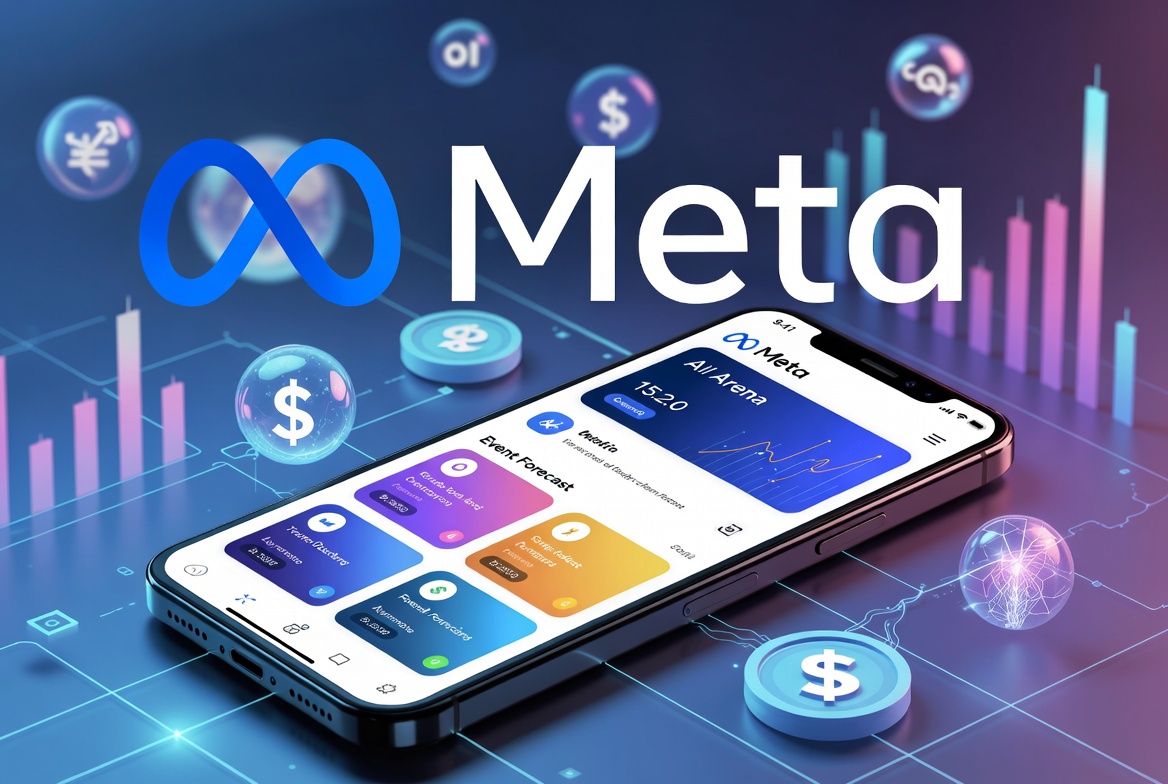
We previously reported on the announcement of the Meta prediction app, Arena. What we didn’t know at the time was that this decision came after Meta’s failed attempt to acquire Kalshi, the leading prediction market in the U.S.
This pivot from Mark Zuckerberg after the failed purchase of Kalshi underscores Meta’s drive to enter the prediction market sector and, at least initially, to capture trader interest through virtual currency mechanics while leveraging its massive Facebook and Instagram user base.
Internal documents and accounts from those familiar with the plans reveal Arena will harness artificial intelligence to generate questions and resolve outcomes on news and trending topics. Arena users will receive a daily virtual allotment of play money, creating a low-barrier entry point distinct from real-stakes platforms, which require disclosure of personal information, bank account or crypto wallet connections, and deposits.
Acquisition Talks Advance Then Stall
Zuckerberg met personally with Kalshi CEO Tarek Mansour in 2025 as the platform surged in popularity, according to NPR reporting. The discussions explored a full acquisition. However, the talks broke down amid competing accounts: some cite reluctance on Kalshi’s side to surrender its potentially massive future while others point to Meta’s concerns over legal and ethical complexities. Neither company has issued public comments on the matter.
Timeline of Meta’s Engagement with Event Forecasting
| Period | Key Development |
|---|---|
| 2020 | Meta launches Forecast, an early points-based app for crowdsourced predictions |
| 2022 | Meta shutters Forecast due to high operational costs of manual processes |
| 2025 | Zuckerberg meets Kalshi CEO Tarek Mansour to discuss acquisition |
| March 2026 | Meta and Kalshi announce partnership integrating markets into Threads |
| June 2026 | Reports detail Arena app development under Zuckerberg’s direction |
With the external path closed, Meta redirected resources inward. This decision aligns with the company’s pattern of building capabilities when acquisitions do not materialize. They’re obviously hoping that this latest venture to delve into consumer platforms outside of their core social media platforms works out better than previous attempts, including Forecast, a failed crowdsource prediction “game” they launched in-house just six years ago.
Arena App Takes Shape as Standalone Platform
Arena functions as an independent smartphone app, separate from Meta’s core social networks. Mark Zuckerberg has noted he’s taking direct oversight of this project. The app builds on lessons from Forecast by using AI to automate question creation and outcome determination, eliminating previous manual curation burdens. It is possible that Forecast simply was born before the technology existed to make it commercially viable. Arena will test that notion.
Traders engage through daily virtual allotments of play money. The design supports forecasts on diverse events while leaving open the possibility of future real-money features. This structure positions Arena to test user appetite at scale through Meta’s distribution channels.
Meta and Kalshi formed a partnership in March 2026 to integrate Kalshi markets into Threads. The collaboration provides Meta’s billions of active users with immediate forecasting options as Arena undergoes internal testing ahead of a potential rollout on iOS and Android.
As with most Meta tools and products, the company cites a deeper understanding of consumer behavior and preferences as a primary reason for development. Not a bad idea for a company that earns heavily from marketing information extracted from its massive global user base
Meta consistently monitors emerging behaviors and competitor momentum before committing resources. Columbia University law professor Tim Wu noted that the company clutches at every shiny object, cushioned by highly sustainable advertising revenue that allows repeated experiments. Wu questioned whether a play-money forecasting app would deliver lasting thrill for most users. Though we can imagine the “play-money” portion of this app is only an initial status if that proves out.
Strong Trading Volumes Fuel Broader Interest
Combined activity across leading platforms reached $50 billion in 2025 and has already surpassed $130 billion in 2026. Kalshi reached a $22 billion valuation in its latest round, with its sights set on $40 billion in the next, while Polymarket stands at $10.7 billion. These metrics illustrate why large technology companies now eye the space aggressively.
Meta aims to harness its over 3 billion daily users to accelerate Arena’s adoption. The standalone app format offers flexibility for rapid iteration based on early engagement data. Built-in tools and apps on Facebook require far longer and more complex development cycles.
But never count out Meta’s inherent advantage in launching any consumer app. Given its billions of captured users and over $82 billion in cash on hand, it is always to be taken seriously, despite some recent major product failures, like the Metaverse.
Public Commentary Highlights Regulatory Concerns
Senator Richard Blumenthal criticized the new Arena initiative, stating that Meta had copied slot machines to addict users to Instagram and now seemed intent on turning the company into a prediction market operation. He connected the model to profiting from addiction and called for legislative safeguards. Though worth noting, Senator Blumenthal is a heavy critic of almost every trending news story and a longtime opponent largely of prediction markets in general.
Ongoing legal scrutiny around forecasting platforms adds complexity. Starting with play money may help Meta navigate these issues in the initial phase, but it will eventually come to face an even greater level of scrutiny than standalone entities like Polymarket and Kalshi, if for no other reason than its massive corporate and consumer scale, and the fact that Congress has taken Meta and Zuckerberg to task previously over several other high-profile issues.
References
- Meta considered buying Kalshi before developing its own prediction market app – NPR
- Mark Zuckerberg Directed Meta to Create a Prediction Markets App – The New York Times
- Meta plans to release AI-powered prediction market app – NPR