In a dramatic turn of global events, the recent US-led military actions against Iran have not only reshaped geopolitical landscapes but also triggered significant resolutions in high-stakes prediction markets. Traders who positioned on outcomes related to Iran’s Supreme Leader Ali Khamenei’s status found their contracts settling amid confirmed reports of his demise, unlocking millions in payouts. As the dust settles, attention shifts to active contracts forecasting potential ceasefires and regime stability, offering fresh avenues for informed speculation. This convergence of real-world developments and market dynamics presents a compelling scenario for those tracking event-driven probabilities.
Overview of the US Strikes on Iran: Key Developments and Implications
The joint US-Israeli military operation, dubbed Operation Epic Fury, commenced on February 28, 2026, targeting critical Iranian infrastructure, including nuclear facilities, missile sites, and naval assets. President Donald Trump announced the strikes in a video statement, emphasizing objectives to dismantle Iran’s nuclear and missile programs while calling for regime change. Reports from CNN detailed explosions in Tehran and other cities, with Iranian state media confirming the death of Supreme Leader Ali Khamenei in a targeted strike on his compound.
The assault involved over 1,000 targets, as per US Central Command statements, resulting in the sinking of Iranian naval vessels and the destruction of ballistic missile facilities. CNBC coverage highlighted retaliatory Iranian missile launches against US bases in the region and Israeli territories, escalating tensions across the Middle East. Casualties included three US service members killed and multiple injuries, with Iranian officials reporting over 200 deaths, including civilians, in strikes near military sites.
Analysts from the Council on Foreign Relations noted the strikes’ aim to topple the regime, with Trump urging Iranians to seize control. CFR insights suggest this could mark a pivotal moment, potentially leading to prolonged conflict or negotiated resolutions. Satellite imagery revealed extensive damage to key sites, including Khamenei’s Tehran compound, as documented by The New York Times. These events have directly influenced prediction market outcomes, resolving contracts tied to leadership changes and military actions while invigorating trades on future scenarios.
Resolution of Khamenei Status Markets: High-Volume Settlements on Polymarket and Kalshi
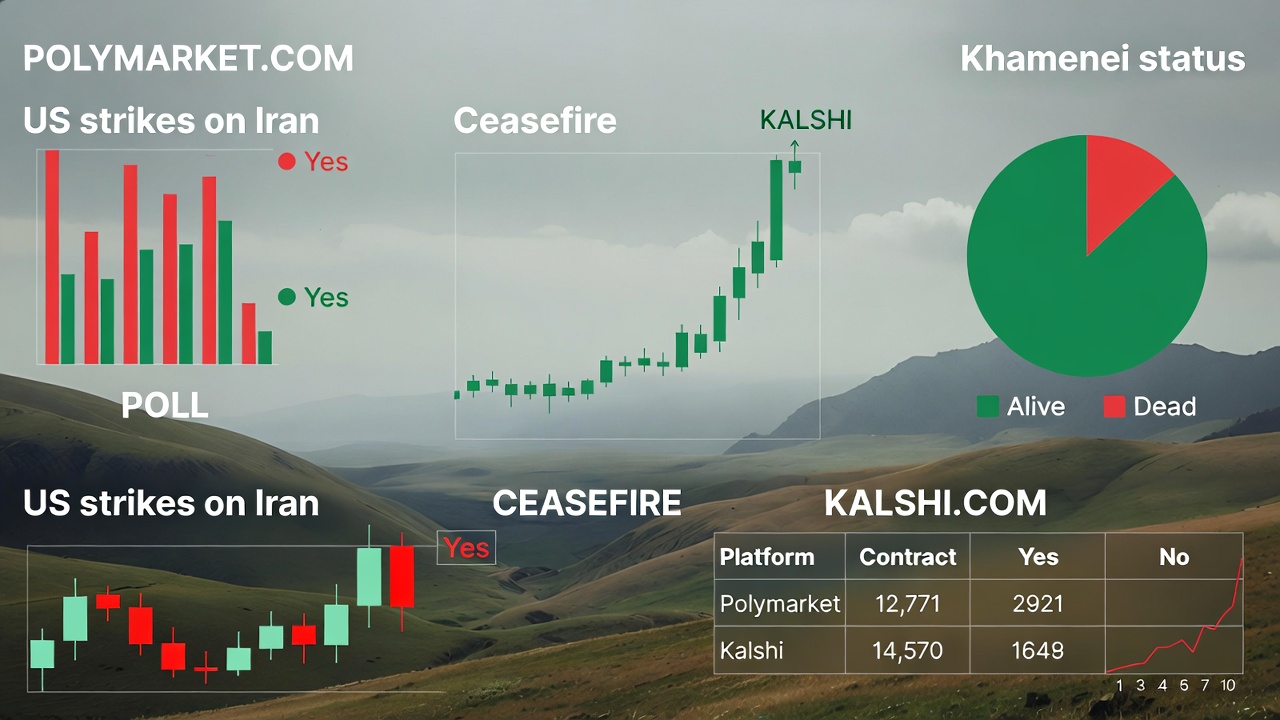
Prediction markets on platforms like Polymarket and Kalshi saw immediate resolutions following confirmation of Khamenei’s death. On Polymarket, the contract “Khamenei out as Supreme Leader of Iran by February 28?” resolved to Yes at 100%, reflecting the verified outcome. This market, which had accumulated $95 million in trading volume, saw probabilities surge in the hours leading up to the strikes, with final settlements paying out $1 per Yes share.
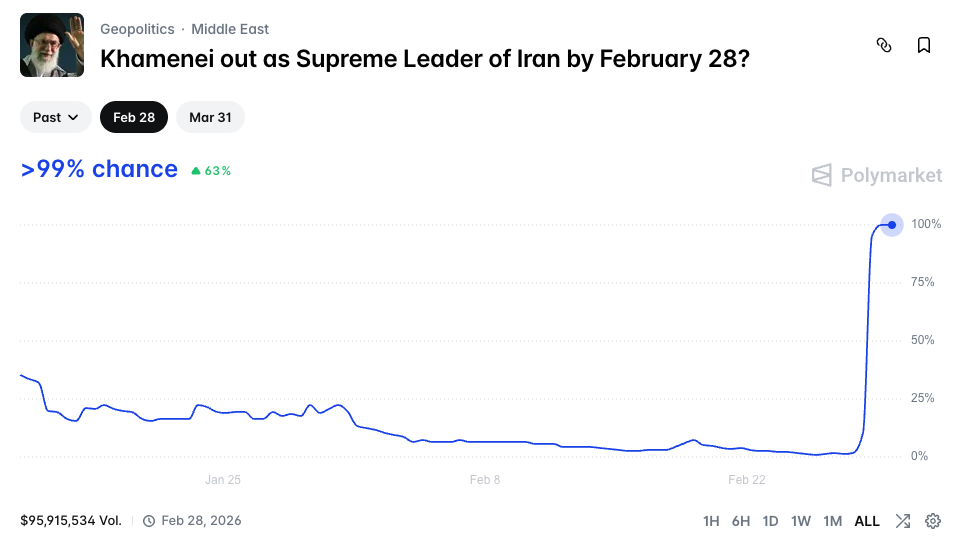
Similarly, the broader “Khamenei out as Supreme Leader of Iran by March 31?” contract on Polymarket also resolved affirmatively, amassing $54 million in volume. Traders who held Yes positions benefited from the rapid confirmation via Iranian state media and international reports. The Wall Street Journal reported on the pre-strike betting surge, noting how these markets predated the February 28 events but aligned precisely with unfolding realities.
On Kalshi, the “Ali Khamenei out as Supreme Leader?” market, which garnered between $36 million and $55 million in volume, incorporated a unique resolution clause for death scenarios. Positions were settled at the last-traded price before confirmation of Khamenei’s demise, avoiding direct payouts tied to mortality.
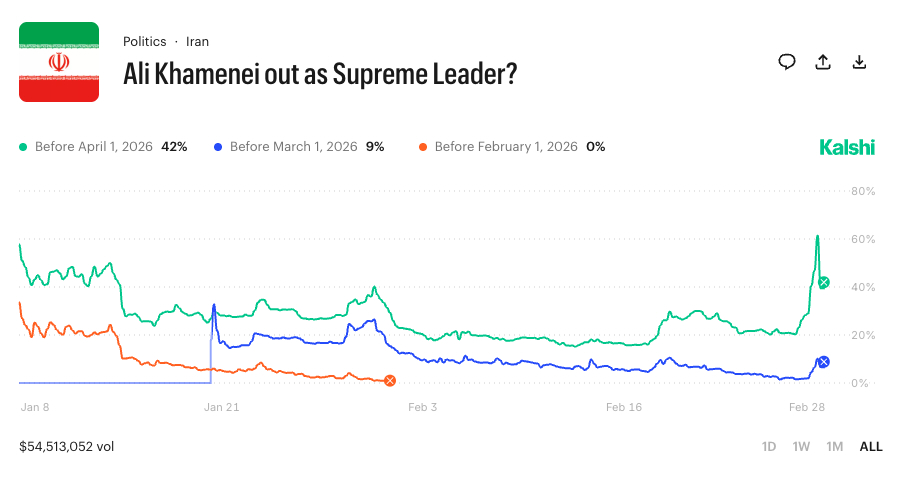
This design, as explained by Kalshi’s leadership, aimed to maintain market integrity amid sensitive geopolitical events. Business Insider coverage highlighted user reactions to this mechanism, with the platform reimbursing fees to ensure fairness.
These resolutions underscore how real-time global developments can swiftly conclude long-running contracts, providing payouts based on collective trader foresight. The alignment of market probabilities with actual outcomes illustrates the dynamic interplay between news cycles and trading activity.
Trading Volumes and Market Dynamics: A Closer Look at Pre-Resolution Trends
Before the strikes, trading volumes on Iran-related contracts skyrocketed, reflecting heightened anticipation. Polymarket’s “US next strikes Iran on…?” series saw the February 28 option attract $55 million in volume, resolving to Yes post-strike confirmation. Overall, US-Iran conflict markets on Polymarket exceeded $529 million in total bets, marking one of the platform’s most active event clusters.
To illuminate key metrics, consider the following table summarizing resolved markets:
| Market Name | Platform | Trading Volume | Pre-Resolution Probability (Yes) | Resolution Outcome |
|---|---|---|---|---|
| Khamenei out by February 28? | Polymarket | $95 million | ~68% (hours before strikes) | Yes (100%) |
| Khamenei out by March 31? | Polymarket | $54 million | ~75% | Yes (100%) |
| US strikes Iran on February 28 | Polymarket | $55 million | ~81% | Yes (100%) |
| Ali Khamenei out as Supreme Leader? | Kalshi | $36-55 million | ~68% | Settled at last-traded price |
This data, drawn from platform analytics and reports like those from CoinDesk, shows how volumes built amid escalating tensions. Probabilities adjusted in real-time to news of impending actions, with some contracts seeing sharp increases just before official announcements. Such trends offer traders opportunities to capitalize on information asymmetries, though platforms emphasize fair resolution based on verifiable sources.
Ongoing Ceasefire Contracts: Forecasting De-Escalation Amid Conflict
As military operations continue, attention turns to contracts predicting ceasefires between the US and Iran. On Polymarket, the “US x Iran ceasefire by March 15?” stands at 33% Yes, with $4 million in volume, indicating cautious optimism for short-term halts. The March 31 variant prices at 56% Yes, suggesting traders see a moderate likelihood of de-escalation within the month.
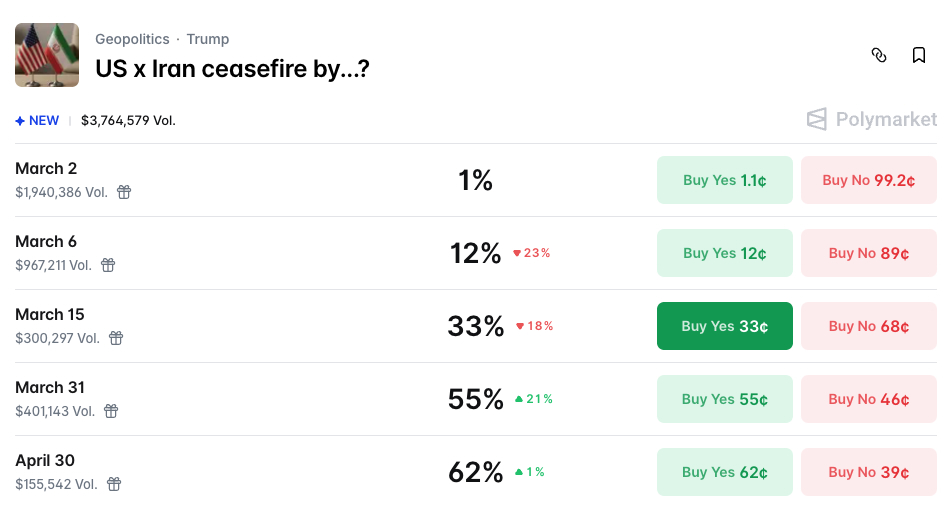
Extending further, the April 30 ceasefire contract holds at 61% Yes, reflecting expectations of prolonged negotiations. These markets factor in variables like diplomatic interventions and retaliatory strikes, with volumes building as updates emerge. Bloomberg analysis points to how such contracts provide probabilistic insights into conflict trajectories.
Kalshi also features related markets, including prospects for a new US-Iran nuclear deal by various dates, with odds at 57% for before 2027. Traders can position on multilateral agreements that might include sanctions relief in exchange for nuclear restrictions, adding layers to ceasefire speculations.
Broader Geopolitical Market Activity: Regime Stability and Nuclear Targets
Beyond ceasefires, active markets explore regime durability. Polymarket’s “Will the Iranian regime fall by March 31?” trades at 26% Yes with $13 million volume, while the June 30 version at 47% Yes suggests growing uncertainty over medium-term stability. Annual forecasts like “Will the Iranian regime fall before 2027?” at 57% Yes attract $7 million, incorporating factors such as internal uprisings and external pressures.
Contracts on the Strait of Hormuz closure—critical for oil shipments—show 30% Yes by March 31, escalating to 43% by year-end, with $4 million series volume. These reflect concerns over economic disruptions from retaliatory actions.
Successor markets, such as “Will Iran name a successor to Khamenei by March 2?” at 17% Yes, ramp up to 80% by March 31, with nearly $1 million volume. This progression indicates expectations of swift leadership transitions amid power vacuums.
Nuclear-focused contracts, like “Will Israel or the US target an Iranian nuclear facility?” at 85% Yes with $724K volume, highlight persistent threats to Iran’s programs. Similarly, “US forces enter Iran by March 31?” at 23% Yes part of a $2 million series, gauges invasion probabilities.
For a comprehensive view, the table below outlines select active markets:
| Market Name | Platform | Current Yes Probability | Trading Volume | End Date |
|---|---|---|---|---|
| US x Iran ceasefire by March 31? | Polymarket | 56% | $4 million | March 31, 2026 |
| Will the Iranian regime fall by March 31? | Polymarket | 26% | $13 million | March 31, 2026 |
| Will Iran close the Strait of Hormuz by March 31? | Polymarket | 30% | $4 million (series) | March 31, 2026 |
| US-Iran nuclear deal by March 31? | Kalshi | 14% | $576K | March 31, 2026 |
| Will Iran name a successor to Khamenei by March 31? | Polymarket | 80% | $995K (series) | March 31, 2026 |
Traders weigh diplomatic signals, military updates, and economic indicators to adjust positions, creating a fluid environment for probability-based engagements.
Market Responses to Escalation: Retaliation and Regional Involvement
Iran’s counterstrikes, targeting US bases and Israeli cities, have influenced contracts on broader regional dynamics. Polymarket’s “Will another country strike Iran by March 31?” at 66% Yes, with $403K volume, anticipates potential coalition expansions. Similarly, “Will France, UK, or Germany strike Iran by March 31?” at 35% Yes reflects European involvement odds.
Contracts like “Iran x Israel/US conflict ends by March 31?” at 63% Yes with $459K volume project resolution timelines, balancing escalation risks with peace prospects. These markets adapt to reports of attacks on Gulf states and oil facilities, as noted in Reuters dispatches.
The “Will the US officially declare war on Iran by December 31?” at 11% Yes with $1 million volume suggests low expectations for formal declarations, favoring limited operations. This restraint could bolster ceasefire probabilities, enticing traders to explore undervalued outcomes.
Strategic Insights for Traders: Navigating Post-Strike Markets
With resolutions behind and active contracts ahead, traders can leverage historical patterns from resolved markets to inform positions. The swift probability shifts pre-strikes highlight the value of monitoring news sources for early indicators. Ongoing markets on regime fall, successor naming, and ceasefires offer diversified options, from short-term binaries to long-horizon forecasts.
Economic ripple effects, such as potential oil disruptions, underpin contracts like “Will Iran strike Gulf oil facilities by March 31?” at varying probabilities. MarketWatch projections tie these to commodity trends, providing cross-market correlations for strategic trading.
The US strikes on Iran have resolved millions in prediction market trades while sparking vibrant activity in ceasefire and stability contracts. This evolving landscape invites objective analysis and positioned engagement, where probabilities meet real-world outcomes in a professional arena of foresight and resolution.