
Published: November 23, 2026
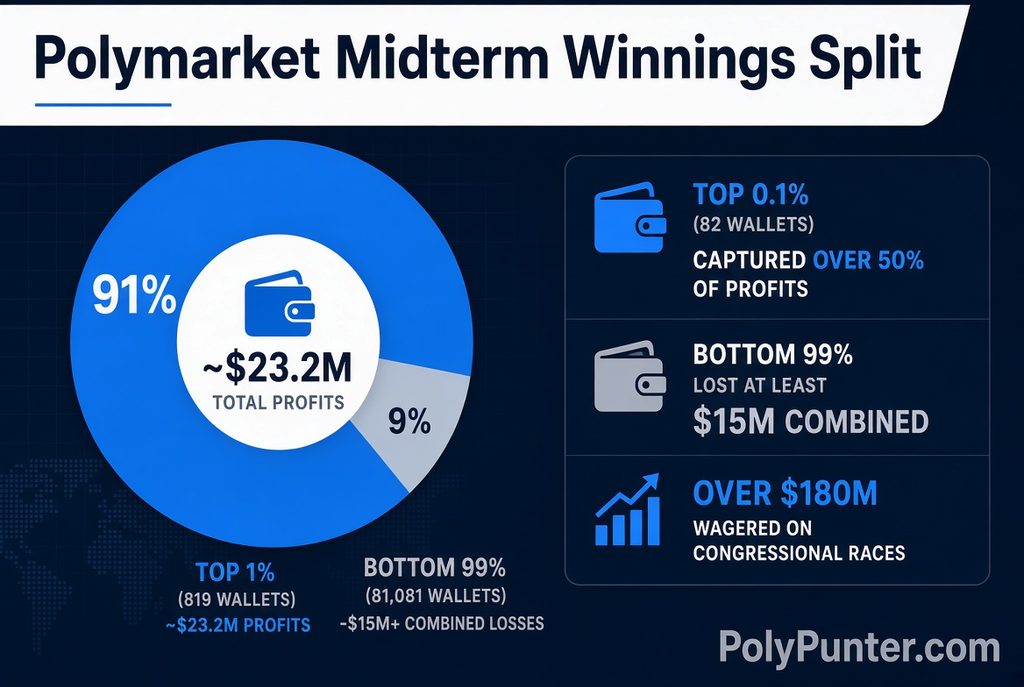
A new briefing from the Anti-Corruption Data Collective (ACDC) puts hard numbers on who actually walked away with the money after the 2026 midterms. Just 819 wallets on Polymarket collected 91% of the roughly $23.2M in profits from congressional races. The other 99% of wallets that traded the same markets finished with a combined loss of at least $15M. Traders had put more than $180M into those contests, yet the gains stayed locked inside a very small group of accounts.
The skew gets even sharper higher up the list. Only 82 wallets, the top 0.1%, took more than half of everything that was won. At the same time, the platforms themselves pulled in an estimated $11.7M in fees. Those figures sit next to the accuracy numbers: Kalshi, Polymarket, and Polymarket US together matched six established forecast models at 91% on Senate races and 95% on House races.
The researchers did not rely on anyone’s self-description. They looked for wallets that stayed active around the clock, pushed large volume, and spread positions across many different markets at once. Plenty of the biggest winners showed all three habits together, the kind of footprint you see with professional desks or automated systems rather than someone checking prices a few times a day.
Polymarket is still the only major platform that puts full wallet-level trade and profit data on a public blockchain. That made it possible to watch individual accounts without waiting for platform summaries. The same visibility also let ACDC separate occasional traders from the continuous, high-volume operators who dominated both volume and returns.
Prediction Market Accuracy Versus Traditional Forecast Models
When the question is simply who won each race, the markets lined up with the conventional forecasts. For contests that had clear outcomes by 19 November, the platforms called 32 of 35 Senate seats correctly and 409 of the settled House seats. Six forecast models, averaged equally, produced the same 91% and 95% rates. Both the markets and the models drifted toward Democrats in the final weeks and both correctly flagged the chamber shifts that followed.
ACDC’s own comparison found the platforms added only a 0.2-percentage-point edge over the leading models across congressional races. Michelle Kendler-Kretsch, a research fellow at ACDC, pointed out that traders appear to be pulling in data from traditional forecasters while the forecasters are not pulling in data from the markets. David Szakonyi, co-founder of the group, called the result marginal forecasting gains next to clear financial costs and real political risks.
Polymarket’s post focused on the 98.4% figure for the day-before favorite. That is a narrower test than a full head-to-head against published models or a Brier-score check. Kalshi pointed to its own post-election analysis, which showed stronger Brier-score results than most of the forecast models. The races the markets missed tended to be the lower-volume ones that also showed heavier concentration among the top five traders.
Election Integrity Concerns Raised By The ACDC Findings
The briefing is blunt about the integrity side. Prediction markets create real risks to election integrity that have not been fully addressed. Thin markets can still be moved by modest orders, and those moves sometimes stick long enough to shape the narrative that appears in coverage. ACDC has already documented cases in which a single order shifted a displayed probability by several cents and the new price held for days.
The profit split makes the issue sharper. When a few hundred wallets take the majority of the gains while tens of thousands of other traders absorb the losses, the setup favors accounts with better information, faster tools, or simply more capital.
Platforms continue to argue that the profit motive itself keeps prices honest and that the forecasts give the public useful information. The Commodity Futures Trading Commission has made similar arguments while it fights state-level restrictions in court. ACDC’s numbers after the midterms test that claim against both the limited accuracy improvement and the clear transfer of winnings to a small set of accounts. The researchers see a marginal forecasting benefit next to concrete financial and integrity costs.
References
- Most winnings on Polymarket midterm bets went to top 1% of bettors, report says | Reuters
- Midterm election prediction markets added almost nothing and cost society millions – ACDC
- ACDC Gambling on Democracy Brief 5 After the Midterms PDF
- Polymarket on X
- How Polymarket Priced the Midterms and What’s Next for Crypto
- Can Kalshi And Polymarket Predict The Midterms?
- Polymarket’s top 1% of wallets took 91% of midterm betting winnings
- ACDC: 819 Polymarket Wallets Took 91% of Midterm Profits