Published: November 23, 2026
May you live in interesting times.
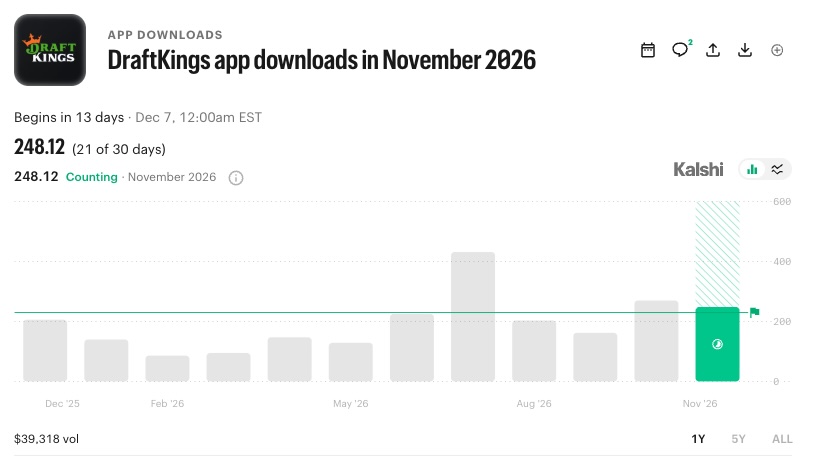
In a somewhat ironic move, Kalshi opened trading on DraftKings’ slice of the U.S. sportsbook market on November 23. Traders can now take positions on whether DraftKings Sportsbook & Casino will grab a bigger or smaller share of app downloads in any given period. The exchange filed the contracts with the CFTC the Friday before under Regulation 40.2(a), then listed them as Carbon Arc Sector KPI Markets. The same listings also cover DraftKings app download growth and the operator’s online sportsbook advertising spend.
Everything settles against numbers from Carbon Arc, the data provider Kalshi already uses for other advertising and download KPI contracts. Because the markets list on a recurring basis, traders can put on new positions as fresh periods of data roll in. DraftKings currently holds roughly 36% of online sportsbook handle across the ten states that break out brand-level results for the first nine months of 2026. That keeps it just ahead of FanDuel in most recent counts, even as their combined share has slipped from nearly 74% in 2024.
The contracts let traders take a view on DraftKings’ user-acquisition pace without waiting for the next earnings call. Kalshi treats 100 as the baseline for no year-over-year change on the related download series, so a reading of 120 means 20% growth. Traders who think heavier marketing will lift DraftKings’ download share can buy the contracts. Those who expect slower momentum can take the other side. Every account faces a $25,000 position accountability limit on each individual strike.
New Contracts Let Traders Position On DraftKings App Download Share
The main contract asks whether DraftKings Sportsbook & Casino’s share of app downloads clears a stated level in a set period. Kalshi described it as a recurring binary option that can resolve above, below, exactly at, at least, at most, or between the chosen thresholds. Companion contracts track a growth index for those same downloads and a separate listing on the company’s online sportsbook advertising spend. All three pay out based on Carbon Arc figures rather than anything DraftKings releases itself.
Each contract settles at $1 if the condition hits and $0 if it misses. Traders can open or close positions before the period ends, so an early view can be adjusted if newer trends show up. Kalshi already lists company-level download contracts for DraftKings. The share contracts simply add a relative measure against the rest of the sportsbook category.
The recurring setup means new strikes appear as Carbon Arc publishes the next round of data. Kalshi said in its CFTC filing that it plans to keep listing the contracts on an ongoing basis after the November 23 start. That lines up with the monthly or weekly updates Carbon Arc already supplies for other KPI series. Traders watching DraftKings’ promotional calendar can shift positions as big marketing pushes begin and wind down.
Restrictions And Position Limits Shape Who Can Trade
Kalshi has blocked certain groups from trading the new contracts so that people with non-public information cannot move prices. DraftKings staff, and staff at any other app in the same group who set or know about marketing plans, user-acquisition targets, or download data, cannot place the trades. Ad-tech and app-store insiders face the same ban. The restrictions match the limits Kalshi already applies to other contracts that settle on private-sector data.
The contracts stay open to the broader group of Kalshi traders who have no special access to DraftKings’ internal plans. Those traders can still react to public signals such as new state launches, big promotional campaigns, or shifts in overall sportsbook handle. DraftKings has said that 80% to 90% of prediction-market volume in sportsbook states comes from professional syndicates and institutional traders.
Broader Context For DraftKings Market Position
DraftKings and FanDuel together took 68.9% of the $43.7 billion bet online in the ten U.S. jurisdictions that publish brand-level results for the first nine months of 2026, according to RG. DraftKings accounted for 36.2% of that handle and FanDuel 32.7%, with Fanatics in third at 9.7%.
In the nine markets that have multi-year history, the two leaders’ combined share has fallen from 73.9% in 2024 to 68.8% in 2026.
The same reports show smaller operators still gaining ground. Fanatics has expanded its share while bet365 has grown in the states where it operates. Citizens researchers have noted that DraftKings climbed to the largest online sports-betting platform by certain measures while still facing rising investment from competitors.
Those competitive moves are exactly what the new Kalshi contracts let traders price. A trader who expects DraftKings to reclaim share through heavier advertising can buy the corresponding contracts. A trader who expects continued erosion can sell them.
DraftKings has continued to expand its own prediction-market activity even as it reports limited overlap with Kalshi users. The company has said most prediction-market volume in sportsbook states would not have flowed to traditional sportsbooks anyway. The new contracts give traders a way to test related questions about user acquisition and advertising intensity.
References
- New: Kalshi bets on DraftKings’ share of US sportsbook markets
- CFTC Designated Contract Market Products Filing 68289
- FanDuel And DraftKings Take 69% Of US Bets, But Their Grip Is Slipping
- Robins: Only 1% Overlap Between DraftKings And Kalshi Users
- Geoff Zochodne X post on Kalshi advertising-spend contract
- Kalshi is not having any impact on DraftKings, FanDuel, says Jefferies analyst David Katz
- How the Rise of Prediction Markets Impacts Sportsbooks
- Jason Robins: DraftKings & FanDuel ‘Basically Tied’ in Sports Betting Market Share