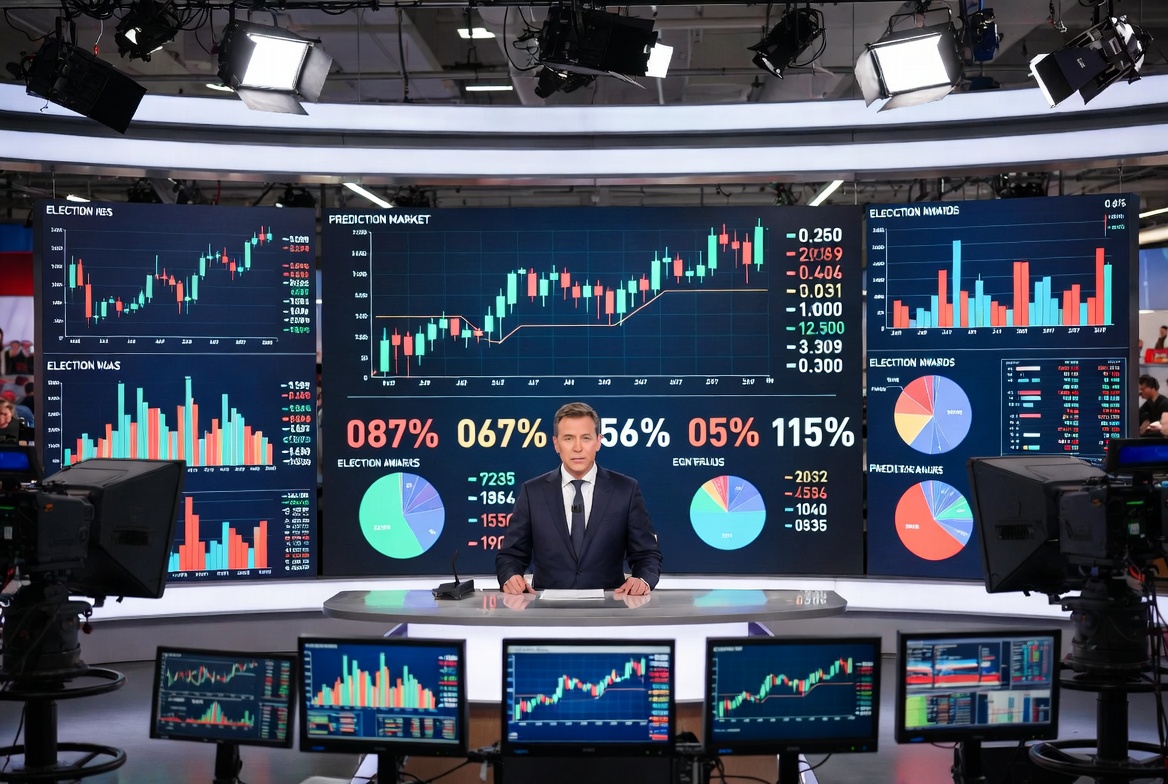
Prediction markets data is becoming a key component of many modern news broadcasts. Media outlets now embed live prediction market probabilities directly into election coverage and awards broadcasts. Platforms strike exclusive data deals that supply fluctuating odds on major events within seconds of new developments. Journalists reference these numbers alongside polls and expert analysis to give audiences immediate insight into collective expectations.
Media Giants Embrace Prediction Market Data for Dynamic Real-Time Odds Reporting
Prediction market media partnerships are accelerating rapidly across television networks and digital publishers. Kalshi secures exclusive integrations with CNN that place its event probabilities on air and online. Kalshi also partners with CNBC for multi-year data integration across business programming.
Polymarket signs an exclusive contract with Dow Jones that feeds odds into Wall Street Journal stories and related properties. Substack creators gain native tools to display live market data in newsletters through a formal data partnership with Polymarket. The Golden Globes broadcast flashes Polymarket probabilities before each award category airs, marking the first awards show to integrate such real-time insights.
These arrangements position prediction markets as a fresh layer of insight that newsrooms actively incorporate rather than ignore. Higher viewer engagement follows as audiences track shifting odds in real time. Newsrooms gain a quantitative edge that traditional polling snapshots cannot match.
Key Prediction Market Media Partnerships Driving Real-Time Odds in Journalism
| Platform | Media Partner | Integration Details | Impact on Coverage |
|---|---|---|---|
| Kalshi | CNN | Official prediction market partner with data across TV, digital, and social | Real-time probabilities appear in political and cultural segments |
| Kalshi | CNBC | Multi-year exclusive deal for business programs | Odds update live during market and event discussions |
| Polymarket | Dow Jones (Wall Street Journal) | Exclusive partnership for election and event odds | Probabilities supplement financial and political analysis |
| Polymarket | Substack | Native embedding tools for newsletters with disclosure | Creators display live markets to engaged subscribers |
| Polymarket | Golden Globes (CBS) | The audience sees probabilities before the winners are announced | The audience sees probabilities before the winners announced |
Traders betting on outcomes drive prices that reflect fresh information faster than many conventional reports. Dustin Gouker notes that prediction markets and news media exist in parallel because each needs the other for full context. Journalists turn to the markets for rapid forecasts on everything from award winners to policy shifts.
Real-Time Odds From Prediction Markets Complement Traditional Journalism With Actionable Probabilities
Prediction markets price future events in continuous markets that adjust instantly to breaking news. Experts note that these tools put hard numbers on scenarios journalists once described only in qualitative terms. Readers click through to platforms after seeing odds cited in stories, creating a feedback loop that boosts both traffic and informed discussion.
Polymarket CEO Shayne Coplan frames the entire ecosystem as News 2.0, harnessing crowd wisdom backed by real financial stakes. Platforms expanding their reach through deals with CNN, CNBC, and Dow Jones bring this model directly into mainstream coverage. Audiences now consume probabilities alongside narrative reporting, gaining a more complete picture of likely outcomes.
This video explores how prediction markets reach massive valuations and integrate into media. Viewers witness the growing influence of real-time odds across news cycles.
Critics Raise Concerns Over Accuracy and Misinformation in Prediction Market Social Feeds
Prediction market platforms maintain active social channels that reach millions of followers with rapid-fire updates and memes. A New York Times investigation of Polymarket’s posts across X, TikTok, Facebook, and Instagram uncovers repeated instances of false or misleading claims. The company amplifies unverified stories that distort political realities while positioning itself as a truth engine.
Examples include exaggerated reports on arrests for online speech and inaccurate claims about public officials’ finances. These feeds generate massive views yet operate without the editorial standards that bind traditional newsrooms. Critics argue the combination of high-stakes betting and unchecked social amplification risks eroding public trust when markets claim News 2.0 status.
Media partnerships intensify scrutiny because news outlets now lend credibility by displaying the same platforms’ odds. Journalists must verify market signals independently, even as partnerships grow. The tension highlights a broader debate over whether crowd-funded probabilities truly enhance or undermine rigorous reporting.
Analysts Weigh Benefits and Risks of Prediction Market Media Partnerships in Modern Journalism
Prediction markets supply probabilities that react faster than polls and incorporate diverse trader information. Media outlets citing these odds help audiences understand sentiment shifts in elections and award races. Partnerships with Kalshi and Polymarket, therefore, provide newsrooms with a practical tool to stay relevant in a fast-moving information landscape.
Some coverage now features side-by-side comparisons of market odds and expert commentary. This blend creates compelling stories that merge quantitative data with human context. Platforms that forge deeper ties with publishers gain legitimacy, while journalists access a dynamic data source that keeps stories fresh.
Concerns persist about potential influence when paid integrations blur lines between editorial content and sponsored data. Independent journalists report receiving direct offers to produce market-focused stories, raising questions about editorial independence. Newsrooms adopting these partnerships navigate new ethical terrain to preserve reader confidence.
Future of Journalism Evolves With Prediction Market Real-Time Odds and Strategic Media Alliances
Prediction market media partnerships continue expanding as more outlets recognize the value of live probabilities. Substack creators and legacy publishers alike integrate the data to meet audience demand for immediate insights. The model rewards accuracy because traders risk capital on their convictions rather than mere opinions.
Journalism gains a powerful complement: quantifying uncertainty in real time. Audiences engage more deeply when they watch odds move alongside developing stories. Media partnerships, therefore, foster a hybrid news environment where probabilities and narratives reinforce each other.
Challenges remain around misinformation on social platform feeds and the need for transparent disclosures. Yet the overall trajectory points toward greater adoption of prediction market tools across the industry. Real-time odds reporting is no longer experimental but an established feature of how major outlets deliver timely, data-driven journalism.
References
- Polymarket Says It Predicts the Truth. Its Social Feeds Are Filled With Falsehoods. – The New York Times
- Prediction markets are trying to lure journalists with partnership deals – The Verge
- Are Prediction Markets Actually Good for Journalism? – Columbia Journalism Review
- Kalshi to become CNN’s official prediction market partner
- CNBC and Kalshi Strike Exclusive Partnership
- Polymarket and Dow Jones Announce Exclusive Prediction Market Partnership
- Golden Globes Inks Exclusive Partnership With Polymarket – The Hollywood Reporter
- CNN strikes prediction data partnership with Kalshi – Axios
- Wall Street is Now Betting on Everything – YouTube