
Published: November 15, 2026
No story has gripped the business world more this past week, perhaps this past year, than the ouster of Nvidia CEO Jensen Huang. Huang has been caught up in multiple marital affair stories, with one of the women involved alleged to be a Chinese spy. The latter element adds a legally complicated layer to your typical “executive busted with mistress” tabloid story.
When Nvidia’s board accepted Jensen Huang’s resignation late on November 11 and named Colette Kress interim chief the next morning, the move stunned many who had treated the longtime chief and co-founder as inseparable from the company. Yet contracts on Kalshi and Polymarket had already moved sharply higher the previous evening, climbing from the mid-teens into the 80s and 90s as fresh reports about his relationships circulated.
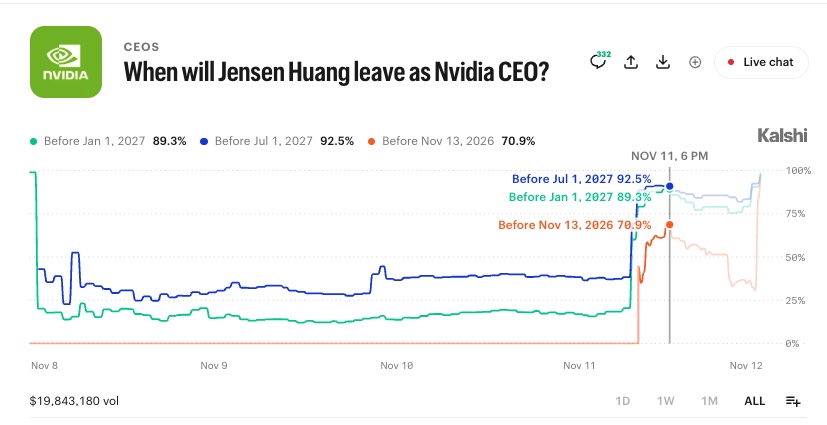
Traders watching the Jensen Huang order books saw a single number update in real time while most research notes and news stories were still being drafted. The episode offers a clear look at how these markets can turn scattered information into a real-time public signal that helps capital move faster than it otherwise would. This is the public utility of prediction markets.
The Odds Shifted Before the Formal Announcement
For most of the preceding days, the contracts sat quietly in the 15-to-20 percent range, reflecting low expectations of an exit even after Huang’s own admission of an affair. Then, on the evening of November 11, prices on both platforms jumped within a couple of hours.
One tracking page showed Polymarket’s year-end contract rising from roughly 15 percent to 69 percent after additional details surfaced, with volume on that contract alone exceeding $1.2 million. Kalshi posted similar vertical moves. By the time the company confirmed the change the following morning, the contracts had settled near certainty.
The traders did not uncover the underlying facts. They simply priced the emerging consensus as information reached investors, company insiders, and others tracking the story. High volume during the peak window, with tens of millions of dollars equivalent across related contracts, kept the prices from swinging wildly on thin liquidity.
The Kobeissi Letter noted the shift on X, pointing to an 85 percent chance while flagging the related market-value drop. Anyone watching could see the updated probability long before the official filing locked the outcome in place.
Why the Markets Moved Ahead of Conventional Coverage
Equity research teams and news outlets eventually reported the allegations and board actions with accuracy, yet their published work typically arrived after confirmation. During the overnight gap between the evening reports and the morning announcement, the contracts supplied a live figure.
Later assessments from Wall Street desks added financial context, but markets had already folded the newest details into a continuously updated price. Successor contracts kept the process going after the resignation. Ian Buck quickly led in the low-to-mid 30 percent range on both platforms, ahead of Kress and several external names.
Traditional research still delivers useful depth on models and longer-term strategy. It does not, however, reprice a specific near-term event every time new information appears. Meanwhile, prediction market contracts force a numerical commitment and corresponding price signal that shifts with each trade.
Media outlets like CNBC and The Economist reported in depth on the Huang impact after the announcement. They add meaningful color and context to the business story. The contracts, by contrast, offered the continuous public number during the critical window. Together, rapid pricing and deeper analysis give a fuller picture than either approach alone. But rapid pricing is the timeliest. And in market terms, first is better.
What Faster Pricing Means for Capital and Governance
When probabilities update quickly and openly, capital can shift with less lag. Nvidia’s share price decline tracked the rising exit odds, reflecting fresh assessments of key-person risk. Investors monitoring the contracts could adjust holdings before the formal announcement. Smaller holders without dedicated research desks saw the same signal available to larger funds. Successor markets extended the effect, letting traders factor shifting views on technical continuity and customer relationships into portfolio decisions while the board continued its search.
Boards still deliberate privately and release conclusions through filings. The markets do not replace that process, but they make informed and staked external assessments of likely outcomes visible in real time. In this case, the rapid rise in exit odds on November 11 showed that market actors viewed the reports and board posture as decisive.
Successor pricing after the announcement kept that transparency running. Differing resolution rules or thinner liquidity on some contracts can introduce noise. Even so, the core mechanism delivered a useful public number that reduced information gaps during a high-stakes corporate event.
The Nvidia succession shock is one clear illustration. Prediction platforms now list contracts on many corporate and technology outcomes. When liquidity supports continuous trading, these markets function as a real-time public good: a capital-weighted summary of available information that anyone can observe.
Prediction market data is not a standalone product. It complements rather than replaces investigative reporting or institutional work. As a result, capital allocation becomes more efficient, and governance-related uncertainty resolves more transparently for investors, employees, and other stakeholders.
In the recent midterm elections, it was typical for the leading prediction markets to see 4 to 5 visitors to election market pages for every one who placed a trade. Most visitors were coming to see the data for reasons completely unrelated to event forecast trading. The market data is free to the public and equally accessible to all. It’s democratized forecast market information in finance, economics, global events, politics, weather, and yes, cultural, sports, and entertainment areas. This is the social value of event markets that gets lost in so much negative news and politics around the prediction market industry.
References
- TechCrunch: Nvidia’s Jensen Huang resigns, chipmaker names CFO Colette Kress as interim CEO
- Reuters: Nvidia CEO Jensen Huang resigns in blow to AI boom
- CNBC: Jensen Huang departure odds stay low after Nvidia board probe
- Office Chai: Chances That Jensen Huang Will Be Removed As NVIDIA CEO Jump To 80%
- The Kobeissi Letter on X: Market expectations for Jensen Huang exit surge
- Business Insider: Here’s Who Prediction Markets Are Eyeing As the Next Nvidia CEO
- CNBC Television on YouTube: Experts react to Nvidia CEO Jensen Huang’s resignation
- The Economist on YouTube: Jensen Huang resigns as Nvidia CEO
- The Motley Fool: Who Will Replace Jensen Huang? Here’s What Prediction Markets Think
- Prediction.com: Jensen Huang Resigns as Nvidia CEO: How Prediction Markets Priced His Exit