Published: November 19, 2026
Sports trading keeps the order books busy and the company flush with monthly performance gains, but Kalshi’s move into GPU futures is worlds more important.
AI startups routinely get hit by swings in the cost of the chips that actually run their models. Because most startups cannot easily pass higher compute costs to customers, rental-price volatility has become a core operating risk. Imagine running a restaurant where your operating costs shift dramatically month to month beyond your control. Transparent indexes and futures contracts now let buyers and sellers lock in rates or offset unexpected moves, turning an unpredictable expense into a more manageable input cost. This is true operational cost hedging.
Kalshi’s work with Compute Desk to list futures on GPU (AI processor) rental prices finally gives prediction-market supporters the kind of hedge they’ve talked about for years. It addresses a real business operating cost instead of another weekend of sports speculation. It deserves far more attention in the positive column of sector developments.
A Brief Summary of the GPU Rental Market
Feel free to skip this section if you’re already familiar with the GPU rental market.
The GPU rental market lets companies rent access to high-end graphics processing units by the hour or month instead of buying the hardware outright. Training large AI models and running inference requires thousands of GPUs for weeks or months, yet demand often exceeds available supply. Renting gives companies flexible capacity without the multi-million-dollar capital outlay of owning the chips, not to mention the high electricity costs of operating them.
AI startups, research labs, neocloud providers, and large technology companies all rely on this rental market. Not every company is Google or Amazon. Early-stage teams use short-term or reserved rentals to train models and serve users while they scale. Larger operators rent excess capacity or hedge their own hardware costs by offering idle GPUs to others. Demand is driven by the rapid growth of generative AI, which has made high-end chips such as the B200, H100, and H200 essential.
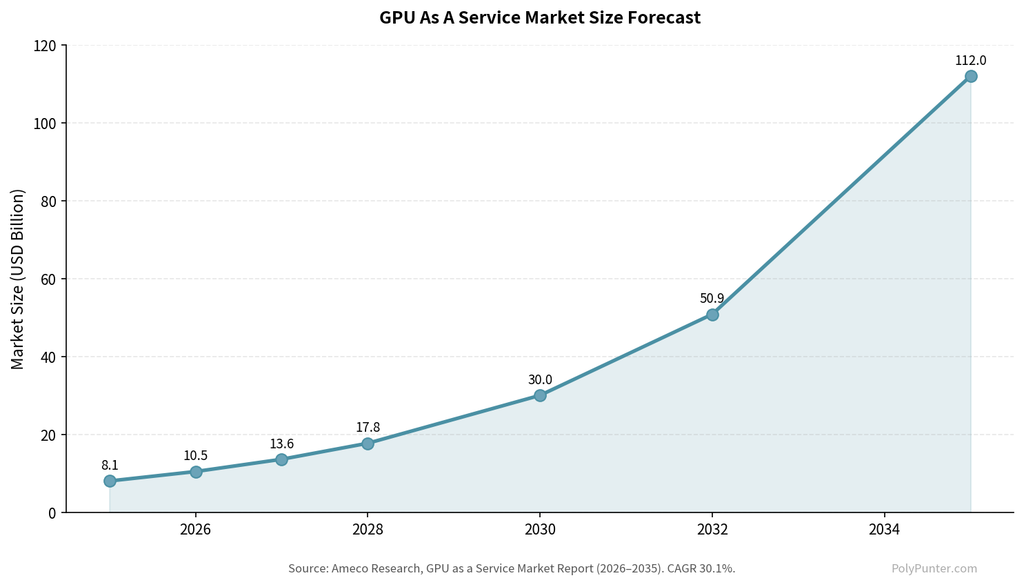
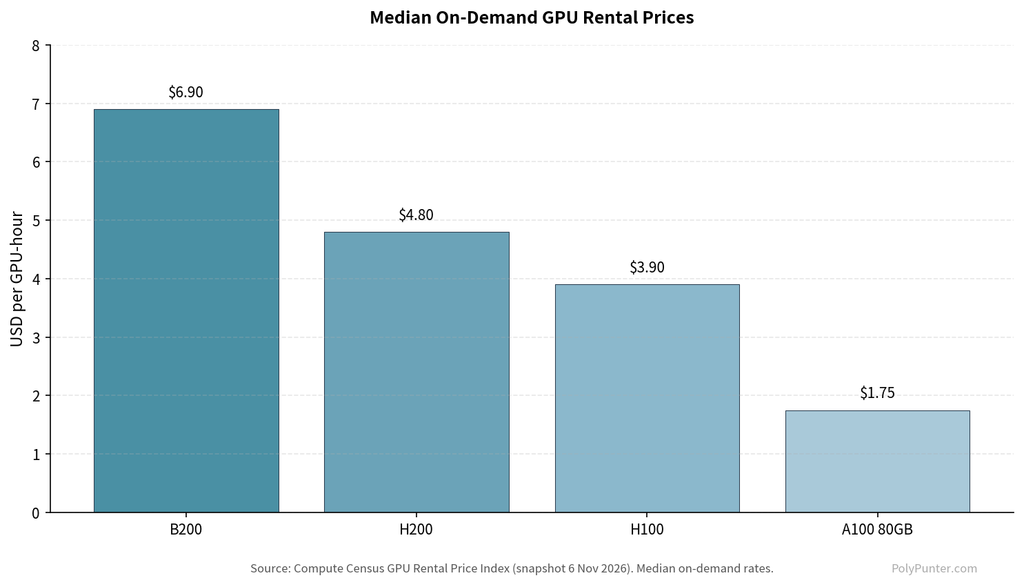
Market size is substantial and still expanding. Individual reserved contracts can run into the tens or hundreds of millions of dollars, and the broader compute rental sector is widely estimated in the tens of billions annually. And that is likely only to grow. Prices remain volatile: Compute Desk’s B200 index recently traded near $6.06 per GPU-hour after rising more than 20 percent in ninety days. Supply constraints, power limits, and sudden shifts in AI investment create sharp swings that can erase margins on fixed-price products. This is a highly volatile commodities market.
Why GPU Costs Keep Catching Startups Off Guard
AI training runs and inference both depend on relatively scarce GPUs compared to demand. GPU rental rates move with supply, power constraints, and sudden demand spikes. A rental price jump can wipe out margins on a fixed-price product or force a founder to pause a launch while they renegotiate cloud terms. Plenty of early-stage teams still treat compute as something that happens to them with no recourse, rather than a cost they can plan around, largely because that’s simply the practical reality.
Kalshi’s chief risk officer, Udesh Jha, has said compute creates natural demand for futures because both sides need a way to manage that forward-looking price. Back in July of this year, the exchange put out market-implied forward curves for the B200, H200, and A100, built from its own weekly and monthly contracts. Those curves gave people the first clear market forecast of where rates were expected to go. Earlier versions of the products came down during regulatory review; the current push with Compute Desk indexes is an attempt to put the same idea on a sturdier base.
Compute Desk publishes daily blended indexes for one-year reserved U.S. rental prices on chips including the B200 and H100. A startup that knows it will burn through thousands of hours now has a published rate to watch instead of relying only on private talks with neoclouds. That narrows the information gap that used to favor the largest buyers in the market heavily.
How the Hedge Actually Works
A team that already knows it will need B200 capacity next quarter can buy a futures contract that settles against a Compute Desk index. If the rental rate rises, the futures position can cover much of the extra cash cost. If the rate falls, the company pays less for the real capacity and takes a limited loss on the futures. Either way, the unit cost of the training run or inference service becomes easier to forecast reliably.
The earlier prediction-market contracts already offered a lighter version of the same idea. Traders could take a view on whether a given chip would clear a strike by a certain date. Stacking those contracts across different expirations let Kalshi build forward curves that answered ordinary planning questions, such as the implied average price for the following month. Dated futures and perpetuals tied to independent indexes would stretch that capability to longer windows and bigger sizes, the way producers and consumers already transfer risk in oil or metals.
A binary event contract on a game or an election does not change the underlying activity. A GPU futures position provides real utility: it lets a company manage a cash-flow risk that can decide whether their product ships on time. Teams that manage this risk can show investors a more stable cost picture. Capacity owners who sell the same contracts face less earnings volatility, which can make it easier to finance more data-center builds.
Sports Volume Versus Actual Business Use
Most of Kalshi’s volume still comes from sports. Those contracts have frequent events and straightforward resolution, and CEO Tarek Mansour has noted that the activity draws people who like thinking in probabilities. It has also helped pull liquidity into other categories and drawn investment capital into this sector. Without sports event markets, perhaps nothing else in prediction market development would come to fruition. It’s a part of the bargain that must be reconciled.
The downside for operators like Kalshi is that they are compared, arguably fairly, to unlicensed sportsbooks. Supporters usually reply that the products can also serve hedging and forecasting. But that defense becomes heavily strained when plain comparisons between sportsbooks and sports event markets are laid out for the average person.
Compute markets are the cleanest current example of actual hedging and forecasting in practice. A startup locking in the cost of its next training cluster is handling a business exposure, not hoping for a win on a basketball game prediction tonight. Policy discussions would be clearer if they separated contracts that transfer real economic risk from those that mainly let people speculate on games of chance.
Kalshi has described a sequence that starts with prediction markets for price discovery, moves to perpetual futures for ongoing exposure, and then adds dated futures for specific months. The Compute Desk partnership pushes the later stages forward. If the Commodity Futures Trading Commission finishes its review, still delayed into early 2027, the contracts could trade under federal oversight as swaps. That structure is what larger counterparties usually want before they commit real capital to a hedging program.
What Still Needs to Be Worked Out
Kalshi pulled its earlier compute products in August 2026 after the CFTC dug more deeply into the markets. The regulatory body has pushed related decisions into early 2027. CME Group and Intercontinental Exchange are chasing their own versions with different index providers. The competition is useful; no one has launched a fully approved, liquid market yet.
Coverage remains imperfect because much GPU capacity still moves through private bilateral deals. Compute Desk mixes verified transactions with list prices and follows IOSCO and BMR standards. Even so, the gap between the index and any single company’s actual rental contract will not disappear. Most users will likely combine futures with over-the-counter arrangements, as they do in other commodity markets. Futures contracts would still give AI startups a tool they didn’t previously have.
What Changes if the Market Actually Forms
Capacity owners who can hedge price risk face less volatility and may get better financing terms. The pattern is familiar from natural-gas futures, which made longer-term infrastructure contracts easier to bank. Transparent prices also give startups a key financial planning tool. When B200 futures move sharply, chip designers, cloud providers, and policymakers see it faster than they would from private surveys.
Practical successes for this hedging tool would look ordinary rather than dramatic. Startups would list GPU futures hedges next to their cloud compute commitments when they raise money. GPU operators would report how much of their capacity is hedged. Compute Desk indexes would turn up in ordinary AI finance conversations. None of that requires sports event trading-sized monthly retail volume. It only requires available contracts, liquid enough for real trading sizes, and trusted enough to settle against.
Kalshi has already pulled institutional interest into areas such as stock perpetuals. Extending the same approach to compute would set the platform apart and give a clearer example of event contracts serving a productive role under CFTC oversight. Until clearance arrives for these futures markets, the existing prediction-market contracts and published indexes still give founders a directional signal to watch as they set up internal processes.
Most public and political chatter about prediction markets still centers on elections and sports. Those markets have their place, most notably, enabling broader product and business development funding. But they do not show the full range of what prediction market systems can provide in terms of public utility.
GPU futures are the clearest current case of the hedging use case that supporters have described for a long time. As Compute Desk indexes keep tracking elevated rental rates, the need only grows. Teams that prepare to use these risk mitigation tools will enter the next stretch of AI development with more control over their costs than teams that absorb every swing. Enabling these markets could be a signature achievement for Kalshi.
References
- Kalshi Turns to Compute Desk in Renewed Push for GPU Futures
- Kalshi Taps Compute Desk as B200 Rents Rise 24% in 90 Days
- Compute, Power and the Rise of AI Infrastructure Markets | Kalshi Research
- GPU compute forward curve — Kalshi
- Compute Desk | GPU Rental Price Indexes
- The Financial Market Emerging Around AI Compute | Andrawes Bahou, Compute Desk
- Kalshi Ramps Up Effort to Build Markets for AI Computing Power
- Kalshi Is Sizing Up a $5 Trillion Compute Derivatives Market
- The Debate Over Compute Futures Heats Up | Hyperbolic
- Kalshi Plans to Launch AI Compute Futures with Compute Desk