Published: November 17, 2026
Amazon Ads just updated its Gambling and Games policy, so prediction markets are now treated in the same verification bucket as sports betting, online casinos, and lotteries. Before any campaign can run, the advertiser has to prove the business is licensed or otherwise lawful in every country it wants to reach. The revised page, dated around mid-November 2026, adds prediction markets to the list of seven categories already subject to those ongoing checks.
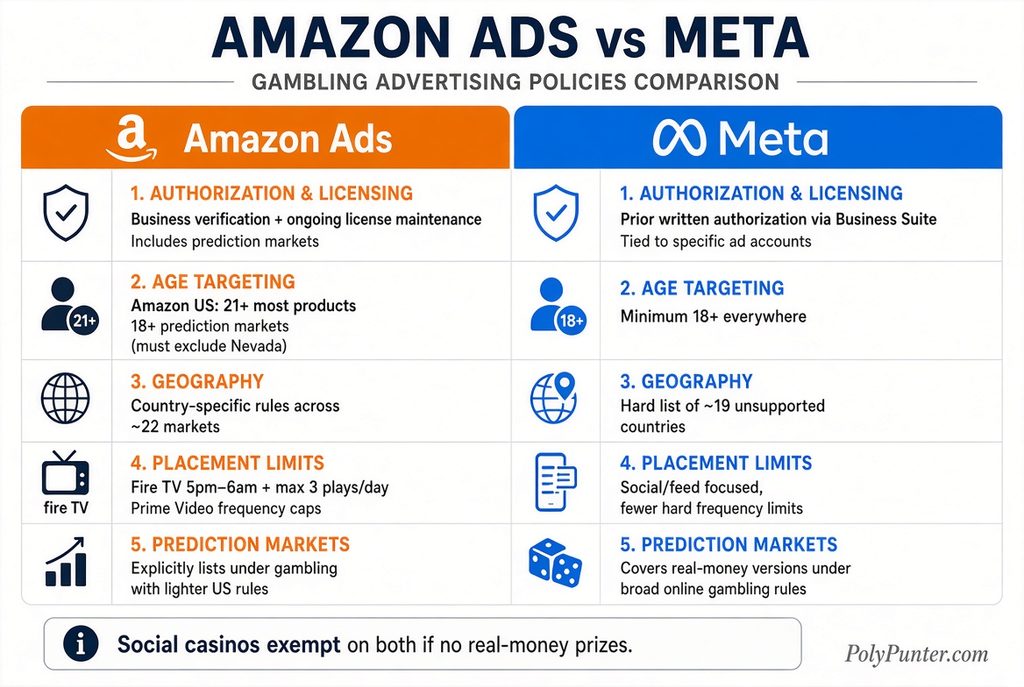
U.S. rules treat prediction markets differently from most other gambling ads. They can target people 18 and older, but Nevada must be fully excluded. On Fire TV, ads are limited to three plays in a 24-hour window and can run only from 5 p.m. to 6 a.m.
Verification is not a one-time form. Once approved, the advertiser must keep every required license current for the entire time the ads are live and must tell Amazon Ads right away if any license is suspended or expires. Social casino games that never involve real-money wagering remain outside the rules. Ads that show models or actors who look under 25 continue to be blocked everywhere under Amazon’s rules.
Verification And Ongoing Compliance Duties
Prediction market companies must set up their Amazon Ads account as a gambling business and provide proof that the activity is licensed by a regulator or otherwise lawful in each target country. The same verification step covers online casinos, national or state lotteries, daily fantasy sports, sports betting, online horse racing, offline gambling places, and prediction markets.
At account setup, the advertiser also has to pick the Gambling and Sports Betting category so Amazon’s supply partners get the right signals about who should see the ads. That choice helps keep the campaigns off sites aimed at kids or younger adults.
Creative rules stay the same for everyone. Ads cannot show people chasing losses or make claims that look deceptive. If a local law requires problem-gambling resources or responsible-gaming messages, those pieces have to be included. In the United States, the policy drops that disclosure requirement for prediction markets, so the creative load is lighter there even though the verification work is not.
Amazon checks lawful status at the country level rather than forcing a full state-by-state review for most products. Teams are now matching their existing licenses against the 22 country sections in the policy, which cover places such as the United States, United Kingdom, Canada, Australia, Brazil, Japan, and Mexico. No effective date has been posted, so most companies are simply gathering the paperwork while they wait for clearer timing.
United States Targeting Differences
The general U.S. rule sets most gambling ads at 21 and older. Prediction market ads get a clear exception: they may target 18 and older as long as Nevada is completely removed from the audience. Nevada is a hard exclusion. Campaign settings must detarget the state.
The policy does not say whether a federal designation is enough on its own in every other state, so compliance teams are checking each market separately. The same section says these ads do not have to carry the responsible-gambling messages or extra disclosures that other products need.
Lotteries also get the 18-and-older cutoff. Sports betting and online casinos stay at 21. Anyone building campaigns that mix products therefore needs different targeting settings and usually different creative. All of them still have to select the Gambling and Sports Betting category so the inventory partners receive consistent signals that these are restricted ads.
Inventory Limits On Fire TV And Streaming Platforms
On Fire TV, prediction market ads (and other covered gambling ads) can run only between 5 p.m. and 6 a.m. and are capped at three impressions per viewer in any 24 hours. Prime Video uses the same three-impression limit and allows ads only next to content rated PG-13 or TV-14 and higher. The caps reduce repeated exposure while still opening streaming slots that used to be tighter.
Amazon lists eight kinds of supply that are open with restrictions: Streaming TV and Prime Video, IMDb, Amazon Store display (lotteries only), Fire tablets, Amazon Music, Live Sports, Twitch, and the open internet. On Amazon Music, ads must skip children’s music and kids’ podcast genres. Twitch blocks homepage placements, and First Impression Takeovers and creator sponsorships carry extra rules.
Fire TV also bars share-of-voice packages and takeovers in the markets where gambling ads are allowed. Interactive video elements can appear only inside actual video ads. Put the overnight window, the daily cap, and those format limits together, and the practical options for living-room devices get narrower. Though hardly anything close to a tight restriction or a practical ban.
Other countries add their own timing rules. In the United Kingdom, every gambling ad on every Amazon supply type must run between 9 p.m. and 6 a.m. That means a global campaign cannot just copy the same settings everywhere. Each market needs its own scheduling range, targeting, and often its own creative.
Broader Effects For Prediction Market Advertisers
Putting prediction markets inside the Gambling and Games policy means that platforms that have long described their products as event contracts still have to clear a marketing step that groups them with traditional gambling advertisers. The upside is access to Prime Video, Twitch, and Fire TV inventory.
Traders who use these platforms will likely notice fewer or later-running ads on Fire TV devices because of the three-play daily limit and the overnight window. The same three-impression cap on Prime Video makes it harder to hit the same viewer multiple times during one night of live sports. Media buyers are already shifting budgets and dayparts while the verification process finishes.
Legal teams are reviewing how Amazon’s country-level test aligns with federal rules on event contracts and state efforts to limit certain offerings. Because the U.S. section does not require responsible-gambling disclosures for these ads, creative teams can leave those elements out in that market.
Amazon’s streaming and device inventory still offers reach that is hard to match elsewhere. The verification requirement and the frequency controls add friction, though. Companies that clear the process get a clearer path onto the permitted supply. Those that cannot show licensed or lawful status in a given country stay blocked. In practice, the policy works as both a gate and a map for anyone trying to advertise prediction markets on Amazon properties.
References
- Amazon Ads Support Center – Gambling and Games policy
- RG.org – Amazon Ads Adds Prediction Markets to Gambling Verification
- Casino.org – Amazon Labels Prediction Markets as Gambling in New Ad Rules
- NEXT.io – Amazon gambling advertising rules updated in 22 countries
- iGamingToday – Amazon Updates Gambling Advertising Rules in 22 Countries, Adds Prediction Markets
- PPC Land – Amazon forces prediction markets through gambling ad verification