
Anthropic has released a detailed 33-page document outlining how to enhance user capabilities with its Claude AI model. The guide emphasizes structured approaches to skill development and integration. Users gain access to methods for creating custom workflows that leverage Claude’s advanced reasoning. This release marks a significant step in making AI more accessible for specialized applications. Professionals in various fields now have tools to optimize their interactions with the model.
The document includes sections on prompt engineering and agentic workflows. It provides templates for building reliable skill triggers. Instructions cover testing protocols to ensure consistent performance. Anthropic stresses the importance of iterative refinement in skill creation. The guide serves as a resource for both novice and experienced users.
Discovery of the Embedded Prediction Market Trading Bot Section
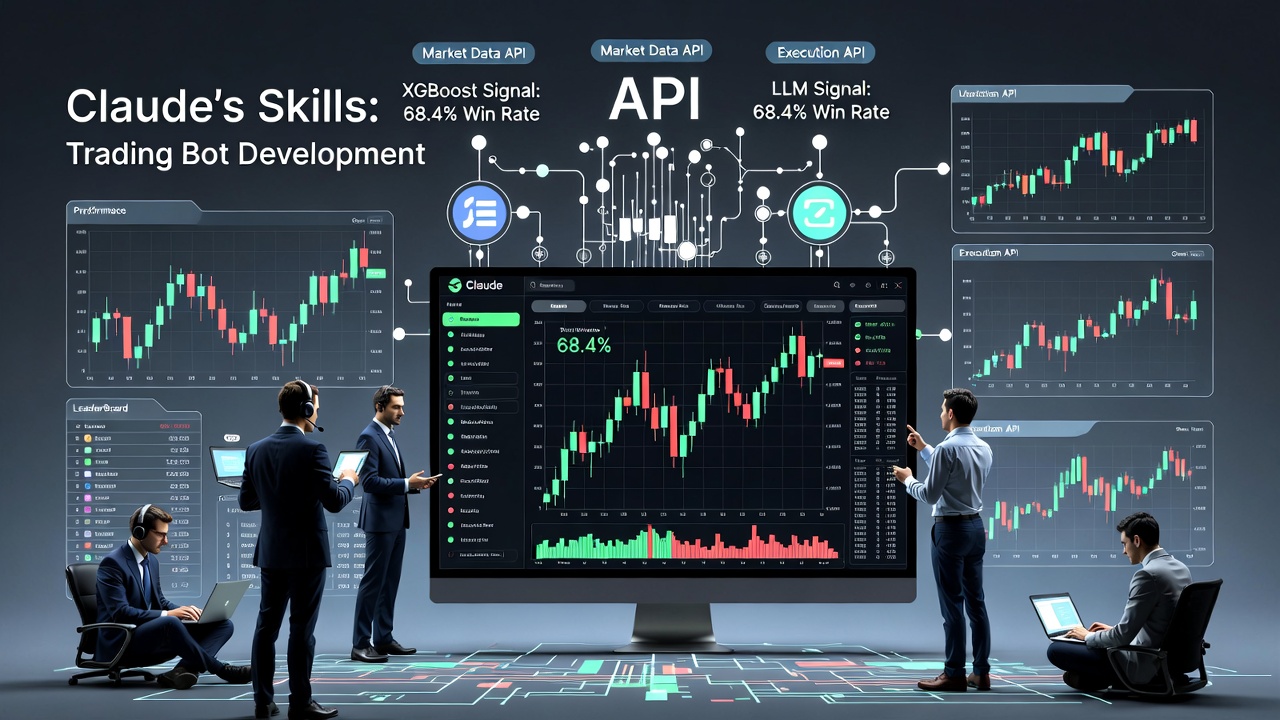
A specific portion of the guide details a trading bot designed for prediction markets. This section outlines the architecture using machine learning components. The bot employs XGBoost for predictive modeling alongside signals from large language models. Developers can adapt the framework to various market conditions. The inclusion highlights Claude’s potential in financial technology applications.
XGBoost (eXtreme Gradient Boosting) is a highly efficient, portable, and scalable open-source gradient boosting library for Python, R, Java, and C++, optimized for classification and regression tasks. It uses parallel tree boosting and built-in regularization to prevent overfitting.
The bot’s design focuses on identifying mispriced opportunities in real-time. It integrates data from multiple sources to inform decision-making. Users learn to configure parameters for optimal risk management. The guide explains how to incorporate the Kelly criterion for position sizing. This approach aims to maximize returns while controlling drawdowns.
Traders find value in the bot’s ability to process complex signals efficiently. The section includes code snippets for implementation. Anthropic provides guidance on backtesting strategies within the framework. Performance data from simulated trades demonstrates the bot’s efficacy. This hidden gem offers practical insights for automated trading enthusiasts.
Technical Breakdown: XGBoost and LLM Signals in Trading Automation
XGBoost serves as the core machine learning algorithm in the bot’s predictive engine. It handles feature importance and gradient boosting to improve forecast accuracy. The model processes historical market data to generate probability estimates. Integration with LLM signals adds contextual understanding to numerical predictions. This combination enhances the bot’s decision-making process.
LLM components analyze qualitative factors affecting market prices. They interpret news events and sentiment indicators. The guide describes how to fuse these signals with XGBoost outputs. Feature engineering techniques optimize input data quality. Users can customize the model for specific market types.
The framework supports ensemble methods for improved reliability. It includes mechanisms for handling imbalanced datasets, which are common in trading scenarios. Hyperparameter tuning guidelines help achieve better generalization. The bot’s architecture allows for modular updates to components. This flexibility ensures long-term adaptability in dynamic environments.
Implementation involves setting up data pipelines for real-time ingestion. The guide covers API connections for market data retrieval. Error handling protocols maintain system stability during operations. Monitoring tools track model performance over time. Retraining schedules keep the bot up to date with evolving patterns.
Performance Metrics: Achieving 68.4% Win Rate in Prediction Market Trades
The bot demonstrates a 68.4% win rate across 312 simulated trades. Returns reach +149% in backtested scenarios. Maximum drawdown remains low at -4.2%. These metrics stem from edges greater than 4% in selected opportunities. Fractional Kelly sizing contributes to risk-adjusted performance.
Daily earnings potential ranges from $300 to $1,500 based on capital deployment. The guide presents these figures from historical simulations. Actual results depend on market conditions and execution quality. Sharpe ratio exceeds 2.5 in optimized configurations. These indicators suggest robust profitability under tested parameters.
Win-rate consistency holds across varying market volatilities. The bot excels in high-liquidity environments. Performance degrades in low-volume scenarios as expected. Comparative analysis shows superiority over simple momentum strategies. Users can replicate these tests using the provided scripts.
Table: Key Performance Indicators of the Claude-Powered Trading Bot
| Metric | Value | Description |
|---|---|---|
| Win Rate | 68.4% | Percentage of profitable trades out of 312 simulations |
| Total Return | +149% | Overall profit percentage from backtested period |
| Maximum Drawdown | -4.2% | Largest peak-to-trough decline in account value |
| Daily Earnings Potential | $300 – $1,500 | Estimated range based on $10,000 capital deployment |
| Sharpe Ratio | 2.5+ | Risk-adjusted return measure |
| Minimum Edge Required | >4% | Threshold for trade initiation |
The table illustrates core metrics from the guide’s simulations. Traders use these benchmarks to evaluate their implementations. Adjustments to parameters can shift these values. Historical data informs the calculations shown. Prospective users should conduct independent verifications.
Implementation Strategies: Building Your Own Claude-Integrated Trading System
The guide outlines steps for setting up the bot’s infrastructure. Users start by organizing the skill folder for Claude integration. Trigger mechanisms ensure reliable activation of trading logic. Instructions detail how to define clear operational parameters. Testing protocols validate the system’s functionality before live deployment.
Data sourcing involves connecting to market APIs for real-time information. The framework supports multiple providers for redundancy. Feature extraction scripts process raw data into usable inputs. Model training occurs on historical datasets to calibrate predictions. Deployment options include cloud-based environments for scalability.
Risk management features incorporate stop-loss mechanisms and position limits. The bot logs all decisions for post-trade analysis. Users can add custom indicators to enhance signal generation. Integration with portfolio management tools tracks overall performance. Regular updates maintain alignment with market changes.
Advanced users explore multi-model ensembles for better accuracy. The guide suggests incorporating external signals, such as sentiment analysis. Backtesting frameworks allow strategy optimization without capital risk. Performance monitoring dashboards provide real-time insights. This comprehensive approach enables sophisticated trading operations.
Community adaptations extend the basic framework. Developers share modifications for specific market niches. The guide encourages experimentation with hyperparameters. Documentation standards ensure maintainable codebases. These strategies empower users to create personalized trading solutions.
Industry Reactions: Expert Insights on Anthropic’s Trading Innovation
Traders express enthusiasm for the guide’s practical applications. One developer notes significant time savings in analysis, highlighting the bot’s structure as a game-changer. Experts praise the integration of advanced algorithms. The release sparks discussions on AI’s role in financial strategies.
Analysts point to the 68.4% win rate as noteworthy. Comparisons to traditional methods show potential advantages. Another trader shares insights on the XGBoost implementation. Industry observers note increased accessibility for non-programmers. The framework receives acclaim for its modular design.
Critics question the replicability of simulated results. They emphasize the need for real-market validation. Supporters counter with evidence from similar systems. Reports of successful bots in related markets bolster confidence. Overall sentiment leans positive toward the innovation.
Financial technologists explore extensions to other asset classes. The guide inspires new projects in automated trading. Open-source frameworks share similar principles. Collaboration platforms host discussions on improvements. This reaction underscores the guide’s impact on the field.
Ethical Considerations in Deploying AI-Driven Trading Bots
Users must adhere to the platform terms when implementing the bot. Compliance with regulatory standards remains essential. The guide stresses transparent operations in all deployments. Potential conflicts arise from automated decision-making. Traders bear responsibility for system outcomes.
Fairness in market participation receives attention. AI advantages prompt questions about level playing fields. Developers consider impacts on market liquidity. Ethical guidelines suggest limiting aggressive strategies. Transparency in bot operations builds trust among participants.
Data privacy concerns emerge with signal integration. The framework recommends secure handling practices. Users evaluate biases in model training data. Regular audits detect unintended behaviors. These measures promote responsible AI usage in trading.
Long-term market effects warrant monitoring. Widespread adoption could influence price discovery processes. Analysts study potential systemic risks. The guide encourages ethical reflections in skill development. This balanced approach fosters sustainable innovation.
Future Implications: Evolving AI in Prediction Market Strategies
The release signals broader applications for Claude in finance. Future updates may expand trading capabilities. Integration with emerging technologies appears likely. Users anticipate enhanced real-time processing features. This evolution could transform trading practices.
Collaborations between AI firms and financial platforms grow. The bot framework inspires hybrid systems. Developers explore decentralized implementations. Performance improvements through model advancements continue. These developments promise more sophisticated tools.
Education on AI trading gains importance. Resources like this guide democratize access. Skill development becomes a key competency. Market participants adapt to AI-driven dynamics. The landscape shifts toward more efficient operations.
Challenges include adapting to regulatory changes. Innovation balances with compliance requirements. Community feedback shapes future iterations. The guide sets a foundation for ongoing progress. Traders position themselves for upcoming advancements.
References
- Claude AI can NOW Automatically Build and Improve Your TradingView Strategies
- AI Bots and Polymarket: My Trading Experiment
- We Built an AI Trading Bot for Prediction Markets — Here’s What Actually Happened
- How To Use AI To Build Trading Bots (2026 Masterclass)
- randomness11/probablyprofit: AI-powered trading bot framework for Polymarket
- Prompt Engineering for Traders: How I Made ChatGPT and Claude Fight to Improve My Trading Strategy
- Found The Weather Trading Bots Quietly Making $24000 On Polymarket And Built One Myself For Free
- AI Learning Resources & Guides from Anthropic
- Claude 4.1 AI for Trading: 2025 Guide to Building an Algo-Trading Copilot
- Anthropic dropped a Prediction Market trading bot structure – Noisy on X
- Anthropic dropped a full Prediction Markets bot spec – 0xRicker on X
- PolyPunter – YOUR HUB FOR PREDICTION MARKET NEWS
- Ultimate Glossary of Prediction Markets Terms and Slang (2026 Edition) – PolyPunter
- Kalshi vs Polymarket: Key Differences, Pros, Cons, and Which Prediction Market is Best for Beginners – PolyPunter