
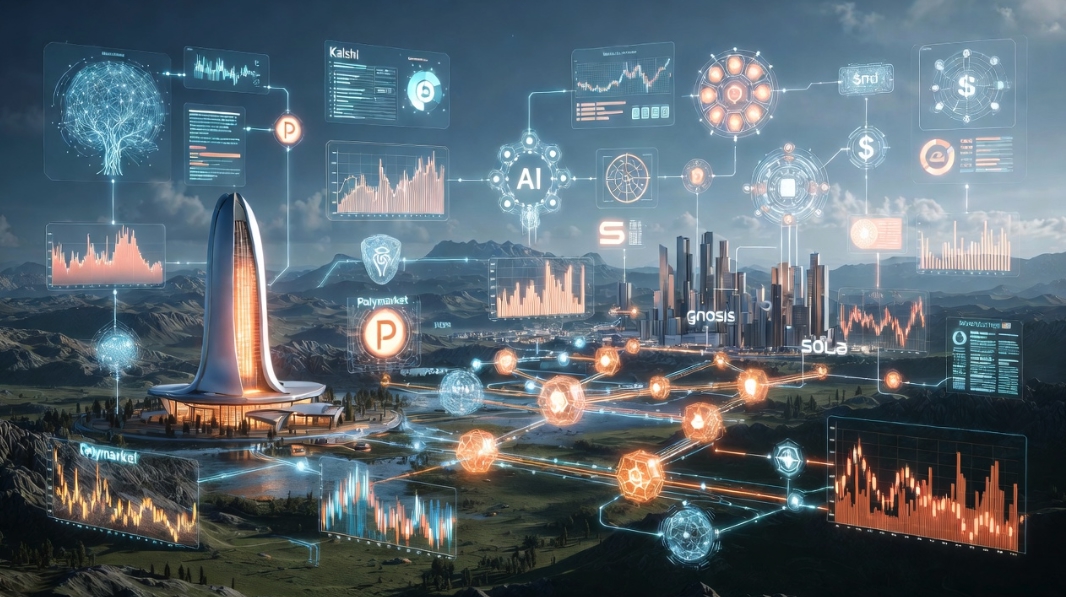
Current State of AI Integration in Prediction Markets
Today, AI integration in prediction markets focuses on providing contextual insights, analyzing market dynamics, and aiding user decisions without full trade automation. Platforms use AI to interpret probability shifts and link them to real-world events, making complex data more accessible in AI forecasting tools.
- Kalshi’s AI Partnership with xAI: Kalshi, a leading regulated U.S. prediction market, integrates Grok from xAI to improve user experience. Grok analyzes contract details, resolution rules, and events for tailored explanations of market movements, surpassing general AI models in specialized prediction data handling. Recent discussions on X highlight integrations like dflow’s proof-of-KYC system with Kalshi for secure AI-enhanced predictions.
- Polymarket’s AI-Generated Summaries: Polymarket leverages AI for summaries detailing probability changes and connecting them to news or events, providing context for active contracts without extensive manual research. In decentralized settings, projects like Triton AI develop autonomous trading intelligence for Polymarket on Solana, emphasizing instant settlement and DeFi composability.
- Synthdata’s Predictive Network: Synthdata’s decentralized AI network has miners generating probabilistic price paths for assets like Bitcoin (BTC). Demonstrated on Polymarket through BTC hourly up/down markets, it uses AI paths to calculate odds and trigger trades if discrepancies arise. This has grown initial balances significantly, with accuracy measured via Continuous Ranked Probability Score (CRPS).
These AI integration examples in prediction markets support scaling amid surging trading volumes, which surpassed $44 billion in 2025.
AI Agents Revolutionizing Decentralized Prediction Markets
In decentralized prediction markets, AI agents—autonomous machine learning-powered entities—participate as traders, forecasters, and liquidity providers. This is prominent on blockchains like Gnosis, where low fees and EVM compatibility facilitate AI deployment in AI agents in decentralized markets.
- Gnosis Ecosystem Innovations:
- Presagio (Omen 2.0): Utilizing Gnosis’s Conditional Token Framework (CTF), Presagio incorporates AI agents for sophisticated strategies, with automated market makers and Kleros for crowdsourced resolution. Backed by Gnosis DAO, it drives AI in forecasting.
- Infinite Games: Builds AI-powered networks with miners submitting predictions, validators scoring via peer metrics, and LLMs matching human performance. It employs proper scoring rules for honest forecasts and handles time-series data.
- OLAS Predict: Offers modular agents for market creation, trading, intelligence, and resolution, with over 361 daily active agents handling millions of transactions autonomously.
- Solana and Other Blockchain Integrations: Projects like GVRN AI on Solana integrate with Meteora for liquidity, while PerpTools provides AI automation in perpetual markets. Linera, supported by a16z, focuses on AI+crypto for prediction markets, aligning with VC trends in infrastructure. xAI’s crypto specialist hires aim at training AI with on-chain data for market structure and risk analysis.
AI agents enable 24/7 operations across markets, processing real-time data and coordinating decentralized intelligence, fostering “info finance” in prediction market innovations.
Benefits and Future Potential of AI in Prediction Markets
AI integration offers key advantages in prediction markets AI trends:
- Enhanced Accuracy and Efficiency: AI models match or surpass prediction markets in real-event forecasting, with tools like GenCast providing probabilistic outputs from market data. In finance, AI achieves 65-85% accuracy using LSTM and neural networks.
- Liquidity in Niche Markets: AI agents address thin markets by efficiently pricing low-stakes events, enabling expansion to granular predictions.
- Improved User Interfaces: AI translates natural language queries into trades, reducing complexity as markets grow.
- Data Synergies: Markets provide probabilistic data for AI training, while AI refines expectations, projecting trillion-dollar volumes by decade’s end.
Future trends include hybrid AI-blockchain systems for privacy-preserving training and quantum enhancements in AI forecasting tools. Projects like Ritualnet blend EVM++ with native AI for gaming and predictions.
| Aspect | Current AI Role | Future Potential |
|---|---|---|
| Forecasting Accuracy | Matches markets (e.g., GenCast) | 85%+ with quantum ML |
| Liquidity Provision | Agents in micro-markets | Millions of granular markets |
| User Engagement | Summaries and explanations | Natural language trading interfaces |
| Data Utilization | Training AI on probabilities | Symbiotic loops for info finance |
Challenges and Ethical Considerations in AI Prediction Markets
Despite advancements, AI integration in prediction markets faces obstacles:
- Prediction Market Paradox: AI improvements may lead to markets mirroring AI forecasts, creating circularity and bias from capital-weighted data.
- Bias and Manipulation Risks: Opaque AI models raise regulatory issues, with potential for volatility from high-frequency trading.
- Incentives and Power Dynamics: AI may consolidate control if innovations are acquired by major players.
- Ethical Concerns: Profiting from AI predictions on sensitive topics could increase addiction or inequality.
Regulatory evolution is needed for explainable AI in financial applications to ensure fairness in decentralized prediction markets.
Conclusion: The Future of AI in Prediction Markets
AI integration is positioning prediction markets as vital financial infrastructure, combining human incentives with machine efficiency in prediction market innovations. From Kalshi’s Grok features to Gnosis’s AI agents, this evolution promises scalable, accurate forecasting. Addressing paradoxes and biases is essential to maximizing benefits. As xAI advances crypto-AI convergence, 2026 may be transformative for AI integration in prediction markets.