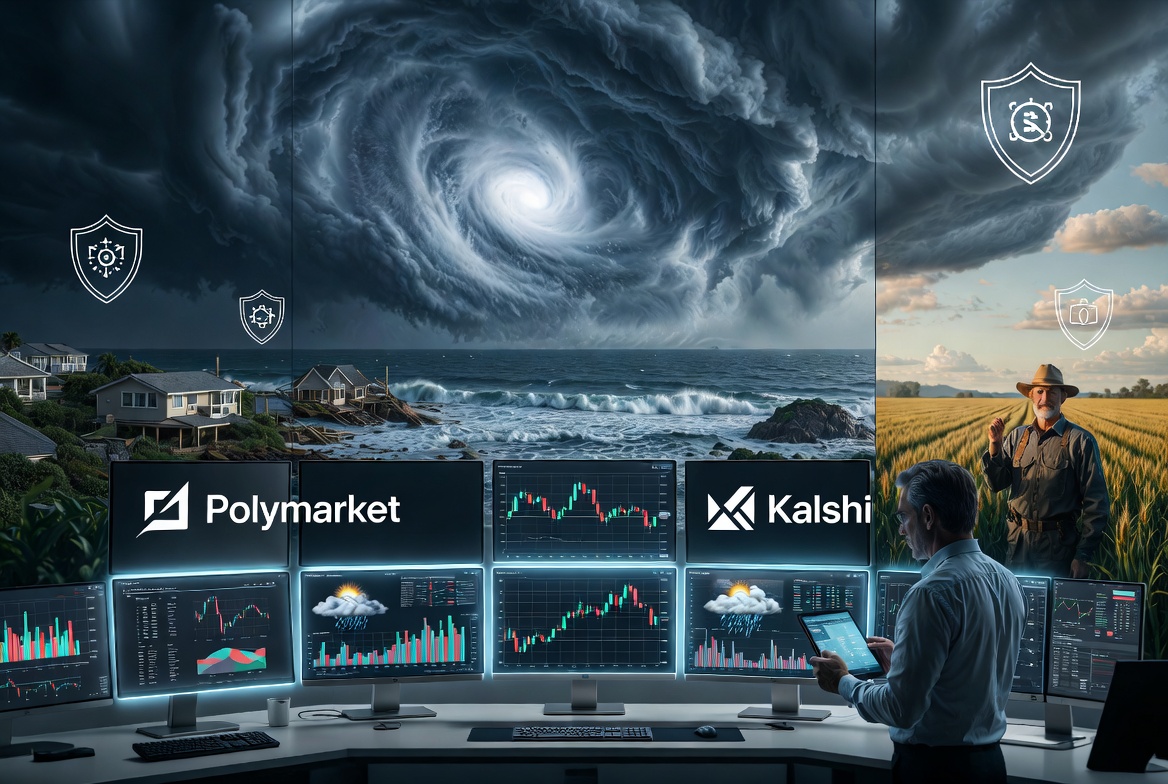
Prediction markets can be used by businesses to hedge shocks from catastrophes and operational risks. Traders can buy and sell contracts on specific triggers such as hurricane wind speeds or temperature thresholds. This trading creates contracts that pay out automatically when events hit. Risk managers believe these types of market tools can fill persistent gaps left by traditional systems.
Parametric Triggers Boost Efficiency in Catastrophe Hedging
Weather-related prediction market contracts settle on data from NOAA or satellite imagery. Settlement immediacy eliminates lengthy claims that slow recovery after a disaster strikes. Consequently, a ski resort operator can buy shares on below-average snowfall and lock in protection without having to prove exact revenue loss. Hedge funds layer these positions on top of existing coverage, providing financial flexibility that conventional policies rarely provide.
Trading volumes are showing surging adoption. Combined monthly trading exceeded $18 billion earlier in 2026. Weather and catastrophe categories are growing fast, as traders are creating a counterbalancing backstop to damaging weather events. Real-time repricing allows hedges to adjust as weather forecasts sharpen, offering a clear edge over static insurance plans.
| Event Type | Common Trigger | Typical Payout Structure | Example Use Case |
|---|---|---|---|
| Hurricane Impact | Scaled to the deviation index | $1 per contract if yes | Coastal property portfolio protection |
| Temperature Extremes | Days above 95°F | Scaled to deviation index | Agricultural demand hedging |
| Rainfall Shortfall | Precipitation <50% average | Binary or tiered resolution | Event venue cancellation coverage |
Insurance carriers view the markets as complements that can accelerate liquidity in crises. One carrier executive described how contracts supply supplemental capacity exactly when reinsurance tightens.
Carrier Management highlights insurability questions that arise.
Businesses Can Apply Markets to Operational Risk Management
Event organizers can hedge against weather-related cancellations weeks in advance. Money flows immediately if weather-related resolution triggers are activated. Retail chains can protect against heat waves that suppress foot traffic while manufacturers guard flood-vulnerable supply routes. Prices aggregate diverse information faster than any single actuarial model would allow.
Suddenly, energy firms can offset regulatory shifts through correlated contracts. Technology companies can mitigate launch delays and treat uncertainty as a tradable asset. Many risk managers are excited about how this approach democratizes risk transfer for smaller entities that once faced prohibitive costs.
Weather Markets Lead Climate Adaptation Efforts
Traders can mitigate the effects of record-heat years and specific storm paths through weather-related contracts. Farmers can secure protection against drought indices. Municipalities can offset infrastructure strain from extreme precipitation.
This Prof G Markets video reveals how platforms turn interest into practical tools.
Climate contracts drew hundreds of millions in volume last year on leading venues. That’s expected to keep rising. Corporations can hedge environmental policy reversal probabilities on carbon costs. Insurers can refine underwriting using aggregated forecasts, while crowd wisdom sharpens climate predictions.
Aeon examines the moral dimensions of monetizing weather events.
Hybrid Models Deliver Faster Recovery and Capital Efficiency
Traditional indemnity insurance requires proof of loss and creates disputes that prolong payouts and the provision of financial relief. In sharp contrast, prediction contracts automate settlement and release funds within hours of verified triggers. Homeowners can add targeted hurricane coverage to their policies for deductibles and temporary expenses.
| Aspect | Traditional Parametric Insurance | Prediction Market Contracts |
|---|---|---|
| Settlement Speed | Days to weeks | Hours to days |
| Cost Structure | High premiums with admin fees | Market-driven with lower overhead |
| Liquidity | Limited providers | Global trader pool |
| Customization | Standard templates | Granular user-created options |
Reinsurers can tap platforms for peak-season capacity. They could access retail and institutional capital that diversifies concentrated exposures. Hybrid strategies can blend long-term policies with short-term overlays and optimize protection costs. This layered defense becomes vital as the frequency of catastrophes climbs.
Interactive Brokers details forecast contract uses.
Institutional Adoption Marks Maturity in Risk Transfer
Hedge funds exist to run quantitative strategies that isolate perils across exposed portfolios. Quantitative desks model macro correlations with contract prices and generate edges from mispricings. Banks bundle hedges with advisory services to expand their offerings to clients.
Daily volumes can reach hundreds of millions, signalling a professional shift. One week in early 2026 recorded peaks above $700 million driven by these risk management flows. Platforms add order types and API tools that fit institutional needs. The data increasingly demonstrate the potential of hedging power, as the field challenges skeptics of these risk-mitigation strategies.
Thus, entrepreneurs can program insurance-like products on the market infrastructure. Hotels hedge against peak-season storms while logistics firms protect against port closures. Investment capital finds uncorrelated returns, and technology lowers barriers to precise coverage. This is financial innovation.
This discussion breaks down the information edge these markets create. It shows their central role in risk transfer during volatile periods.
Moral and Practical Concerns Over Weather Markets
Critics are raising questions about perverse incentives that arise when traders monetize disasters. But evidence indicates that markets improve forecasting accuracy only by financially rewarding informed traders. Transparent pricing reveals true risk perceptions and pressures insurance policymakers for stronger preparation. Platforms maintain rules against market manipulation, and obviously nobody can control the actual weather.
Calls are increasing from risk managers for test sandboxes that can nurture innovation in these hedging tools while safeguarding less-informed users. But as with any prediction market, liquidity and volume growth are required to enhance accuracy.
Technological Integration Opens Future Horizons
Blockchain oracles and AI agents further tighten price discovery and enhance opportunities to integrate prediction markets with real-world insurance instruments. They can fully automate creation and execution for hyper-specific risks.
With these tools, supply chain managers hedge against shortages linked to geopolitical flare-ups. Tourism operators protect against travel advisories. Decentralized finance blends with risk management, unlocking insurance efficiencies perhaps previously considered impossible.
References
- Predicting the Insurability of Prediction Markets
- The Prediction Markets Are Coming For Risk Markets
- The moral risk of prediction markets for weather catastrophes
- Disaster Insurance Applications of Forecast Contracts
- Innovating hedging and risk transfer with forecast contracts
- Prediction Markets Are Insurance Companies Waiting to Happen