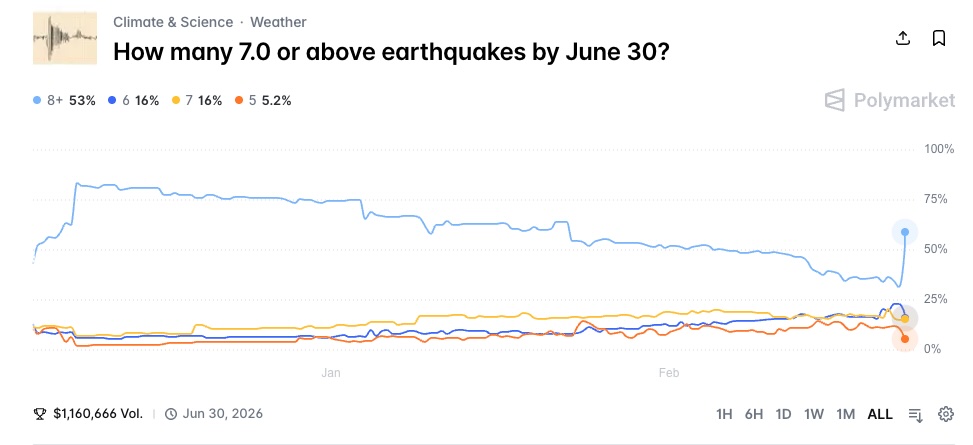
In the realm of forecasting uncertain events, one particular market stands out for its focus on the unpredictable forces of nature: the question of how many earthquakes of magnitude 7.0 or higher will occur globally by June 30, 2026. This scalar market on Polymarket, which spans from December 4, 2025, to the end of June 2026, invites participants to wager on outcomes ranging from fewer than 5 to 8 or more such events. With current odds favoring 8+ at around 35%, and other bins like 6 at 22%, it encapsulates the blend of data-driven speculation and human fascination with geological phenomena. Let’s explore who might be drawn to bet on this seismic query, the underlying draws of such predictions, and how its trading volume stacks up against similar non-political, non-sports markets.
Who Places Bets on Earthquake Predictions?
A diverse array of individuals and entities find themselves attracted to betting on earthquake-related outcomes. At the core are those with a professional stake in understanding seismic risks, such as geologists and seismologists who monitor fault lines and tectonic plates for a living. These experts might use the market as a way to test their models against the collective wisdom of the general public, leveraging years of studying historical data and real-time monitoring from organizations like the U.S. Geological Survey (USGS). For instance, a researcher familiar with plate tectonics could bet based on patterns observed in active zones like the Pacific Ring of Fire, where most major quakes originate.
What is the “Ring of Fire”?
Most earthquakes and volcanic eruptions do not strike randomly but occur in specific areas, such as along plate boundaries. One such area is the circum-Pacific Ring of Fire, where the Pacific Plate meets many surrounding tectonic plates. The Ring of Fire is the most seismically and volcanically active zone in the world.
Beyond professionals, risk managers and insurers represent another key demographic. Insurance companies, particularly those underwriting policies in earthquake-prone regions, could view these markets as a hedging tool or a source of aggregated insights. By observing shifts in odds, they gain a sense of market sentiment on potential catastrophes, which informs premium adjustments or reinsurance strategies. Speculators with a financial bent also participate, treating the market like any other asset class where information asymmetry can yield profits. These might include quantitative analysts who build algorithms to predict seismic activity based on precursors like minor tremors or geological stress indicators.
Earthquake enthusiasts and hobbyists round out the group, often driven by personal interest in earth sciences. Retirees, students, or amateur geophysicists who follow earthquake trackers online might bet small amounts to engage more deeply with the subject. In some cases, residents of high-risk areas, such as California or Japan, could wager as a form of psychological preparation or even catharsis, turning anxiety about “the big one” into a structured activity. Overall, the bettors span from informed insiders with specialized knowledge to casual participants seeking intellectual stimulation, united by a shared curiosity about the planet’s volatile dynamics.
What Draws People to These Types of Predictions?
The allure of betting on natural events like earthquakes lies in the intersection of uncertainty, information aggregation, and potential rewards. Prediction markets excel at pooling dispersed knowledge, where participants’ wagers reflect their beliefs weighted by confidence and capital. For earthquake forecasts, this means incorporating diverse inputs—from satellite data on ground deformation to historical trends—into a single probability distribution. People are drawn to this because it transforms passive observation into active participation, rewarding those who can operationalize obscure information ahead of the crowd.
Another draw is the intellectual challenge. Earthquakes embody chaos theory in action: seemingly random yet governed by underlying patterns. Bettors enjoy the puzzle of deciphering signals amid noise, much like stock traders analyzing market volatility. The ethical dimension adds intrigue; while some criticize profiting from potential disasters, proponents argue that accurate predictions can indirectly aid preparedness by highlighting risks. For example, if odds spike for higher counts, it might prompt public awareness or policy discussions on building codes in vulnerable areas.
Financial incentives play a role, too. In a world where traditional investments fluctuate, these markets offer uncorrelated opportunities. A correct bet on an underpriced outcome—say, anticipating clustered quakes due to aftershock sequences—can yield substantial returns. Moreover, the markets’ efficiency in forecasting outperforms many expert opinions, as they punish bias and encourage truth-seeking. This reliability attracts those disillusioned with polls or pundits, who prefer data-backed odds. Psychologically, the thrill of “beating the market” mirrors gambling, but with an informational edge that feels more like skill than luck. Ultimately, these predictions tap into humanity’s age-old quest to foresee and mitigate nature’s fury, blending science, economics, and human nature.
Trading Volume in Context: A Comparative Analysis
The earthquake market by June 30, 2026, has seen a trading volume of approximately $435,000, positioning it on the lower end of non-political, non-sports topics. In comparison, cryptocurrency-related markets dominate with much higher liquidity. For instance, scalar markets on Bitcoin’s price for February 2026 have amassed around $82 million in volume, reflecting the intense interest in digital assets’ volatility. Ethereum and Solana price targets follow suit, with $27 million and $11 million, respectively, underscoring crypto’s appeal to tech-savvy traders seeking high-stakes speculation.
Health and economic forecasts also outpace seismic ones. The market for U.S. measles cases in 2026 boasts $7 million in volume, driven by public health debates and vaccination trends. Similarly, predictions on Federal Reserve rate cuts in 2026 have reached $7 million, attracting economists and investors attuned to monetary policy shifts. Even extraterrestrial curiosities like alien confirmation before 2027 draw $6 million, fueled by scientific announcements and cultural hype.
Space exploration markets, such as human moon landings in 2026, hover at $2 million, appealing to aerospace enthusiasts but lacking the urgency of financial or health topics. Climate-related predictions, like 2026’s ranking among the hottest years, match the earthquake market at about $1 million, indicating shared interest in environmental uncertainties but lower overall engagement. This disparity highlights how earthquake bets, while intellectually engaging, compete with more immediate or trendy subjects. The lower volume may stem from earthquakes’ perceived randomness, deterring casual bettors who prefer markets with clearer informational edges or higher media visibility.
| Polymarket Market Topic | Approximate Volume (USD) |
|---|---|
| Bitcoin Price in February 2026 | $82,000,000 |
| Ethereum Price in February 2026 | $27,000,000 |
| Solana Price in February 2026 | $11,000,000 |
| U.S. Measles Cases in 2026 | $7,000,000 |
| Fed Rate Cuts in 2026 | $7,000,000 |
| Alien Confirmation Before 2027 | $6,000,000 |
| Human Moon Landing in 2026 | $2,000,000 |
| 2026 Hottest Year Ranking | $1,000,000 |
| 7.0+ Earthquakes by June 30, 2026 | $435,000 |
Historical Context of Global Earthquakes
To appreciate the market’s odds, consider historical patterns. Globally, earthquakes of magnitude 7.0 or higher occur about 15-18 times per year on average, based on long-term USGS records. This includes roughly 17 in the 7.0-7.9 range and one magnitude 8.0 or above. However, rates fluctuate; the 1940s saw peaks of up to 30 annually, while the 1980s dipped to around 11. Recent decades show no significant increase, debunking myths of rising activity despite improved detection.
For seven months, like this market’s timeframe, one might expect 8-10 events, aligning with the current favoritism toward higher bins. Clustering—where one major quake triggers others—adds variability, as seen in years like 2010 with 23 major events. Bettors factoring in such dynamics contribute to the market’s predictive power.
| Decade | Average per Year |
|---|---|
| 1900s-1910s | 18 |
| 1940s | 30 |
| 1980s | 11 |
| 2000s-2010s | 16 |
| Overall Average | 15-18 |
Current Market Dynamics and Implications
As of early 2026, the market’s volume reflects cautious interest amid ongoing global events. With earthquakes already recorded this year, odds have shifted from initial estimates, emphasizing the market’s responsiveness. This fluidity draws participants who thrive on real-time data, using tools like seismic apps to inform trades.
Broadly, such markets highlight how betting can democratize forecasting, but they also raise questions about incentivizing focus on negative outcomes. Yet, their utility in aggregating beliefs often outweighs concerns, providing a barometer for risks that traditional methods might overlook.
Conclusion
Earthquake prediction markets like this one captivate a niche yet passionate audience, from experts to enthusiasts, by offering a platform to monetize knowledge on nature’s whims. While volumes lag behind crypto or economic bets, their draw lies in the intellectual and ethical layers they add to speculation. As seismic events unfold, these markets serve as a reminder of our evolving relationship with uncertainty, blending science with economic incentives in pursuit of foresight.