
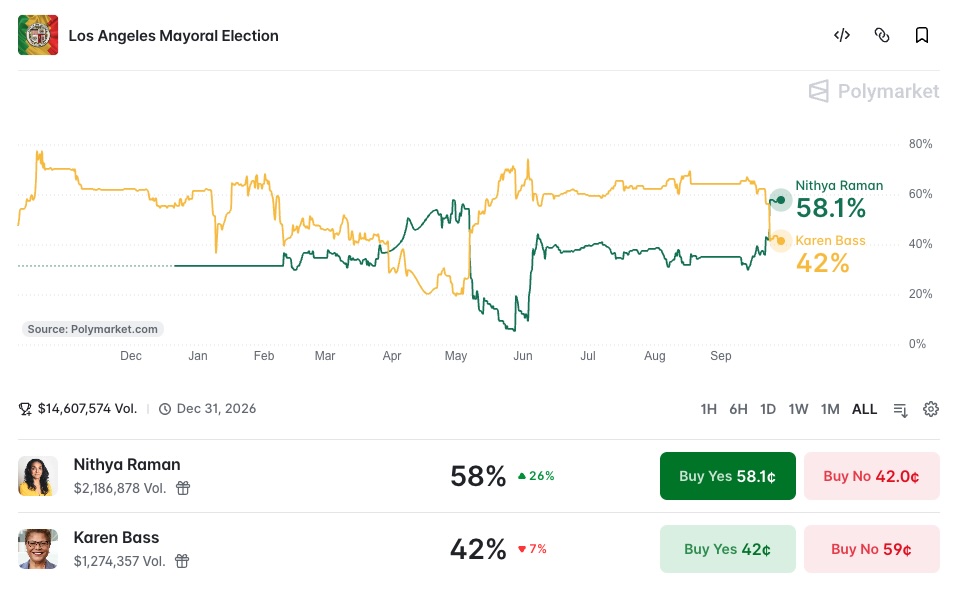
Prediction market contract prices flipped on Monday, giving City Councilmember Nithya Raman a clear edge over Mayor Karen Bass in the Nov. 3 runoff for Mayor of Los Angeles. Traders were paying about 58% on Raman to win and about 42% on Bass to keep the seat. That 16-point gap opened after a mid-September survey hit.
On the main event page, Raman sat near 58.1% and Bass near 41.5%, with more than $14.6 million already matched. Twenty-four-hour volume was only $26.8K, yet the direction was clear. After weeks of tighter pricing, the market started treating the challenger Raman as the distinct favorite.
The spark was a UC Berkeley Institute of Governmental Studies survey co-sponsored by the Los Angeles Times. It put Raman at 39% among likely voters and Bass at 28%, with 33% still undecided. Bass campaign spokesman Alex Stack called the result an outlier. Traders, reading the same figures, disagreed and kept lifting Raman.
Why Mayoral Runoff Odds Moved After the Survey
The survey of 2,150 likely voters ran online from Sept. 15 through Sept. 20 and carried a margin of error of about 3 points. Mark DiCamillo, who directs the Berkeley IGS Poll, said Raman now holds the easier path. Bass’s team pointed to an August Neighborhoods for a Better L.A. survey that had the mayor ahead 41% to 35%. Prediction markets may be superior election forecasters, but traders still move prices based on survey results, so they remain intertwined.
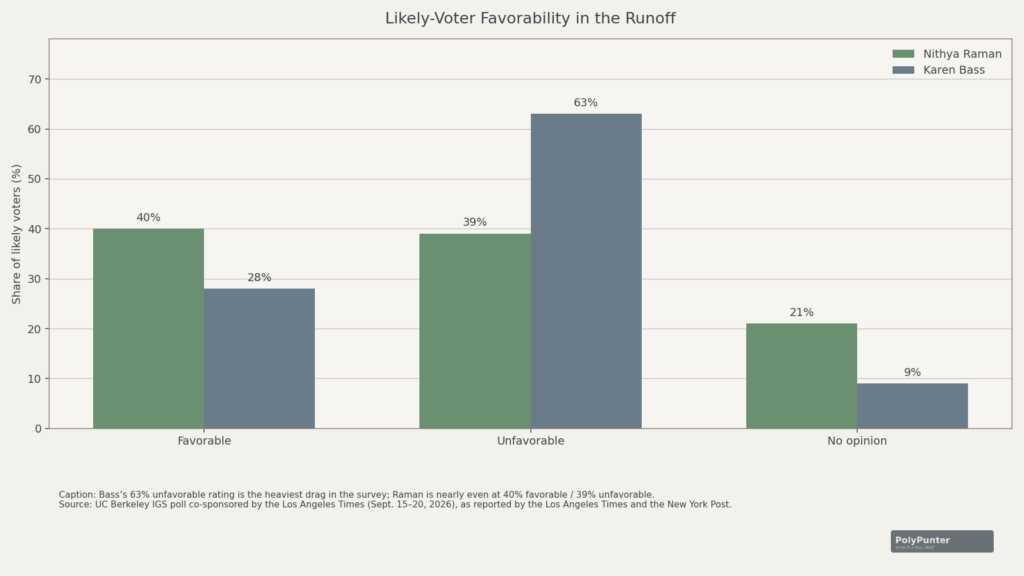
Two other findings mattered more than the raw split. Bass’s unfavorability sat at 63%, with only 28% viewing her favorably. Raman was closer to even, at 40% favorable and 39% unfavorable. Meanwhile, 56% of likely voters rated Bass’s response to the 2025 Palisades fire as poor or very poor.
In the June 2 primary, Bass led with 34%, Raman took about 29%, and reality-television personality Spencer Pratt took about 26%, missing the runoff. Now 63% of Pratt’s voters remain undecided. Among those who have chosen, 22% lean Bass and 16% lean Raman.
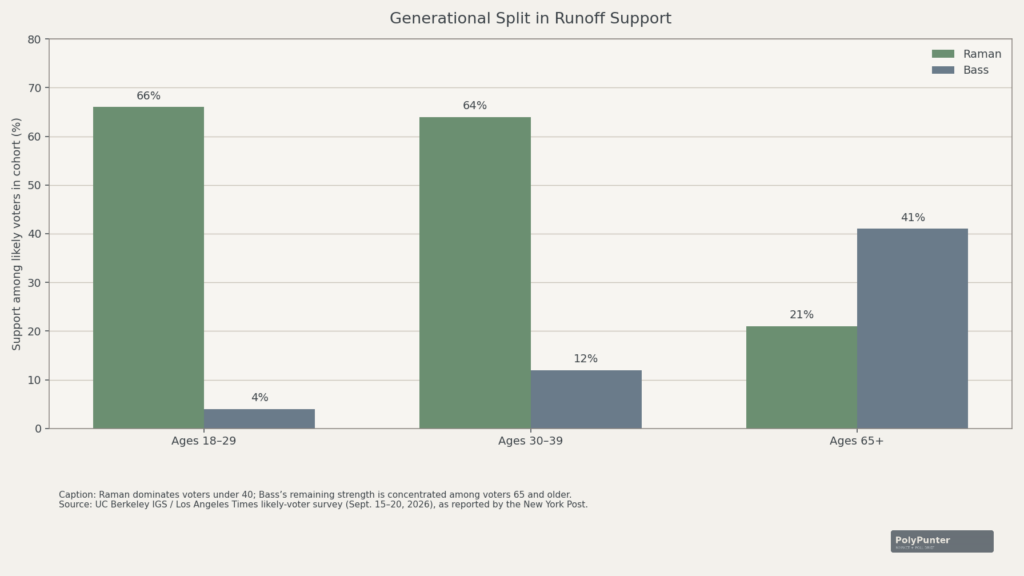
Younger voters are driving the gap. Raman holds 66% among likely voters ages 18 to 29 and 64% among those 30 to 39. Bass leads only among voters 65 and older, 41% to 21%. As a result, the market is pricing a younger, more progressive coalition than the primary electorate.
Raman also won the Democratic Socialists of America’s local chapter endorsement. The Los Angeles Police Protective League is backing Bass and has already aired ads on encampment rules near schools and past votes on department spending. Those attacks are landing, yet they have not pulled the contracts back to even.
How Debates and Recovery Anger Feed the Trade
Traders are not waiting for another survey. They buy and sell every time a new clip or mailer drops. Bass says Raman offers plans without production. Raman says homelessness fell in her district while it rose citywide, and that Inside Safe has spent hundreds of millions without matching results on the street.
The mid-August runoff debate hosted by the Sherman Oaks Homeowners Association set the tone. Bass accused Raman of missing votes. Raman told the mayor to let her finish. Those lines keep circulating, and they keep feeding orders.
A later environmental forum put both candidates in separate fireside chats. Bass defended her record and asked what Raman had produced after more years on the council. Raman said climate work had lost focus.
A short debate recap is also moving among people watching the contracts:
The clip shows the same clash over police raises and who actually shows up for the job. Volume has not exploded, but the price has kept drifting toward Raman since the survey dropped.
Former Los Angeles city council member Zev Yaroslavsky called the survey a shot in the arm for Raman and a bad day for the mayor. Stack keeps saying door-to-door energy looks closer. Traders keep asking who is winning among the people who have not picked a side, as that undecided number in surveys remains large.
What the November Price Still Leaves Open
Mail ballots in California go out universally on October 1; that calendar is now part of the trade. A large undecided share this late usually means late movement. Even so, Raman’s 58% price already embeds some chance that Pratt voters break late for Bass and that older turnout saves the incumbent. We can see the massive generational differences in the survey results.
A sitting mayor at 63% unfavorable heading into a runoff is rare. And not in a good way for Bass. Raman is polarizing too as a DSA candidate, but she starts with a better net rating and a much stronger hold on voters under 40. Campaign mail and union ads can still move the needle. They have not yet moved the contract back to a coin flip.
Related contracts on the same event page list 11 possible outcomes, so the two main prices do not have to add to 100%. That lets traders express more than a simple head-to-head view. Some are buying Raman while hedging smaller outcomes. Others are fading the incumbent on unfavorability without waiting for a second survey.
The primary already showed how late ballots can rearrange the field. Raman overtook Pratt only after more mail was counted several days after the election had ended. Traders remember that high-profile lag and flip. They also remember that no candidate cleared 50% in June, which is why this runoff exists. Neither candidate is what you’d call popular with a majority.
Campaign Pushback and the Next Five Weeks
Bass is leaning on experience and the claim that other surveys look tighter. Raman is leaning on the generational split and the fire-recovery negatives for Bass. Progressive and socialist groups are organizing for Raman. The police union is organizing against her. Those two machines will spend the next five weeks chasing the same undecided third of the electorate. Turnout will be a huge driver; in California, turnout largely comes from mailed and harvested ballots by professional collectors.
Now the live question is whether the 33% undecided block behaves like the younger cohort that already broke for Raman or like the older cohort that still prefers Bass. Until the ballot box answers that, 58-42 is the price. Traders can fade it, fade the survey, or keep buying the challenger. Monday morning they chose the last option.
References
- Nithya Raman takes double-digit lead over Karen Bass in new mayor’s race prediction
- Polymarket event: mayoral election contracts
- PolyInsider live odds and volume
- Raman takes big lead over Bass in latest poll
- Massive swing rocks mayor’s race as concerning poll released
- Raman’s big lead puts pressure on Bass
- Bass, Raman spar over policing and homelessness
- Bass, Raman tout environmental records at forum