

The clock is ticking on a pivotal regulatory moment for Distributed Ledger Technology (DLT)-based prediction markets. DLT-based prediction markets include all blockchain-based markets, such as Polymarket. Alexandru Badea, Senior Regional Director at NAGA, warns that the European Commission’s targeted consultation on the Markets in Crypto-Assets Regulation (MiCA) review, opened on May 20, 2026, now carries an extended deadline of September 30, 2026. While regulators signal their direction, the industry remains largely quiet, and that silence will be read by the industry as consent.
This consultation marks the first formal request asking whether DLT-based prediction markets belong inside the EU rulebook and under which rules. Combined monthly activity on major platforms reached $44.8 billion in June 2026, yet recent industry attention has left this EU question almost unnoticed. Responses will feed a mandated report to the European Parliament and Council due by June 30, 2027, under Articles 140 and 142 of MiCA, potentially accompanied by a new legislative proposal.
Whoever submits before the deadline will help set the outcome. The coming weeks represent the last practical chance to influence rules that will govern EU access for the next decade.
Core Question Facing DLT-Based Prediction Markets in the MiCA Review
The consultation, prepared by the digital finance unit, targets specialists including crypto-asset service providers, issuers, supervisors and finance ministries. Exchanges, market makers and trade associations can still reply through the open EU Survey portal. The central issue is clear yet super high-stakes: should DLT-based prediction markets and crypto perpetuals fall under MiCA or under MiFID II?
Under MiCA, an operator could become a licensed crypto-asset service provider and gain passporting rights across Economic Area member states. MiFID II, by contrast, would treat many event contracts with binary payouts as traditional financial instruments, triggering the product-intervention rules that banned binary options for retail clients across the bloc in 2018. Obviously, a major difference for platforms like Polymarket.
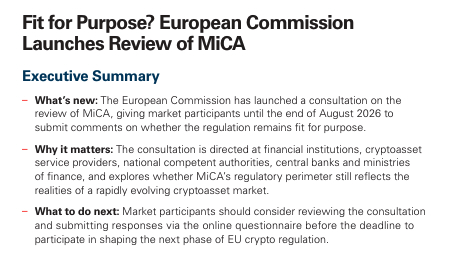
The EU review itself acknowledges that MiCA was drafted before prediction markets scaled to current levels. Consequently, this consultation is the mechanism for catching up. Industry lawyers, including those at Skadden, have framed the stakes in client briefings titled “Fit for Purpose?”, highlighting how the classification choice will decide long-term viability.
If respondents persuade the Commission that a calibrated MiCA-style approach works, centered on disclosure, custody, and market-integrity rules without the binary-options prohibition, Europe could become a fully licensed home for the activity. Otherwise retail access to these prediction markets faces severe limits.
ESMA Statement Raises Stakes for Event Contracts Classification
Pressure intensified on July 3, 2026, when the European Securities and Markets Authority (ESMA) issued a public statement declaring that event contracts whose underlyings fall within MiFID II’s Annex I qualify as financial instruments. These contracts are therefore captured by national binary-options prohibitions on marketing, distribution or sale to retail clients.
ESMA made clear that commercial branding as “event contracts” changes nothing. Firms offering such products even to non-retail clients still require MiFID II authorization. Tokenized versions that avoid financial-instrument status might instead fall under MiCA.
This clarification follows months of national actions in which gambling authorities within Europe coordinated enforcement, creating a pincer movement alongside securities supervisors. The absence of purpose-built rules in between has left operators navigating conflicting demands.
As Badea emphasized, the consultation now offers the first chance to fill that vacuum through intentional, proactive design rather than enforcement alone.
Soaring Volumes Underscore the Cost of Restrictive Outcomes
Restricting retail access under a MiFID II outcome would push activity offshore or limit it to institutional desks only. Operators would then face a choice between costly per-jurisdiction licensing or wholesale retreat from the region, the latter of which entails its own opportunity costs of lost trading volumes.
In addition, national blocks and joint declarations from multiple gambling regulators already signal coordinated pressure. A MiCA-aligned regime could reverse that trajectory by enabling passporting and clearer compliance paths.
The irony remains sharp: the single event that most affects European prospects of pan-EU prediction markets cannot itself be traded.
Industry Silence Risks Consenting to Narrower Rules
Badea warns that industry inaction will be interpreted as agreement. The original August 31 deadline has been extended to September 30, 2026, according to the Commission’s consultation page, providing a final window. Nothing prevents exchanges, market makers or associations from weighing in through the EU Survey portal. Aside comment: the EU Survey portal resembles a high school webpage.
Given ESMA’s position, unregistered responses tacitly endorse the stricter classification. The mandated 2027 report will echo through European rules for the next decade, so input arriving before the deadline can still shape whether a workable MiCA path emerges or whether binary-options restrictions dominate.
Consequently, the coming weeks represent the last practical opportunity to influence the outcome. Platforms that have scaled rapidly now confront a binary choice of their own: engage or accept the default trajectory, the latter of which is likely to be heavily lobbied by longstanding gambling associations.
References
- MiCA Is Not Only for Crypto. It Will Also Decide Prediction Markets’ European Future
- Targeted consultation on the review of MiCA Regulation
- Europe Has No Licensed Prediction Markets. ESMA Just Raised the Entry Bar
- What’s In a Name? ESMA Says Prediction Markets Are Still Binary Options
- MiCA review to set whether EU prediction markets face crypto rules or strict MiFID limits
- ESMA Warns Prediction Market Contracts May Fall Under EU’s Retail Binary Options Ban
- ESMA Says EU Retail Ban Covers Many Prediction Markets, With MiCA Awaiting the Tokenized Ones
- How ESMA called time on prediction markets’ regulatory free ride

The PolyPunter staff works tirelessly to bring you the latest and most insightful news, information, and tips on the fast-growing economic, financial, and social phenomenon that is prediction markets.