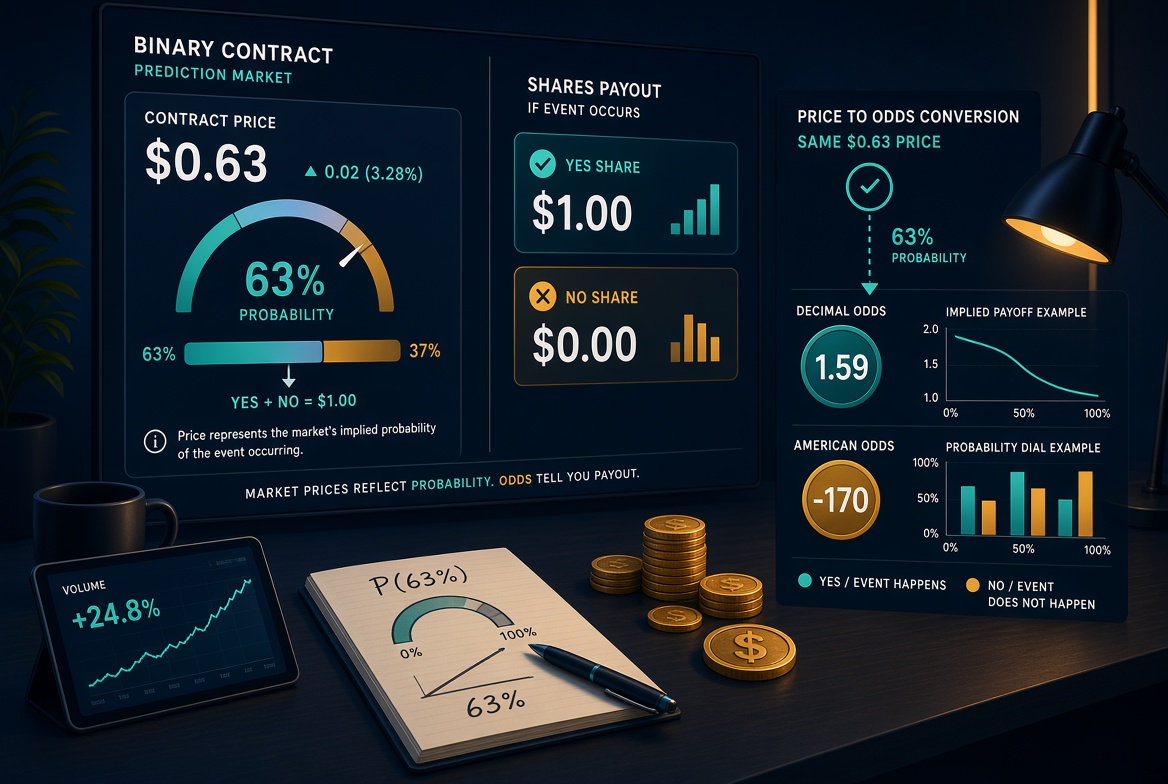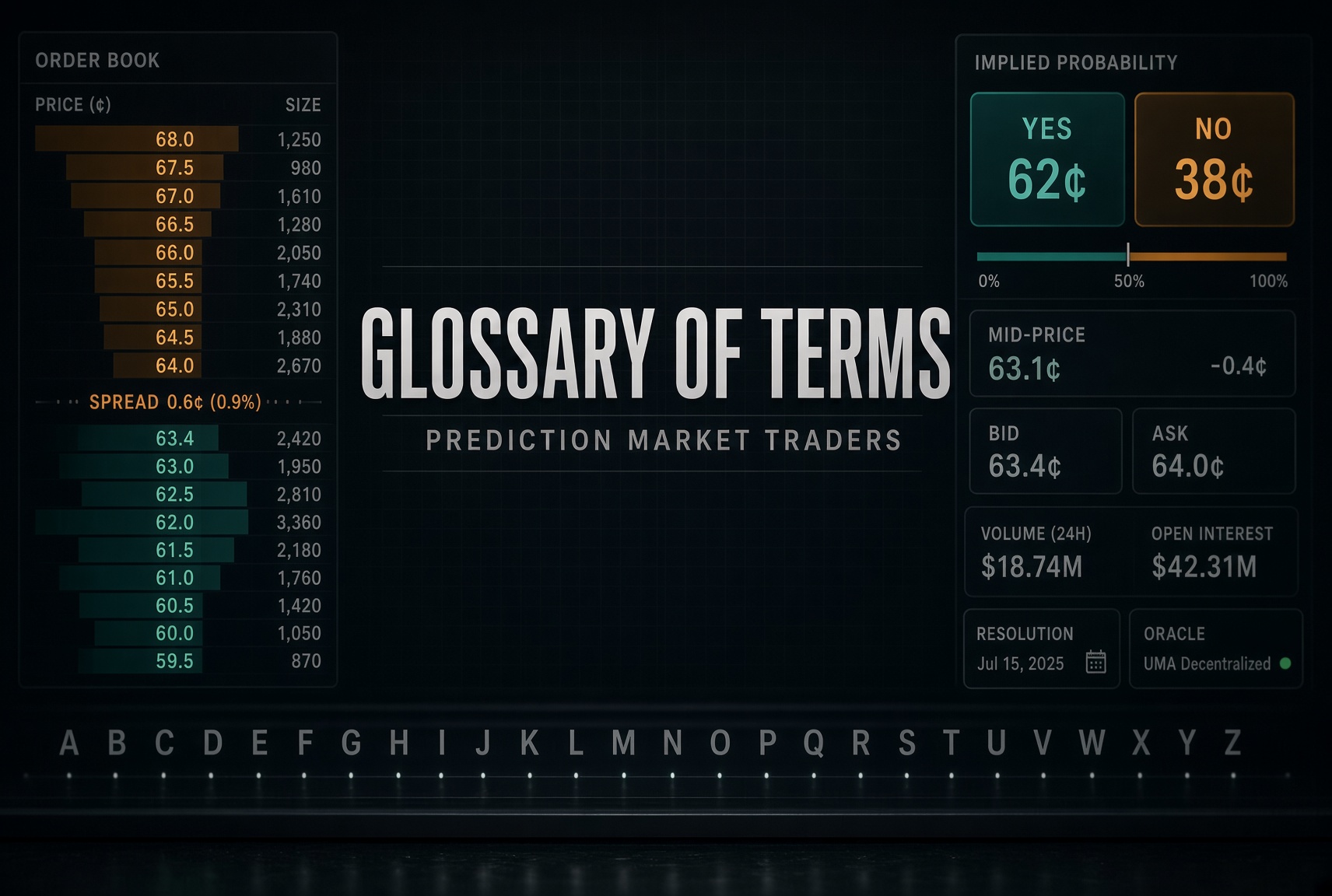

Polymarket accuracy is often debated, as Polymarket calls itself “the world’s largest prediction market” — a real-time truth machine that outsmarts polls, pundits, and the media. Politicians monitor its odds. Traders move millions on its numbers. CBS News’ 60 Minutes dedicated a segment to it.
But how accurate is it really — across different categories, different liquidity levels, and different types of events?
We spent months tracking 50 markets across politics, crypto, sports, economics, and geopolitics — from opening odds through final resolution. We layered in data from independent researchers, academic studies, and on-chain analytics to produce the most complete picture we could find.
What follows challenges the headline narrative in ways every Polymarket trader needs to understand.
The Headline Numbers — And Why They’re Misleading
Polymarket’s Accuracy Dashboard, launched October 2025, reports 95.2% predictive precision across resolved markets. Data scientist Alex McCullough’s independent Dune Analytics analysis broadly supports this, finding the platform achieves 90.5% accuracy one month before resolution, climbing to 94.2% in the final four hours.
On paper, that’s extraordinary. But here’s the problem buried in those numbers: they are almost entirely measured near resolution — when outcomes are already near-certain. A market sitting at 97% “Yes” that resolves “Yes” counts as a correct prediction. That isn’t forecasting. That’s arithmetic.
Fensory Research, in a February 2026 independent analysis of Polymarket’s track record since 2023, found the platform achieves 73% accuracy across the full market lifecycle — from opening odds through resolution, across all categories. That’s still better than traditional polls (68% in comparable political predictions) but a far cry from 95%.
Want a deeper comparison? Read our guide on Are Prediction Markets More Accurate Than Polls? where we compare forecasting methods, explain why markets often outperform surveys, and identify the situations where traditional polls remain the better tool.
The gap between 95% (near-resolution, cherry-picked categories) and 73% (full lifecycle, all categories) is the single most important figure in this article. Understanding why that gap exists is what separates sophisticated traders from the retail crowd.
Accuracy Broken Down by Category
Not all Polymarket categories are created equal. The platform’s accuracy varies dramatically depending on what you’re trading.
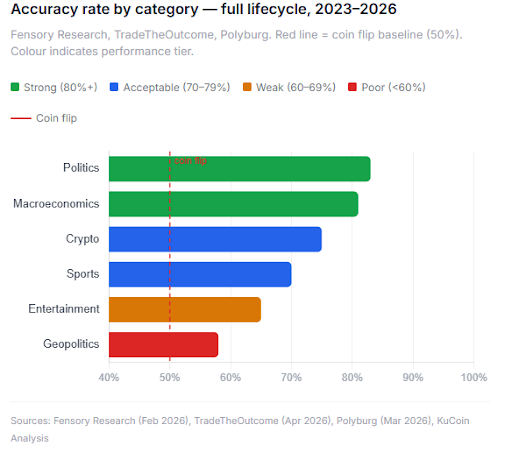
Politics is where Polymarket earns its reputation. The platform correctly predicted 23 of 28 major 2024 election results — outperforming traditional polling aggregators that showed systematic candidate-favouring biases. The US Presidential market tracked within 3% of final vote shares as results came in on election night.
Sports tells a different, uncomfortable story. Now the platform’s largest category by volume — at 39% of all trades — sports markets show significantly weaker calibration. One multi-platform study examining $2.5 billion in combined volume found sports prediction markets achieving a Brier score equivalent to worse than random chance in some sub-categories.
Crypto performs better than sports but worse than politics. The key variable is time horizon: short-window crypto markets (30 days or less) are well-calibrated with professional participants. Long-horizon markets like “Bitcoin to $100K before January 2025” — which Bitcoin did reach — produced a catastrophic Brier score of 0.49 because the market was confidently wrong for months before surging to certainty in the final days.
Geopolitical markets — despite generating headline-grabbing volume around events like Venezuela, Iran, and Ukraine — show the weakest calibration on the platform. Low information flow, ambiguous resolution criteria, and susceptibility to insider trading make these the most dangerous category for retail traders.
Understanding Brier Scores — The Real Accuracy Metric
A percentage accuracy figure (“got it right 81% of the time”) hides the most important dimension: how confident the market was when it was wrong. A market that says 90% and is wrong once is catastrophically worse than one that says 55% and is wrong once.
| Brier Score | Rating | What It Means |
| 0.00 – 0.05 | Perfect | Near-certain events called correctly |
| 0.05 – 0.15 | Excellent | Strong calibration, good forecaster |
| 0.15 – 0.25 | Acceptable | Better than random, usable signal |
| 0.25 | Coin flip | No forecasting value |
| 0.25 – 0.50 | Poor | Worse than guessing |
| 0.50 – 1.00 | Terrible | Confidently, consistently wrong |
Polymarket’s platform-reported Brier score across all resolved markets is 0.0843 — excellent by this measure. But when independent researchers apply it to the full market lifecycle and all categories, including the tail of low-liquidity, ambiguous markets, the figure rises to 0.15–0.20. Still acceptable but no longer elite.
Two specific markets illustrate why averages deceive.
Bitcoin to $100K before January 2025: Correct resolution — Bitcoin hit $100,000. Brier score: 0.4909. The market priced it as unlikely for the majority of its life before surging in the final weeks. Getting the right answer via the wrong path is still terrible forecasting by Brier methodology.
Kamala Harris winning the 2024 Democratic nomination: Correct resolution. Brier score: 0.9098 — near the worst possible score. The market was confidently wrong for so long that a correct endpoint couldn’t redeem it statistically.
These aren’t anomalies. They’re a feature of how volatile, sentiment-driven markets behave when retail traders dominate price discovery early in a market’s life.
The 3% Problem — It’s Not the Crowd
The foundational argument for prediction markets is the “wisdom of crowds”: thousands of participants, each with partial information, collectively producing better forecasts than any single expert.
A working paper published in April 2026 examined every Polymarket trade from 2023 to 2025, running 10,000 simulations per trader to separate skill from luck. The finding was stark: roughly 3% of traders account for the majority of accurate price discovery on the platform. The crowd is noisy. A small group of sophisticated, well-resourced participants moves prices toward reality — and retail follows.
Separate on-chain analysis confirmed this: approximately 63% of Polymarket’s total volume is concentrated in the top 0.23% of wallets.
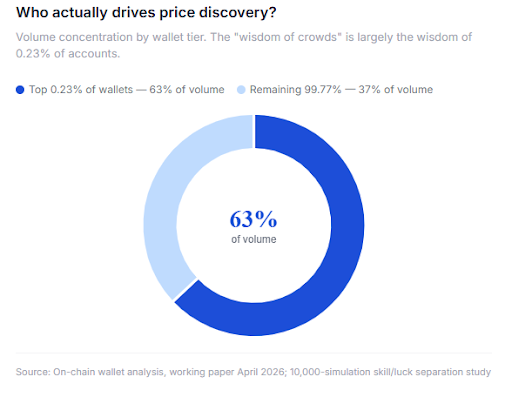
Of the biggest apparent winners by raw profit, only 12% were found to be genuinely skilled when luck was controlled for. Roughly 60% of apparent winners turned into losers when their strategy was tested against a separate set of events.
This reframes the accuracy argument entirely. You are not trading against the wisdom of crowds. You are trading against a small number of professionals who make the market accurate — and everyone else following their signals.
Accuracy Improvement Over Time — The Learning Curve
One genuine positive in the data: Polymarket has demonstrably improved over time as user sophistication increased and liquidity deepened.
Early 2023 markets showed 67% accuracy. By late 2024, that had risen to 76%. The platform’s 2024 election accuracy was the highest it had ever recorded for a political cycle.
The trend is real and attributable to three factors: more professional traders entering the market, deeper liquidity on high-profile events making manipulation harder, and improved resolution criteria following high-profile disputes. Technology and Science markets grew 1,637% year-over-year in 2025. Economics markets followed at +905%. The market is maturing — but unevenly across categories.
The Insider Trading Problem
The Venezuela story is the most documented case of what critics argue is a structural flaw in Polymarket’s design.
In early January 2026, a single anonymous wallet placed $32,000 on “Maduro out of power by January 31, 2026” — hours before US special forces captured Venezuelan President Nicolás Maduro in Caracas. By the time Maduro was aboard the USS Iwo Jima heading to New York, that $32,000 had become approximately $410,000 — a 1,242% overnight return.
Three wallets were scrutinised for making concentrated bets on Venezuela-related outcomes just ahead of the US operation. One wallet was subsequently deleted. Sonar Pro, a platform that tracks top Polymarket trades, noted the trader had an “ultra-concentrated” strategy focused exclusively on geopolitical events and had bet on nothing else — no sports, no crypto.
Trump later announced Venezuelan leakers had been jailed. Congressional members introduced legislation targeting prediction market insider trading. Former SEC chief of staff Amanda Fischer publicly described one situation involving market manipulation as “very illegal.”
This was not the first incident. During the 2024 presidential election, a French national controlling four accounts — operating under usernames Fredi9999, Theo4, PrincessCaro, and Michie — placed a combined $45 million in pro-Trump bets. One account, Theo4, made as many as 71 bets per minute and 2,500 bets in a single 24-hour period. The market shifted dramatically toward Trump in ways that diverged from every polling aggregator showing a near-tied race. Polymarket’s investigation found no evidence of manipulation. The French trader later reportedly made over $80 million on the position.
Whether either case involved genuine insider information or simply better private polling research is unresolved. What is undeniable is that the structure of an anonymous, crypto-based, decentralised platform creates conditions that are extremely difficult to police — and that concentrated positions by sophisticated actors can and do move markets in ways that disadvantage retail participants.
The Resolution Dispute Problem
The Venezuela story has another dimension beyond insider trading: the resolution itself became contested.
US forces entered Venezuela, captured its head of state, and removed him from power. Polymarket resolved the “US invades Venezuela” market “No” — because the resolution criteria defined invasion as “a military offensive aimed at controlling any part of Venezuelan territory.” Capturing the president and transporting him to New York did not, by the contract’s specific language, constitute controlling Venezuelan territory.
The market was arguably right about what would happen. It resolved against what happened.
This is not an isolated case.
| Market | Volume | Actual Outcome | Resolution | Why Contested |
| US invades Venezuela | $87M+ | US forces captured Maduro | No | Criteria defined invasion as territorial control |
| Zelenskyy wears a suit | ~$79M | Multiple outlets confirmed yes | Disputed repeatedly | Alleged Discord coordination to push No |
| US-Ukraine mineral deal | Unspecified | No deal signed | Yes | Resolved verifiably against reported facts |
| Kamala Harris nomination | High | Won nomination | Correct | Brier score 0.9098 — confidently wrong throughout |
The UMA oracle system Polymarket uses to resolve disputes creates its own problem: token holders who vote with the minority are financially penalised. This creates structural incentive to vote with the perceived majority regardless of what actually happened. A coordinated group moving resolution in their preferred direction is not just possible — the mechanism makes it rational.
Wash Trading — The Fake Liquidity Problem
A Columbia University study published in November 2025 found that wash trading — artificial volume created by the same party buying and selling to inflate apparent activity — accounted for an average of 25% of Polymarket’s activity over three years, with peaks reaching approximately 60% in December 2024 during post-election volume spikes.
CertiK analysis independently flagged wash trading at similar levels. The implication matters because liquidity is the mechanism that is supposed to make prediction markets work. More real money at stake means more incentive to find the truth. But if a quarter of that volume is artificial, the depth signal is partially fabricated — and artificially liquid markets can be moved by informed traders more easily than genuine depth suggests.
Polymarket has not publicly addressed the Columbia findings. The platform’s $5 billion annual volume milestone in 2024 and $1 billion valuation may be partially built on inflated numbers — a caveat that Paradigm research flagged directly, noting that some Polymarket volumes may be double-counted.
Polymarket vs Traditional Forecasting: The Honest Comparison
Despite all of the above, Polymarket does outperform the alternatives on well-suited events:
| Metric | Polymarket | Traditional Polls | Expert Forecasters |
| 2024 Election accuracy | 81–85% | ~73% | ~76% |
| Average Brier score (politics) | 0.08–0.12 | 0.22–0.25 | 0.18–0.22 |
| Speed of updating | Real-time | Days/weeks | Days/weeks |
| Sports accuracy | 67–72% | N/A | ~65–70% |
| Crypto accuracy | 72–78% | N/A | ~60–70% |
| Geopolitical accuracy | 55–65% | ~55% | ~58% |
Sources: Fensory Research, Polyburg, TradeTheOutcome, multiple academic analyses 2024–2026
Polymarket genuinely beats traditional polls in political forecasting — by roughly 8–12 percentage points on average. It updates faster than any human forecast. And for events with deep liquidity and clear resolution criteria, it remains the most efficient real-time probability available.
But for sports — now the platform’s largest category — the accuracy advantage largely disappears. And for geopolitical events with ambiguous resolution criteria, all bets are off..
The Favourite-Longshot Bias
One structural finding emerges consistently across independent analyses: Polymarket suffers from the same psychological bias that afflicts traditional prediction markets — the favourite-longshot bias.
On-chain data analysis reveals that contracts priced at 90 cents resolve successfully less than 90% of the time. Contracts priced at 10 cents resolve successfully more than 10% of the time. Retail traders systematically overpay for perceived certainty on high-probability outcomes and underprice low-probability events.
This creates a directional edge for sophisticated traders: fade public sentiment in overconfident high-probability markets and look for value in neglected low-probability markets where retail participation is thin. Polyburg’s calibration analysis (2024–2026) found that events predicted at 70% happened 68–72% of the time — excellent calibration in the middle of the range. The distortions are at the extremes.
What This Means for You as a Trader
After 50 markets and months of tracking, here is our honest, evidence-based verdict:
Trade with confidence in: Binary political markets with clear resolution criteria and deep liquidity. Federal Reserve and macroeconomic event markets where professional participants dominate. Major league sports championships where historical data and sharp bettors move prices.
Trade carefully in: Crypto milestone markets — check the time horizon. Short-window crypto markets are reliable; multi-month crypto markets have historically been poorly calibrated even when they resolve correctly. Check the Brier score history on comparable past markets before sizing a position.
Treat as speculative: Geopolitical markets, any market with ambiguous resolution language, entertainment and celebrity markets, and any market under $50,000 in open interest. In thin markets, a single large trader can move the price — and that trader almost certainly knows more than you do.
Always do this before entering any market:
- Read the full resolution criteria, not a summary. The Venezuela market resolved on a technicality that was visible in the criteria before the US operation.
- Check open interest depth, not just volume. High volume with low open interest signals wash trading or rapid position flipping.
- Ask who has an informational advantage. In political and geopolitical markets, the answer is often “people with government or military access you don’t have.”
- Watch for ultra-concentrated wallet positions. If one or two wallets hold the majority of a market’s open interest, you are providing liquidity to someone who may have information you don’t.
Conclusion
Polymarket vs Reality across 50 markets: the platform is genuinely impressive on a specific set of events — and genuinely dangerous on the events retail traders are most attracted to.
The 95% accuracy headline applies to political and macro markets, measured near resolution. The 73% figure applies to the platform as a whole. The 3% of traders driving accurate price discovery are not you. The 25% wash trading baseline means the liquidity signal is partially fake. And the UMA resolution system has produced outcomes that contradicted observable reality in high-profile, high-volume markets.
None of this means you shouldn’t use Polymarket. It means you should use it eyes open — understanding which category you’re in, what the resolution criteria actually say, and who else is likely holding a position in the market you’re considering.
We’ll keep tracking. Follow PolyPunter for our ongoing market accuracy series — updated monthly with new resolutions, accuracy breakdowns, and the specific markets where we think the current odds are mispriced.