
You might have placed a bet on DraftKings at some point. Maybe it was a Sunday NFL parlay, a March Madness bracket or a late-night prop bet. It felt like gambling — because it was. Now there’s a different kind of platform gaining serious ground, one where you’re not trading against a sportsbook but trading against other people on real-world events. Kalshi, the first federally regulated prediction market in the US, is drawing economists, finance professionals and informed everyday people who want a stake in what happens next.
The question isn’t just “which platform is better.” It’s deeper: what kind of bettor — or trader — do you actually want to be?
What are Kalshi and DraftKings, really?
DraftKings is a sportsbook. It sets the odds. It takes a cut — the “vig” or “juice” — on every bet. The house is specifically designed so that, on average, you don’t win. That’s the business model. Kalshi is a prediction market. When you buy a “Yes” contract, someone else takes the “No” side. Kalshi charges a small fee on each trade and is not your opponent. The market is your opponent — and it’s made of other informed people.
DraftKings
Sports wagering model
- House sets and holds the odds
- Vig built into every bet (4–8%)
- You bet against the sportsbook
- State by state licensing
- Regulated as gambling
Kalshi
Prediction market model
- Crowd sourced pricing
- 1–3% fee per trade only
- You trade against other participants
- Federal CFTC regulation
- Treated as financial instrument
The difference in one sentence: DraftKings profits when you lose. Kalshi profits when anyone trades — your outcome is irrelevant to its revenue.
How Kalshi prediction markets work
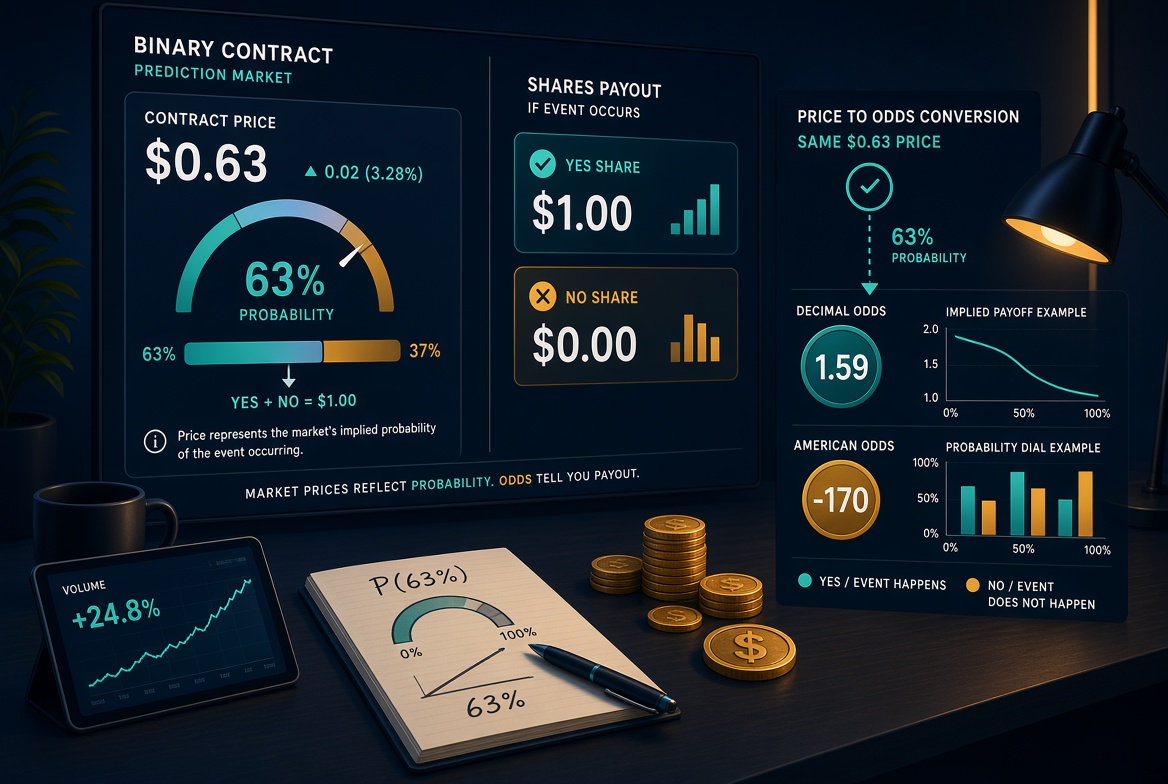
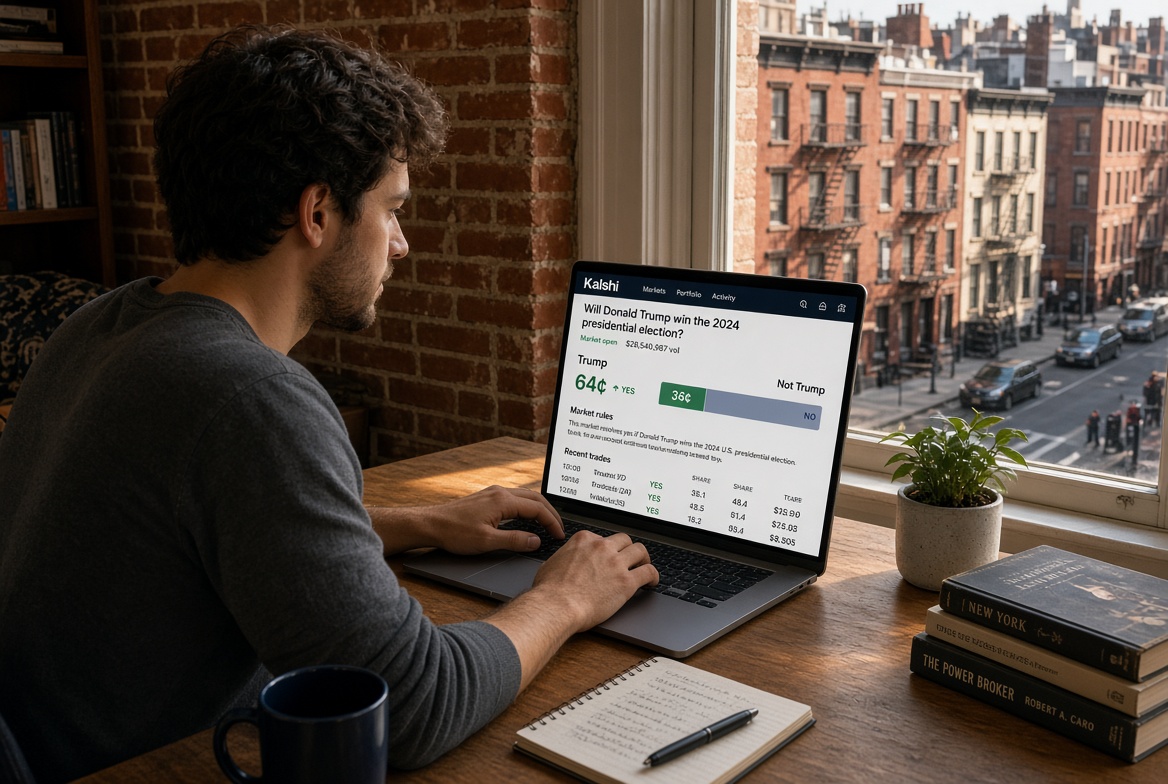
Kalshi organizes everything around a simple binary question: will this event happen, yes or no? Every market is a contract that pays $1.00 if the outcome occurs, or $0 if it doesn’t. The price at any moment reflects the market’s consensus probability — a contract priced at $0.65 means traders collectively think there’s a 65% chance of that event happening.
You’re not trading against odds set by a bookmaker — you’re trading against other people who see things differently.
WORKED EXAMPLE — CELTICS TO WIN THE NBA FINALS | |
| Contract price (market’s implied probability) | $0.70 per contract (70%) |
| Contracts purchased | 100 contracts |
| Total spent | $70.00 |
| If Celtics win — contracts settle at $1.00 | +$30 profit (before fees) |
| If Celtics lose — contracts expire at $0 | −$70 loss |
The key feature that separates Kalshi from traditional sportsbook is you can sell your position before the event resolves. If you bought at $0.70 and sentiment shifts the contract to $0.85 mid-series, you can exit early and lock in profit without waiting for game seven.
How DraftKings sportsbook works?
DraftKings sets lines on sporting events, you place a bet, and DraftKings takes the opposing side. The profit mechanism is the vig — also called juice — baked invisibly into every set of odds it shows you. A fair 50/50 bet would give +100 on both sides. DraftKings typically shows -110, meaning you stake $110 to win $100. That gap is the house’s cut and you never see it as a line item.
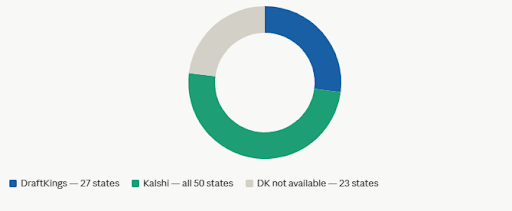
DraftKings also launched its own prediction market product in late 2025 to compete with Kalshi directly. But it’s available only in the ~27 states where DraftKings holds a sportsbook license, versus Kalshi’s 50-state federal coverage.
Side-by-side comparison
| Feature | Traditional Sportsbook (DraftKings) | Prediction Market Exchange (Kalshi) |
| Regulated by | State gaming boards | CFTC (federal) |
| Business model | Acts as the house | Exchange / marketplace |
| Revenue source | Vig on bets | Flat fee per contract |
| State access | ~27 states | All 50 states* |
| Market types | Sports, fantasy, casino | Sports, politics, finance, climate |
| Bet format | Moneyline, spread, parlay | Yes/No event contracts |
| Exit early? | Live only | Yes, sell anytime |
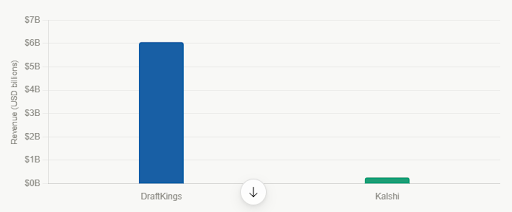
| 2025 revenue | $6.05 billion | ~$260M (+994% YoY) |
Note: MA, NV, and AZ have ongoing legal disputes over federal court rulings on Kalshi sports contracts. Verify your state before depositing.
| 3.76M | $1.9B | $11B |
| Kalshi app downloads Q4 2025 — more than DraftKings and FanDuel combined | Kalshi college basketball wagers in a single month, March Madness 2026 | Kalshi valuation after December 2025 Series E funding round |
The fee breakdown: what you’re really paying
This is where the two platforms diverge most sharply — not just in the amount, but in how the cost is presented to you.
Kalshi’s fee structure
Kalshi charges a flat 2 cents per contract on every trade, entry and exit. No platform fees, no inactivity fees, no ACH deposit or withdrawal fees. Debit card transactions carry a 2% processing fee. On a $100 position in a 50/50 contract, your all-in entry cost is roughly $1.75 — visible, fixed, and identical regardless of the event.
DraftKings’ vig
DraftKings builds its profit into the odds. The vig range from ~4.55% on NFL and NBA spreads up to 15% on niche markets like golf outrights. You never see it itemized — it’s structural.
| Market Type | Kalshi Cost | DraftKings Vig | Winner |
| NFL / NBA spread | ~$1.75 per $100 | ~4.55% | Kalshi |
| MLB moneyline | ~$1.75 per $100 | ~4.35% | Kalshi |
| Golf outright winner | ~$1.75 per $100 | ~15% | Kalshi by far |
| Politics / economics | ~$1.75 per $100 | Not available | Kalshi only |
| Same-game parlay | Available (combos) | Available (higher vig) | Depends |
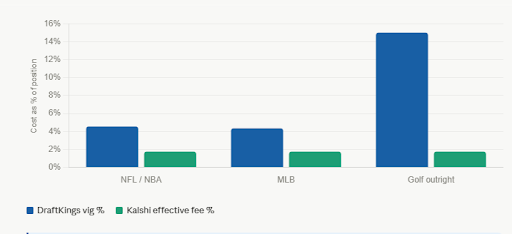
Why vig matters more than it looks: A 4.55% vig on every every NFL position means you need to win 52.4% of your bets just to break even. Kalshi’s flat fee creates no such headwind.
“The all-in cost of activity on Kalshi is highly competitive against both prediction-market alternatives and against equivalent sportsbook vig at conventional sportsbooks. Fee transparency is excellent.”
— Tech-Insider.org, Kalshi Review June 2026
State availability: who can use what
DraftKings holds sportsbook licenses in roughly 27 states plus DC and Puerto Rico — about 53% of the US population. If you’re in California, Texas, Florida, or any state without legal online sports wagering, DraftKings isn’t available to you for real-money wagering.
Kalshi is governed by federal law, allowing it to operate in all 50 states — including the large locked-out markets that explain much of its explosive 2025 growth. Some states have filed legal challenges arguing its sports contracts constitute unlicensed gambling. Cases in MA, NV and AZ were unresolved as of mid-2026. Always verify your state before depositing.
What you can actually participate on
DraftKings covers sports almost exclusively — NFL, NBA, MLB, NHL, college sports, golf, MMA, soccer, and growing international leagues, with thousands of prop markets during peak season. It also offers daily fantasy and iGaming in select states.
Kalshi’s sports selection is growing but narrower per sport. Where it truly wins is outside sports entirely :
- Politics — election outcomes, policy decisions, legislative events
- Economics — Fed rate decisions, inflation readings, jobs reports
- Finance — whether a stock index hits a specific level by a date
- Climate — temperature records, hurricane activity, wildfire events
- Technology — AI model releases, product launches, regulatory rulings
- Pop culture — awards shows, box office results, entertainment outcomes
Kalshi is a market for any verifiable real-world outcome — not just ones involving athletes.
Which platform should you use?
The honest answer is neither is universally better — they’re tools for different jobs. Your choice comes down to where you live, what you want to bet on, and how you think about cost.
| Choose DraftKings if… | Choose Kalshi if… |
| ✓ You’re in a legal sportsbook state and primarily bet on sports | ✓ You live in a state where sportsbook is still illegal |
| ✓ You want player props, same-game parlays, and live depth | ✓ You want to trade on politics, economics, finance, or pop culture |
| ✓ You already have an account with daily fantasy and iGaming access | ✓ You prefer a transparent flat fee over hidden vig |
| ✓ You prefer traditional moneyline and spread formats | ✓ You want to exit positions early as odds shift before resolution |
Many experienced bettors use both — DraftKings for sports depth, Kalshi for everything else and for states DraftKings can’t serve. As DraftKings keeps investing in its own prediction market product, the overlap will grow.
Frequently asked questions
No. DraftKings is a licensed sportsbook that acts as the house — it sets odds and profits when you lose. Kalshi is a CFTC-regulated prediction market exchange that charges a flat 2-cent fee per contract and doesn’t take the other side of your trade. The regulatory frameworks, business models, and underlying mechanics are completely different.
Kalshi is federally regulated by the CFTC, which gives it the legal basis to operate nationwide. However, some states — including Massachusetts, Nevada, and Arizona — have active legal disputes over whether Kalshi’s sports-event contracts constitute unlicensed gambling under state law.
Kalshi charges a flat 2 cents per contract traded — roughly $1.75 on a $100 near-50/50 position. DraftKings builds its profit into the odds via the vig: approximately 4.55% on NFL and NBA spreads, rising to 15% on niche markets like golf outrights. Kalshi is generally cheaper on a cost-per-dollar-risked basis and its fees are transparent rather than hidden in the price.
Yes, but only if you have a genuine informational edge. People who closely follow Fed policy, elections, or macroeconomic data consistently outperform. Without real domain knowledge, you’ll break even at best.
This refers to a widely circulated story about a Kalshi trader who bought large positions on election night contracts just before results became clear. It wasn’t prediction — it was either inside information, extreme risk-taking, or being first to react to public data. Not replicable as a strategy.
DraftKings is more immediately familiar for anyone who has followed sportsbook. Its odds formats, app design and markets are what most casual bettors expect. Kalshi has a moderate learning curve — the contract-based system is intuitive once you understand it, but it’s different from traditional. New users can start with a beginner’s guide to trading on Kalshi before risking real money.
Yes. Because Kalshi is regulated federally by the CFTC as a designated contract market — not a gambling platform — it operates nationwide without needing individual state licenses. There are some international restrictions outside the US.
The bottom line
If you’re using DraftKings and you enjoy it, that’s a legitimate choice. Recreational sportsbook activity is legal, social, and genuinely fun. Just be clear-eyed: the edge is against you structurally, and entertainment is the product you’re buying.
If you’ve never looked at Kalshi, it’s worth taking seriously — particularly if you follow economics, politics, or any specific industry closely enough to form opinions before the consensus catches up. The ability to put real money behind macro views, with federal regulatory protection and no house edge, is a genuinely novel opportunity.
The uncomfortable truth: most people on DraftKings don’t have the edge they think they do, while many of those same people have genuine expertise in areas Kalshi covers. Maybe you’ve been focusing on the wrong category of knowledge all along.