Scooby Doo mysteries always took a supernatural and inexplicable phenomenon and explained it ultimately as a criminal human conspiracy. All it took was a mask reveal, and the ghost or monster turned into the greedy fraudster who stood to profit from his haunting. But, of course! Goblins don’t exist in the real world; shady people, in contrast, are fairly ubiquitous.
We know insider trading exists on prediction market platforms, as self-reported by Kalshi and Polymarket, and in recent federal indictments. We can’t precisely measure the scope. But there has been an obvious profit incentive for military members to trade on war events, a Mr. Beast video editor to trade on Mr. Beast social media events, and a Google technical engineer to bet heavily on Google trending results. To name a few. As in other trading markets, individuals with a financial motive and insider information are drawn to the scheme. This despite warnings from the platforms and potential consequences from the Feds. This is human nature.
On primary election night in California, June 2nd, at almost precisely 9 pm, an hour after all polls had closed and no additional voting was (legally) possible, something rather mysterious occurred on Kalshi. Not to cross-comic the analogies, but it set the Spidey-senses tingling for any veteran market watcher.
The Background of the Los Angeles Mayoral Race
The Los Angeles Mayoral primary is unique in that if any candidate receives 50%+1 of the overall vote, they become the Mayoral winner outright. If no candidate achieves a majority of all votes, as is often the case in a crowded field (this year had 14 candidates on the ballot), then the top two vote-getters advance to a runoff in November during the general election.
Despite low approval ratings and a number of high-profile mishaps while in office, incumbent and career politician Karen Bass was fully expected to, and anointed by all prediction markets, as the clear favorite to be the top vote-getter in the June 2nd vote. While numerous other candidates were running, the anticipated battle for months was for the 2nd runoff spot between social media star Spencer Pratt and sitting City Councilwoman Nithya Raman. Pratt was viewed as the “Republican” in the race, despite it being a no-party-listed contest. Meanwhile, Raman is a member of the left-leaning Democratic Socialists party, a fast-growing party in Los Angeles politics.
Pratt’s candidacy came about after his family home burned down in the Palisades fire of January 2025. The conflagration destroyed the Palisades area of Los Angeles, with residents placing heavy blame on Mayor Bass and the current administration for failing to prevent and fight the wildfire. Pratt went from an outspoken voice for Palisades residents to a full-fledged run for Mayor with serious backing.
As a media-savvy candidate, Pratt quickly gained popularity through independently created viral AI campaign videos from his supporters. His TV debate performance, where he appeared serious, well-versed, and appeared to clean the clocks of both Bass and Raman, solidified him as a serious challenger. Both polling and prediction markets took his chances at a second-place finish very seriously, with Pratt leading the Kalshi market for an extended period.
That is, until 9 pm on Election Night.
What We Know For Sure That Happened
Most public polls had been showing Pratt in second place behind Bass leading up to the election. A few had Raman in second, a tick ahead of Pratt. Others had Pratt as high as first place, edging out Bass in the days prior to June 2. The prediction markets held steady with Bass, Pratt, and Raman in that order of anticipated finish. Though not extreme probabilities in either direction.
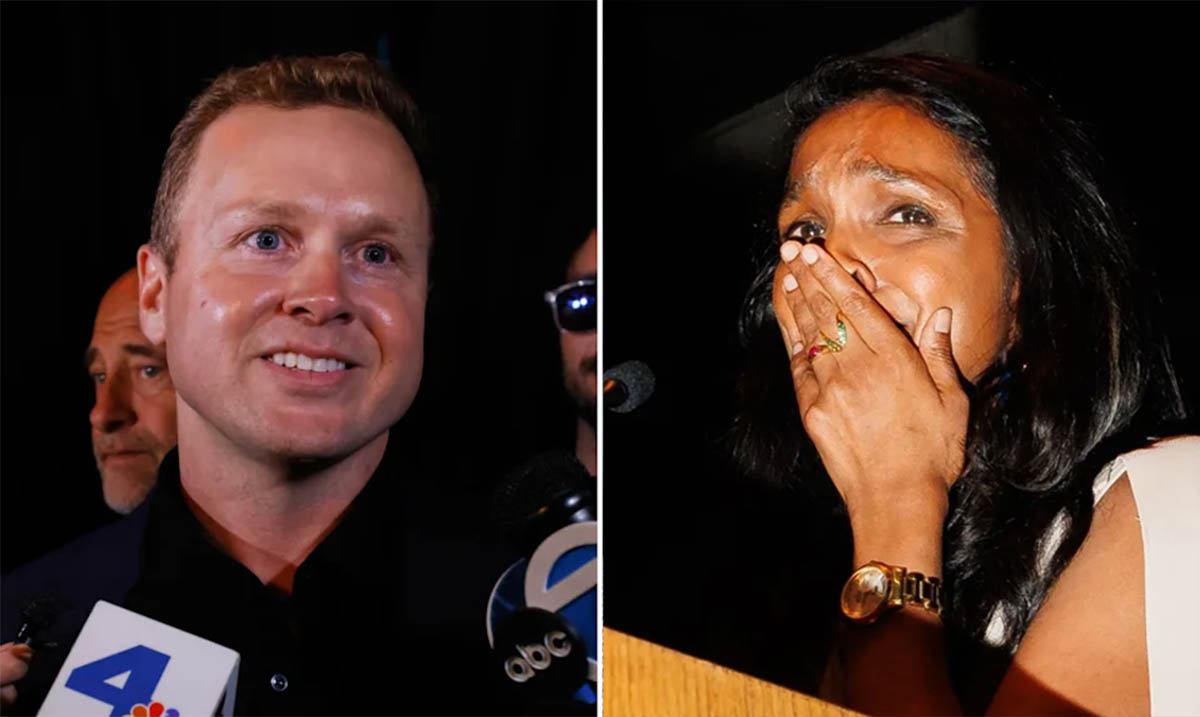
This is how the local ABC station reported the results at 8:41 PM on June 2, 2026, forty-one minutes after the polls closed:
At about this time, people watching post-election events unfold on television were watching Nithya Raman give a tearful speech about a hard campaign to her assembled supporters in downtown Los Angeles, and Pratt’s campaign having what appeared to be a celebration at Don Antonio’s, a Mexican restaurant on the west side of Los Angeles. Neither group was declaring victory or surrender, but the mood and optics were rather noticeable. Combined with these numbers from local media outlets, the Pratt vibe was high, while the Raman vibe was despair.
Throughout the 24 hours leading up to the close of the polls on Election Night, the Kalshi market for the Los Angeles Mayor Winner remained very steady, with Bass at 68.9%, Pratt at 21.7%, and Raman at 9.4%. This was a two-leg market, as a candidate had to finish 1st or 2nd to qualify for the runoff for the Mayoral election in November, naturally incorporating first-leg odds into the ultimate winner forecast.
In related markets, the “Bass-Pratt” probability for the 1-2 run-off positions was at 69%, while “Bass-Raman” was at 32%. Another clear indication from the market that Pratt was expected to take the second spot over Raman. Both of these event markets were highly active, with trading volumes in the millions and strong liquidity.
And Then, 9 PM Happened.
In the primary Mayoral election market for the outright Mayoral Winner, at or about 9 PM, the Pratt probabilities plummeted. It was sudden, fast, and significant. Within a minute or two, Pratt, who had been at a very steady 21.7%, dropped suddenly to 12.8%. A 41% drop, just like that.
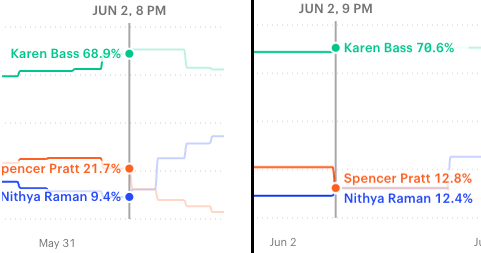
Raman was the primary beneficiary of the sharp, sudden drop, moving into a near-tie with Pratt on Mayoral Winner odds, while Bass also jumped up a couple of points. This, despite the number of actual vote counts posted, with Pratt closer to Bass in first place than to Raman in third, now circulating on TV and online. No other official public information was released at this time.
This begs the question, what happened at 9 PM on Election Night to cause Spencer Pratt to drop from a clear second-place expected finisher?
What Caused the Sudden Precipitous Drop in Expected Probabilities for Spencer Pratt
The short answer is, nobody knows. Not yet. Maybe we’ll never know, but knowing the intensity of both online user digging and likely federal probes to come, we may know most, or all one day.
For now, we’re left with speculation about the murder of the Pratt probabilities. There are two major theories being put forth. (A third was a “pump and dump” scheme on election night itself for those who were facing losses on Raman. But given the events since that evening, with ballots coming in substantially much higher for Raman continuously, a pump and dump scheme seems incredibly unlikely to be the answer.)
Theory 1. The “Left” in Los Angeles/California Elections Rigged the Campaign So Pratt Would Never Have a Shot
This is perhaps the most popular social media theory. It’s rooted in some circumstantial facts, such as the fact that no Republican has won a statewide election in over 16 years. Additionally, viewing expected victories for Republicans in races and ballot measures that appeared to poll popularly, only to see defeat after extended post-election vote-counting days.
Adding fuel to this narrative is the rather massive overhaul of California’s election process by a supermajority of Democrats in the state legislature and a Democratic Governor. The enacted changes on their face, appear to favor higher levels of Democratic-leaning voter participation. This would include universal mail-in ballots, legalizing ballot harvesting, and prohibiting the use of any form of ID when screening voters. Perhaps the culmination was the recent gerrymandering of the states’ Congressional districts in 2025 to more favorably shape Democratic candidates’ outcomes. Governor Newsom himself openly touted this gerrymander as providing more Democratic safe seats.
This “rigged” theory is entirely circumstantial at the moment, and we believe pretty weak, but it raises an important question about what was seen on Kalshi on election night. If market traders believed the election was rigged against Pratt, why were they buying into Pratt before, during, and even for an hour after the election?
A rigged election, or fears of it, couldn’t logically have taken hold suddenly at 9 pm that evening. If you believed the Democratic establishment were going to cheat to make sure Pratt never had a legitimate chance, you would have believed this all along. There was no new (public) information to suddenly believe in rigging. Raman was crying. Pratt was celebrating. Certainly, they didn’t believe it was rigged against Pratt. Barring a Deep Throat-like informant coming forward with evidence of such rigging, the theory doesn’t hold much water at least with respect to prediction market trading and crowd consensus.
Theory 2. The Way Los Angeles Counts Votes Meant that Pratt’s 30% Second Place Was Actually A Serious Underperformance
We could spend hours discussing the wackiness that is the California voting systems. There’s really nothing else like it in the country, some say, in the world. California mails real ballots to all 23 million people on its voter rolls. Those voter rolls are badly outdated and riddled with mistakes, so there are endless stories about people who’ve moved, died, or even about cats getting ballots in the mail.
Suffice it to say, four weeks before every election, everybody on the list gets a ballot and a no-postage-necessary return envelope. You can mail these ballots at any time, including on Election Day itself. Or you can drop them off in Vote Drop Boxes stationed around cities or at in-person polling stations on Election Day. California law allows them to arrive at Election Offices for up to 7 days after Election Day (a policy legal watchers expect SCOTUS to overturn soon as unconstitutional ). Then there are issues with unsigned ballots, provisional ballots, ballots handed in by third parties, etc, etc., until your head will spin. The overarching theme: we will make it as easy as humanly possible to cast votes even if we have to torture election standards to do so..
This leads to the notorious counting issue puzzles of California.While most states declare their election results in hours after polls close, California counts in slow plodding batches. The Los Angeles City elections are counted by Los Angeles County Election Officials, under the County Registrar-Recorder. And they count in-person voting, mail-in voting, drop-off voting, from stations and boxes all around the city.
Slow, Batch Counting Opens The Doors For So Many Issues
In most locales, where election results are posted in a timely manner, voters are unaware of how the counts proceed because all batches are aggregated and winners and losers are posted in short order. When you’re in Los Angeles, and your count can take many days, or even stretch into weeks, and you’re releasing partial counts daily, the “batches” become a hotly contested issue.
When you release voting updates in small batches, you create a public information and sentiment disaster. In an already low-trust environment surrounding elections, you’re now revealing often dramatically different candidate results each day. It’s jarring, makes election watchers and market traders alike uneasy, and invites all kinds of conspiracy theories about why a candidate could receive 40% of the vote one day and 20% the next. These are major, outcome-altering updates, dribbling out day by day.
Now, it is possible that somebody with an understanding of how the counting batches were to occur — voting methods, neighborhoods of the city, differing demographics, past results with similar candidates — could algorithm up a smart formula to show that Pratt’s second place, 30% showing on Election Night, was not the success the general public and media made it out to be. Maybe the 30% was a mathematical harbinger of failure. But even if the advanced math was possible, you’d have to ask how that person, or persons, would have access to the necessary votes counted and not-counted specifics.
Does This Mean Insider Information Occurred?
We strongly believe it has to be considered. Though far from certain, and at this moment, certainly without official legal evidence.
It is possible that somebody developed formulae based on previous election cycles in Los Angeles and definitively concluded that 30% was a sign Pratt was doomed. All without any insider information. Then they started dramatically shifting trades 20-30 minutes after the first results were announced, and they’d run their algos. Perhaps others who had no information panicked and followed suit, and there goes the “What Happened at 9 PM” answer. That is all possible. Just not what we believe happened.
Until official investigative authorities dig into these types of trading details, it’s hard to rule anything in or out. But there are those Spidey-senses. Or Occam’s Razor, perhaps. Whichever of these you point to support the most likely reason being true. In this case, we believe that is squarely in the insider tip-off camp.
Walks Like an Insider Trading Duck
The history to date of insider trading cases on prediction markets has been one in which spikes occur despite no publicly released information. You then see trading certainty without public evidence to support such certainty. In Polymarket, there are other circumstantial signs, such as new wallets suddenly entering and making large trades. We’ll have to see how this shakes out on Kalshi, if or when more precise information is released.
If you read the comments on Kalshi from traders as these drops for Pratt started occurring, you’ll see most writing it off as foolish traders believing in the “rigging” theory. As mentioned above, the timing of that makes no sense. This was somebody very clearly and very assuredly understanding that Raman, despite her tears on Election Night, was headed to the runoff. Similarly, that Pratt, despite being anointed publicly as “in”, was clearly not going to be so, as soon as more days and more batches were counted.
Note: Insider information would not necessarily have had to come from only election officials. There is a scenario whereby political operatives knew they had a bevy of Raman votes in the wings (such as reports of ballot harvesting on Skid Row). They would have had to not only fully know that these ballots would not be part of the initial count on Election Night (which they could assume if they turned them in at the last minute that day) but also not have told Raman herself, who clearly looked emotionally defeated.
What Happens Next?
Eventually, the truth comes out. It’s comforting to believe so, at least. A Federal probe into California election systems and voter rolls has already been announced. We’d hope that what happened on Kalshi at 9 pm on Election Night in Los Angeles would be included in this Federal investigation.
Without regard to partisan motivations, both supporters of free and fair elections and of high-trust prediction markets should favor getting to the truth.