

In the evolving US gaming industry, the rapid expansion of prediction markets has coincided with significant declines in traditional betting stocks. Since the beginning of 2026, shares of DraftKings Inc. and Flutter Entertainment have experienced sharp drops, resulting in substantial market value erosion. Investors attribute this downturn to the competitive pressure from platforms like Kalshi and Polymarket, which have reported multiple-fold increases in trading volumes. Flutter Entertainment’s stock has fallen more than 40% since January, trading around $121, while DraftKings has shed over 50% in the past six months, hovering near $22.
Stock Performance Analysis: DraftKings in 2026
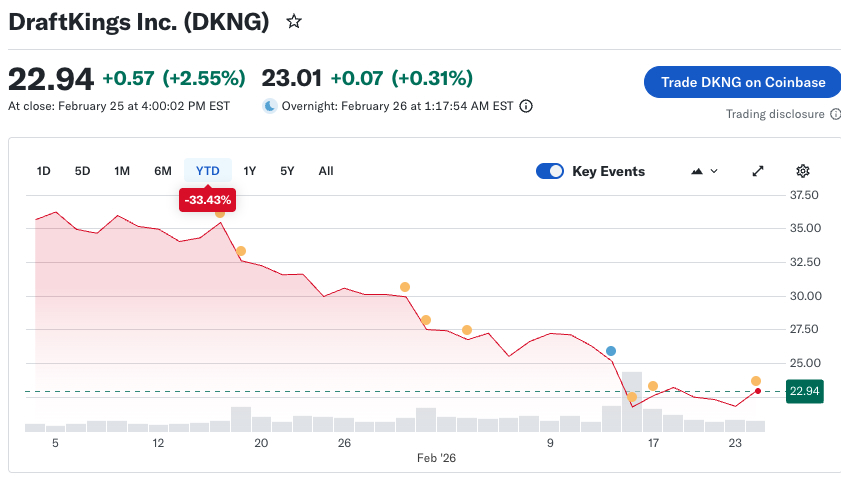
DraftKings, a prominent player in the online sports betting sector, has faced mounting challenges in early 2026. The company’s shares opened the year at around $35 but have steadily declined to the low $20s by late February. This represents a year-to-date drop of approximately 33%, exacerbating a longer-term trend where the stock is down more than 46% over the past year. Analysts point to the influx of competition from prediction markets as a key factor, with DraftKings’ management acknowledging minimal impact from rivals but investors reacting to broader market shifts.
The company’s 2026 guidance has fueled further sell-offs, projecting revenue between $6.5 billion and $6.9 billion, below Wall Street expectations of $7.3 billion. This conservative outlook includes expenses tied to its own prediction market initiatives, highlighting the internal pressures to adapt. Recent trading data shows DraftKings’ market capitalization at around $11 billion, a stark contrast to its peaks in previous years.
| Date | Open | High | Low | Close | Volume |
|---|---|---|---|---|---|
| Jan 2, 2026 | 34.59 | 35.97 | 34.59 | 35.97 | N/A |
| Jan 30, 2026 | 27.51 | 29.01 | 27.51 | 29.01 | N/A |
| Feb 25, 2026 | 22.51 | 22.93 | 22.22 | 22.68 | 7,561,348 |
Flutter Entertainment’s Market Challenges
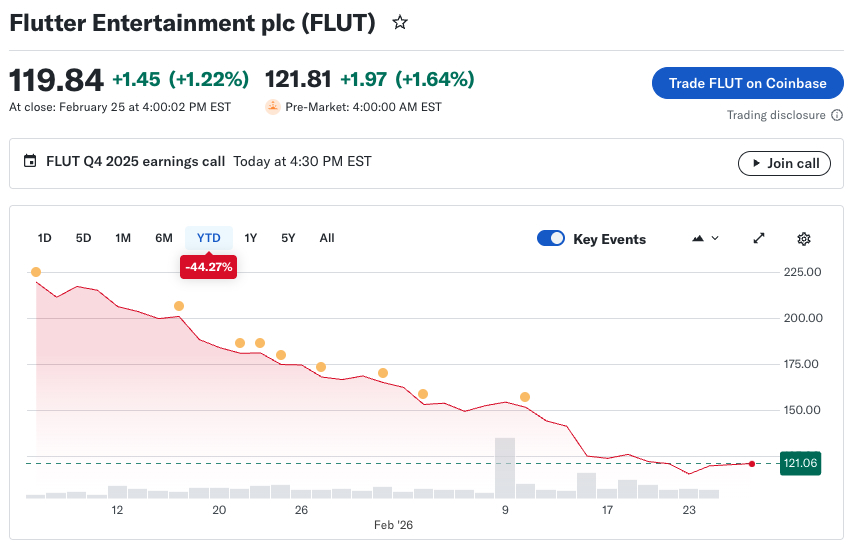
Flutter Entertainment, owner of FanDuel, has similarly struggled, with its US-listed shares dropping to around $121 by late February 2026, a 40% decline since the year’s start. The company’s broader portfolio, including international operations, has not insulated it from the US market pressures, where prediction markets have gained traction. Flutter’s stock is trading at multiples that suggest undervaluation, with some analysts seeing 30% upside potential, yet sentiment remains dampened by competitive threats.
Earnings estimates for Flutter have been revised downward significantly, with fourth-quarter 2025 adjusted EPS dropping 49% in recent months. This reflects concerns over margin pressures and the shift of betting volumes to lower-margin prediction platforms. The company’s market cap stands at approximately $21 billion, down from higher valuations in 2025.
| Date | Open | High | Low | Close | Volume |
|---|---|---|---|---|---|
| Jan 2, 2026 | 216.35 | 219.00 | 213.89 | 218.27 | 2,433,900 |
| Jan 30, 2026 | 166.03 | 166.79 | 160.72 | 165.15 | 4,188,000 |
| Feb 20, 2026 | 121.67 | 123.63 | 119.92 | 121.02 | 2,850,810 |
The Rise of Prediction Markets in the Betting Ecosystem
Prediction markets have emerged as a formidable force, capturing volumes that traditional betting firms once dominated. Platforms in this space have seen notional volumes surpass $5 billion weekly, with sports-related contracts driving much of the activity. This shift is evident in events like the Super Bowl, where prediction markets are estimated to have attracted $630 million in bets, contributing to subdued growth in traditional wagering.
Unlike state-regulated sportsbooks, these platforms operate under federal oversight, allowing nationwide access and bypassing local gambling laws. This regulatory edge has facilitated rapid scaling, with volumes growing exponentially since 2025. Analysts note that while prediction markets offer binary outcomes with potentially lower margins, their appeal lies in broader event coverage and real-time pricing driven by user sentiment.
Key Players: Kalshi and Polymarket’s Volume Growth
Kalshi and Polymarket stand out as leaders, with Kalshi processing over $43 billion in 2025 volumes and approaching 50% market share in early 2026. Weekly volumes for Kalshi have climbed to $2.59 billion, a 6.7% increase, while Polymarket reports $1.82 billion, reflecting their dominance in the sector.

Polymarket’s global reach and diverse categories, including politics and crypto, have driven $33.4 billion in 2025 volumes, with sports accounting for a significant portion. Both platforms have secured substantial funding, valuing them at $11 billion and $8 billion, respectively, signaling strong investor confidence.
| Platform | Volume ($B) | Market Share (%) | Week-over-Week Change (%) |
|---|---|---|---|
| Kalshi | 2.59 | 49.3 | +6.7 |
| Polymarket | 1.82 | 34.6 | -3.2 |
| Others | 0.84 | 16.1 | Varies |
Investor Perspectives on the Shift
Investors have directly linked the stock declines to prediction markets’ ascent, viewing them as a disruptive force that circumvents state regulations and attracts users with tax-efficient structures. While some see limited threats to high-margin products like parlays, others worry about cannibalization of core sportsbook volumes.
Wall Street’s response includes downgraded estimates and sell-offs, with DraftKings trading at 18x 2026 EBITDA and Flutter at 12x, suggesting potential buying opportunities if adaptation succeeds. However, ongoing legal battles over sports contracts could reshape the landscape.
Comparative Analysis: Prediction Markets vs. Traditional Betting
In 2026, prediction markets differ from traditional betting through federal regulation, enabling broader access and event diversity. They aggregate user-driven probabilities, often achieving high accuracy rates of 90-95%, compared to sportsbook odds set by operators. Volumes in prediction markets have reached $127.5 billion notional in early 2026, with sports driving 85% on some platforms.
Traditional betting remains state-bound, facing higher taxes and restrictions, which has led to an estimated $8 billion annual shift to prediction platforms. This dynamic raises questions about market integrity and regulatory alignment.
Future Implications for the Industry
Looking ahead, prediction markets are projected to reach $10 billion in annual revenue opportunities, with traditional firms like DraftKings forecasting hundreds of millions from their own offerings. However, regulatory scrutiny and potential Supreme Court involvement could alter trajectories.
For DraftKings and Flutter, adaptation through product launches and cost management, including layoffs, may mitigate losses. The sector’s evolution suggests a hybrid future where prediction elements integrate into betting ecosystems, potentially stabilizing stocks if incumbents capture share. DraftKing has already entered into the prediction market fray with their own app.
The $26 million hit to betting stocks underscores the transformative role of prediction markets in 2026. As volumes soar and competition intensifies, the industry’s path forward will depend on regulatory outcomes and strategic responses.