
Boston’s sports betting powerhouse DraftKings has announced a round of layoffs and a comprehensive reorganization in early 2026, signaling a strategic pivot in response to escalating pressures from unregulated prediction markets. With a global workforce of 5,500 employees spread across 13 countries, the company is realigning its teams to focus on core priorities and investment areas. This move comes as DraftKings grapples with competitors like Kalshi and Polymarket, which offer sports wagers without the burdensome state taxes and regulations that traditional operators face. As DraftKings relocates its headquarters within Boston and launches its own prediction market initiatives, investors are watching closely amid a 36% year-to-date stock decline.
The Competitive Landscape: Prediction Markets Encroaching on Traditional Sports Betting
In the rapidly evolving world of online wagering, prediction markets represent a formidable threat to established players like DraftKings. Platforms such as Kalshi and Polymarket operate under federal commodities regulations, allowing them to offer event contracts on sports outcomes without adhering to state-specific gambling laws. This exemption enables them to bypass taxes that can reach up to 50% in states like Illinois, or 20% in Massachusetts, where DraftKings pays hefty fees to maintain its operations.
The implications are profound. In 26 states where DraftKings holds licenses, these unregulated competitors could erode market share by attracting users with lower costs and fewer restrictions. For instance, Massachusetts has initiated legal action against prediction markets to protect its regulated ecosystem, highlighting the tension between federal allowances and state sovereignty. Analysts note that this competition is not just about immediate revenue loss but long-term market fragmentation, where users might prefer the flexibility of prediction platforms for sports-related bets.
| State | DraftKings Tax Rate (%) | Prediction Markets Tax Obligation | Potential Revenue Impact |
|---|---|---|---|
| Massachusetts | 20 | None (Federal Exemption) | High – Erodes local market share |
| Illinois | 50 | None | Very High – Significant cost advantage for competitors |
| New York | 51 | None | Critical – Dense population amplifies losses |
| California (Pending) | N/A (Not Yet Legalized) | None | Emerging Threat – Untapped market |
This table underscores how prediction markets’ lack of state taxes creates an uneven playing field, potentially diverting billions in wagering volume away from regulated entities like DraftKings. Industry experts, including those from Citizens Bank, suggest that without regulatory intervention, traditional sportsbooks could see a 10-15% decline in user engagement over the next few years. Though they add that the “catastrophe” label may be far too early and overblown.
Financial Performance: Growth Amid Volatility
Despite the headwinds, DraftKings reported robust financial results for the fourth quarter of 2025. Revenue surged 43% year-over-year to nearly $2 billion, driven by expanded operations and increased user acquisition. Adjusted earnings per share doubled to 36 cents, reflecting improved operational efficiencies and cost controls. However, the company’s forward guidance paints a more tempered picture, projecting only a 14% revenue increase for 2026.
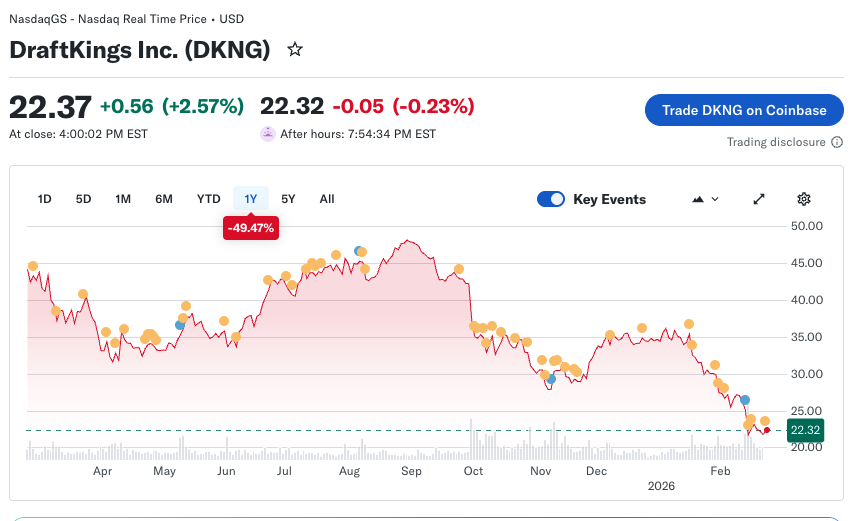
This slowdown in growth projections has contributed to a sharp 36% drop in DraftKings’ stock price (NASDAQ: DKNG) year-to-date. Investors are concerned about the sustainability of DraftKings’ model in the face of unregulated competition, which could compress margins further. Analyst Jordan Bender from Citizens Bank estimates that the current layoffs could trim 5% of the workforce, yielding annual savings of approximately $30 million. These savings are viewed as a “cushion” to fund innovations while appeasing shareholders demanding profitability.
For context, DraftKings’ financial trajectory can be compared in the following table:
| Metric | Q4 2025 | Projected 2026 | Year-Over-Year Change |
|---|---|---|---|
| Revenue | $2 billion | $2.28 billion (est.) | +14% |
| Adjusted EPS | 36 cents | 40-45 cents (est.) | +11-25% |
| Stock Performance YTD | N/A | -36% | Decline due to market pressures |
| Workforce Size | 5,500 | ~5,225 (post-layoffs est.) | -5% |
These figures highlight DraftKings’ resilience in revenue generation but underscore the volatility introduced by external competitive forces. The projected moderation in growth reflects cautious optimism, with potential upside from new ventures but downside risks from ongoing legal battles over prediction markets.
Layoffs and Reorganization: Streamlining for Efficiency
The layoffs, while not quantified by DraftKings, are part of a broader reorganization designed to align personnel with strategic priorities. The company stated that the changes would “better align their people with the most important priorities and areas of investment,” affecting roles across the organization. This follows a similar move in 2023, when DraftKings cut 140 jobs—about 3.5% of its workforce—amid a wave of tech industry reductions.
Relocation plays a key role in this strategy. DraftKings is moving its Boston headquarters from the Back Bay to the financial district, retaining a 125,000 square foot space. This shift could reduce operational costs and position the company closer to financial hubs, facilitating better investor relations and partnerships. In Massachusetts, where DraftKings is a major employer, these changes could have ripple effects on the local economy, potentially impacting ancillary services like real estate and tech support.
The integration of AI is subtly influencing workforce dynamics. CEO Jason Robins has previously indicated that AI could replace certain human roles, particularly in software development, business proposals, and administrative tasks. Although not explicitly tied to the current layoffs, analysts anticipate further “cost structure rationalization” as AI matures, potentially leading to additional efficiencies and reductions.
Strategic Responses: Launching Prediction Markets and Beyond
In a proactive stance, DraftKings is countering the threat by entering the prediction market space itself. The company plans to launch its own platform in states without legalized sports betting, allowing it to offer event contracts similar to those on Kalshi and Polymarket. Robins described this as “the most exciting new growth opportunity” since the 2018 Supreme Court decision legalizing sports wagering nationwide.
This dual approach—maintaining traditional mobile betting in regulated states while expanding into unregulated prediction arenas—aims to diversify revenue streams. By leveraging its existing user base and technological infrastructure, DraftKings could capture a share of the burgeoning prediction market, estimated to grow to $10 billion annually by 2030.
DraftKings’ agility in scaling new opportunities is a core strength. The reorganization ensures resources are funneled into high-potential areas, such as AI-driven personalization and expanded international operations, to mitigate domestic competitive pressures.
Future Outlook: Balancing Growth and Risks
Looking ahead, DraftKings’ trajectory hinges on regulatory outcomes and innovation execution. Ongoing lawsuits in states like Massachusetts could curb prediction markets’ expansion, providing breathing room for traditional operators. However, if federal exemptions persist, DraftKings’ hybrid model may become essential for survival.
Investor sentiment remains mixed, with the stock decline reflecting uncertainties but also opportunities for value buys. Bender’s analysis suggests the layoffs offer a financial buffer, enabling investments without diluting earnings. As the sports betting industry matures, DraftKings’ ability to adapt—through cost controls, technological advancements, and market diversification—will determine its long-term dominance.
In Boston and across Massachusetts, these developments underscore the intersection of tech, finance, and regulation in the wagering sector.