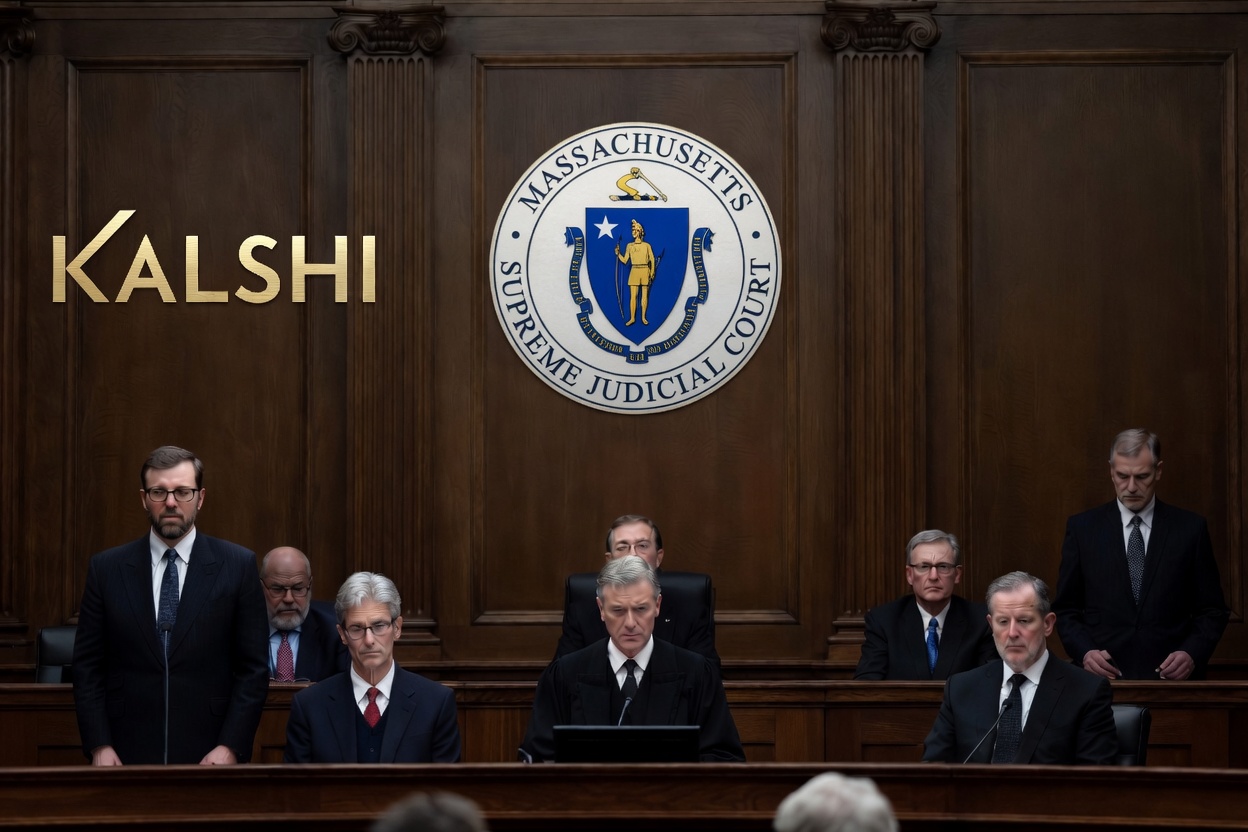
The Massachusetts Supreme Judicial Court subjected the high-profile Kalshi sports contracts case to intense scrutiny during oral arguments, raising serious questions about the future of sports prediction markets. Justices challenged core claims that these instruments escape state gambling oversight, with major implications for sports-event contract trading. This legal battle tests federal preemption against state authority over sports-related prediction platforms and NBA playoff prediction markets.
Attorneys clashed fiercely while the seven-justice panel demanded clear distinctions between regulated swaps and traditional sports wagering. The session, held on May 4, 2026, highlighted tensions that could reshape access to NBA playoff prediction markets, MLB event contracts, and other high-volume sports trading opportunities in the evolving sports prediction markets landscape.
Kalshi Sports Contracts Legal Battle: Sharp Divide on Federal vs State Authority Over Sports Prediction Markets
Grant Mainland, counsel for Kalshi, opened by emphasizing federal oversight under the Commodity Futures Trading Commission and the Commodity Exchange Act. He positioned the sports-event contracts as federally approved swaps rather than gambling products. Justices frequently interrupted, pressing for practical examples that distinguish these from standard sports bets in the Kalshi sports contracts case.
Gerard Cedrone, representing the Commonwealth, countered that broad federal preemption would strip states of the tools to regulate what constitutes sports betting. He warned that such a ruling undermines consumer protections built into state gaming laws. The exchange revealed competing regulatory philosophies in this evolving sports-prediction-markets sector.
Chief Justice Scott L. Kafker probed the real-world user experience, forcing detailed defenses of the platform’s structure. His questions underscored the court’s focus on substance over form in the Kalshi sports contracts dispute.
Justices Question Core Differences in Kalshi Oral Arguments on Sports Prediction Markets
Justice Gabrielle Wolohojian asked directly how Kalshi’s contracts differentiate from what users colloquially call a bet. Her inquiry set a skeptical tone that persisted throughout the hearing on sports prediction markets, as detailed in court coverage.
Chief Justice Kafker followed up, noting that users seeking to wager on game outcomes find a clear pathway through these contracts. He observed that the setup carries a major aspect of sports gambling, a comment that resonated strongly in the Kalshi oral arguments.
Justice Dalila Argaez Wendlandt questioned whether statutory language on exclusive jurisdiction displaces state authority without explicit congressional intent. These pointed exchanges revealed vulnerabilities in the preemption strategy for sports-event contracts.
Key Moments from Kalshi Sports Contracts Case Oral Arguments
| Justice or Attorney | Key Statement or Question | Context and Potential Impact on Sports Prediction Markets |
|---|---|---|
| Justice Gabrielle Wolohojian | “In what way do they differentiate from what would colloquially be known as a bet?” | Directly challenged distinctions in sports-event contracts, pressuring defense on user mechanics |
| Chief Justice Scott L. Kafker | “If you want to gamble on a game, this is one way of doing it, right? This does seem to have a major aspect of sports gambling to it.” | Highlighted practical overlap with wagering on NBA, MLB, and other leagues |
| Grant Mainland (Kalshi counsel) | “This is fundamentally a federal regulatory issue.” | Argued Dodd-Frank Act and CFTC rules preempt state gambling statutes |
| Gerard Cedrone (Commonwealth counsel) | Accepting the position “would be blocking out state regulation of what is in all respects a sports bet.” | Emphasized risks to consumer safeguards in sports prediction trading |
The panel’s rigorous questioning transformed the session into a detailed examination of regulatory boundaries. Consequently, sports traders monitoring event-driven markets now face heightened uncertainty in the Kalshi sports contracts case.
Kalshi Defense Strategy Relies on Dodd-Frank Act and CFTC Self-Certification in Sports Contracts Appeal
Mainland repeatedly cited the 2010 Dodd-Frank Act’s expansion of the definition of swaps to cover these instruments. He described the user-to-user clearinghouse model as a hallmark of legitimate federally regulated exchanges. Justices expressed doubts about whether self-certification under CFTC Rule 40.11 fully resolves the issue of gaming classification in sports prediction markets.
Justice Elizabeth N. Dewar sought clarification on the rule components, noting that the lack of formal public-interest review leaves core questions open. Mainland responded that regulators had not previously blocked sports-related contracts. The defense also referenced a supportive Third Circuit decision, yet the Massachusetts bench viewed the matter as distinct. Thus, the arguments tested federal preemption limits against longstanding state police powers, according to Massachusetts Lawyers Weekly.
Commonwealth Stresses Consumer Protections Amid Kalshi Sports Betting Concerns and Sports Prediction Markets
Cedrone argued that the contracts function like sports wagering, with payouts tied directly to the outcomes of athletic competitions. He stressed that licensing requirements address fraud, underage access, and public health risks associated with widespread sports-event contracts.
Attorney General Andrea Joy Campbell frames the action as essential to closing regulatory gaps in this booming sector. Her office enforces standards that licensed operators must meet to protect participants. The state maintains that federal exclusivity claims threaten effective oversight of prediction platforms.
Therefore, the preliminary injunction serves as a safeguard while appeals proceed, directly affecting the availability of sports prediction markets for users.
Potential Impact of Kalshi Case on NBA Playoff Prediction Markets and Broader Sports Trading
A final ruling against Kalshi would mark only the second state-backed restriction after Nevada, potentially encouraging similar actions elsewhere. Traders active in NBA playoff contracts, MLB matchups, and other live sports events could encounter fewer options if the injunction stands.
The stay currently allows operations to continue, yet the skepticism displayed creates immediate market uncertainty. Sports fans and prediction market participants watch developments closely as volumes tied to major events remain elevated.
This case accelerates discussions of a possible national circuit split, increasing the prospects for higher-court review. As a result, the Kalshi sports contracts case has implications far beyond one jurisdiction, affecting the entire sports prediction markets ecosystem.
Timeline of Developments in Kalshi Sports Contracts Legal Challenge
| Date | Key Development | Significance for Sports Prediction Markets |
|---|---|---|
| September 2025 | Commonwealth files suit over unlicensed sports wagering | Launched enforcement under state gaming rules |
| January 2026 | Superior Court issues preliminary injunction | Temporarily halted sports-event contracts |
| February 2026 | Stay request denied | Advanced enforcement timeline |
| May 4, 2026 | Supreme Judicial Court hears oral arguments | Signaled skepticism toward federal preemption in Kalshi sports contracts case |
The court’s eventual written decision, expected in the coming weeks or months, will clarify the boundaries affecting millions of people engaged in event-driven trading. Passionate participants on both sides recognize the cultural and economic stakes as sports wagering popularity continues rising.
Legal teams prepare for the outcome while platforms navigate this pivotal regulatory test. The Kalshi oral arguments already provide strong signals about the balance between innovation in sports prediction markets and traditional state oversight.
References
- Yogonet – Massachusetts high court signals skepticism in Kalshi sports contracts case
- Reuters – Massachusetts top court appears open to a state ban on Kalshi sports betting
- WCVB – Massachusetts, Kalshi clash reaches Supreme Judicial Court
- Bloomberg – Kalshi Grilled by Massachusetts High Court
- Courthouse News Service – Massachusetts high court puts Kalshi on defense
- Gambling Insider – Massachusetts High Court Signals Skepticism Toward Kalshi
- Gaming America – Massachusetts Supreme Court Signals Skepticism of Kalshi
- Sports Illustrated – Massachusetts Went After Kalshi in Court
- Massachusetts Lawyers Weekly – Swaps or bets? SJC digs into sports prediction market case